Article Summary
This article explains what the Federation Star represents and why many in the ADF struggle to recognise its significance. It argues that 40-plus years of service is a rare institutional achievement that deserves clearer ceremony, storytelling, and public recognition. The article compares Australian practice with allied approaches and offers four modest proposals to lift awareness without diminishing the award itself. It invites a professional discussion about how Defence recognises long service, preserves experience, and signals what it values.
In the past few months, I have had the privilege of serving alongside three members who each received Federation Stars, and one who completed 50 years of service with three pending federation stars. Given the award recognises forty years of service in the Australian Defence Force, most members will serve an entire career without seeing a single presentation. I have now been close to three.
I know all three recipients well and between them, they carry well over a century of uniformed service. They have trained soldiers who went on to train soldiers who are now training soldiers. They are, in the most literal sense, the living memory of the place I work. And here is the detail worth sitting with: each received their Federation Star and, at the time of writing, all three are still serving.
The idea for this article did not arrive at a ceremony. It began earlier, in an ordinary workplace conversation with my supervisor, himself closing in on forty years and continued in a yarn with one of the recipients. What does forty years actually mean? And why did I, a warrant officer with a respectable stack of years of my own, have to go and look up what a Federation Star actually was? Only later, watching people I serve beside receive theirs, did the question harden into something worth writing down.
Let me be clear: the units got it right. Families were invited, senior leaders made the time to attend, and each presentation was conducted with genuine warmth and respect. This article is not a criticism of any unit or of Defence, and it takes nothing away from the Federation Star itself or any other service award. My argument is with the system sitting quietly behind the ceremony, because once the applause fades, the institution's recognition of forty plus years amounts to a small silver device on an existing ribbon, and surprisingly little else.
This article argues that the Federation Star is one of the most significant, least understood, and most under-leveraged forms of recognition in the ADF and that we are underselling it to recipients, to the audience watching, and to the institution itself. I want to spark a professional discussion about whether we can do better, and what better might look like.
What the Federation Star actually is
A confession on behalf of the profession: many members, including some very senior ones, could not tell you what a Federation Star is. Here is the thirty-second version.
The Defence Long Service Medal (DLSM) was established by Letters Patent in 1998, replacing the previous suite of long service awards. It is awarded for 15 years of qualifying service in the Permanent or Reserve forces, or any combination of the two. A clasp, a physical bar fixed to the ribbon above the medal, is issued for each additional five years of efficient service.
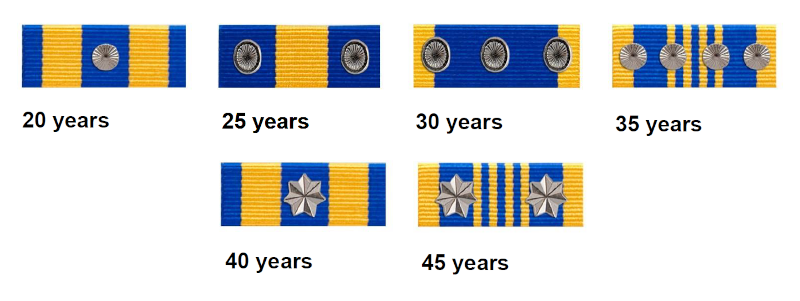
Here is the detail that surprised me, and will surprise most readers: the Federation Star never actually appears on the medal itself. On the mounted medal, the clasps simply stack. A member at forty years wears five bars, one above the other; a member at fifty would wear seven. The star exists only on the ribbon bar worn in general duties. There, the first four clasps are shown as small rosettes. At the fifth clasp, forty years, the rosettes come off and a single silver Federation Star goes on. A second star follows at forty-five years, and a third at fifty.
I will be honest: I have worn this uniform for a long time, and I only learned how to read that ribbon while researching this article. If a warrant officer needs a policy document to decode forty years of service, what chance does the digger standing two ranks back on parade have?
Soldiers' five version: clasps stack on the medal forever; on the ribbon bar, four rosettes become one Federation Star at 40 years, with another star at each five-year mark beyond.
The device itself carries more meaning than its size suggests. The Federation Star is the Commonwealth Star: the seven-pointed star that sits beneath the Union Jack on our national flag and crowns the Commonwealth Coat of Arms. Six points for the original federating states, a seventh for the territories and any states to come. A Federation Star recipient literally wears the symbol of the nation's founding on their chest, arguably the most Australian piece of insignia in the entire honours system.
And yet, consider what the Federation Star is not. It is not a medal in its own right. There is no distinct ribbon, no post-nominal letters, no entry in the Commonwealth Gazette, and no public register of recipients. Glance at a rack of medals and you will miss it entirely: a small silver star on a blue and gold ribbon. Seven millimetres of national gratitude for forty years of service.
What forty years actually means
Numbers on a page rarely land, so let me translate: a member who received a Federation Star in 2026 enlisted in 1986.
In 1986, Bob Hawke was Prime Minister, the Berlin Wall was standing, and the standard rifle was the SLR, the Austeyr was still two years away. There was no email in the orderly room and no PMKeyS. The soldiers these members first trained alongside are, almost without exception, long retired.
Across those forty years, a Federation Star recipient has served under more than a dozen Chiefs of Army. They have watched the profession move through Somalia, Rwanda, East Timor, the Solomon Islands, Iraq, and two decades of Afghanistan, plus the bushfires, floods, and pandemic that defined its most recent chapter.
They have also outlasted at least three pay systems and every Defence IT rollout from the fax machine through to ERP. Anyone who can navigate both in a single career has demonstrated a level of tolerance that probably deserves its own clasp.
More seriously: a Federation Star recipient has seen the institution at its best and its worst, through every restructure, review and recruiting crisis, and stayed anyway. That is not merely time served. In an era where the median military career is measured in single digits, forty plus years of voluntary service is a profound statement of belief in the institution. Retention is not just a policy problem to these people; it is their autobiography.
We do not know how many of them there are. More than 30,000 Defence Long Service Medals have been issued since 1998, but Defence publishes no figure for how many members have reached the fifth, sixth or seventh clasp. That absence of data is, in its own quiet way, part of the story: we do not count what we do not celebrate.
And this cohort is growing. Retirement ages that once ended careers at 60 are now routinely extended, particularly across the Reserves. I currently serve alongside a member about to turn 70 who has completed 50 years of service.
Under the total workforce model, the 45- and 50-year milestones, two and three Federation Stars on a single ribbon, are shifting from theoretical to actual. Ask yourself: have you ever seen a member wearing two Federation Stars? Three?
With extensions becoming routine, three or four stars, reflecting 50 to 55 years of service, is no longer unthinkable. The arithmetic is simple: a member who enlisted at 17, as I did, could be wearing three Federation Stars at 67. We are quietly creating a tier of recognition that almost nobody in the force can read.
Our systems have not quite caught up either. My background is in combat engineering and physical training instruction, and I can tell you the fitness assessment tables run out of age brackets well before these members run out of service, the framework apparently never expected anyone to still be turning up. They are. In growing numbers.
The recognition gap
Here is the uncomfortable comparison. A member completing fifteen years receives a medal, a physical, wearable, mounted medal usually presented on parade. A member completing forty or fifty years receives a device the size of a shirt button. The presentations I saw this year were done properly, with families present and senior leadership in attendance but that reflected the goodwill of the commanders and units involved, not any mandated standard.
Defence occasionally publishes a feature story, as it did in 2025 when a Federation Star capped a forty-year Air Force career on the recipient's final day in uniform. But there is no directed ceremonial standard, no requirement that the member's career be told properly to the audience, no default media story, and no mechanism to preserve the moment afterwards. Everything beyond the device itself currently depends on local initiative, and goodwill is not a system.
There is also a historical irony buried in the 1998 reforms. The old Reserve Force Decoration carried the post-nominal RFD, as the Efficiency Decoration carried ED before it. When the medal suite was consolidated into the DLSM, those letters disappeared, we simplified the system and, in the process, quietly deleted the only long-service post-nominals in the Australian Defence Force. A member completing forty to fifty years in 2026 gets a rosette upgrade instead.
None of this is anyone's fault. It is simply what happens when a system is designed around administrative tidiness rather than institutional storytelling. But it produces a strange inversion: the rarest long-service milestone in the ADF receives the least distinctive recognition.
How our friends and allies do it
We are not the only military that has wrestled with this, and it is worth looking sideways before proposing anything.
Canada arguably does it best. The Canadian Forces' Decoration is awarded at twelve years, with a clasp for each further ten, and every recipient, from private to general, is entitled to the post-nominal CD for life. It costs the Canadian government almost nothing and signals almost everything.
The United Kingdom corrected course after its 2014 independent medal review: it introduced the post-nominal VR for Volunteer Reserves at ten years, deliberately backdated to 1999 and extended long service medal recognition to regular officers who had historically been excluded. The rationale was explicit: visible recognition of sustained commitment matters, to the member, and to everyone watching.
The point of these two examples is not that Australia should copy either model. It is that two of our closest partners have each decided, deliberately, that sustained service deserves visible, escalating, and public recognition, and have built a mechanism for it. We built a rosette exchange.
Why this matters: culture, retention, and One Defence
A fair question at this point: with everything else on Defence's plate, why should anyone care about a small silver star?
Because armies celebrate what they value, and members notice what gets celebrated. Recognition is one of the cheapest and most powerful cultural signals an institution has. A previous Cove contribution on honours and awards made the argument well: people rarely leave over pay; they leave when they feel undervalued, and recognition is one of the few levers we have to make people feel genuinely seen. It closed with a line worth repeating: 'There is no quota on discipline, there should be no quota on recognition of excellence.'
The Federation Star is the recognition of a particular kind of excellence, not a single act of courage or a standout posting, but the compound interest of showing up, year after year, for four decades or more. In the middle of the worst recruiting and retention environment in a generation, we should be holding these people up as loudly as the system allows. Every junior soldier standing in the audience at a Federation Star presentation is watching one possible version of their own future. The question we should ask ourselves is simple: did we make that future look like it mattered?
There is also a One Defence dimension. From where I sit, in a joint operational environment where full-time members, Reservists and partner-nation militaries work side by side every day, the blended career is already the norm, not the exception. Under the total workforce model, more members will reach forty years plus through mixed service: stretches of full-time service (SERCAT 7/6) and periods of part-time or Reserve service (SERCAT 5 or 3), sometimes across more than one uniform.
The same Cove discussion noted a persistent perception among Reservists that medallic recognition is 'the realm of full-timers'. The Federation Star is one of the few awards that genuinely belongs to the whole workforce: it counts all qualifying service, in any category, in any Service. Told properly, it is a One Defence story we are currently not telling at all.
Four modest proposals
I promised discussion, not just complaint. Here are four options, deliberately arranged from lowest-cost to most ambitious.
First, raise the ceremonial floor. Direct that Federation Star presentations occur on parade or at a formation event (dining-in night) wherever practicable, presented by the most senior officer available, with family invited and a proper career citation read aloud. Make a Defence media story the default, not the exception. Cost: effectively zero. Effect: immediate.
Second, count and publish. Establish a national register or honour roll of Federation Star recipients, maintained by Defence Honours and Awards and publicly searchable. If forty years of service is worth a star, it is worth a line in the institutional record. Recipients' stories could feed unit histories, museums and yes, following Cove articles (I have one pending).
Third, capture the knowledge before it walks out the door. A member at forty years is usually within sight of transition. Invite Federation Star recipients to record an oral history, mentor junior members, or contribute a reflective piece to professional military education channels. Forty years of lessons learned should not leave the building in a cardboard box.
Fourth, the ambitious one, ask the Directorate of Honours and Awards to formally examine whether forty years warrants more than a device. Options might include elevating the fifth clasp to a distinct medal, creating a unique ribbon emblem, or reintroducing a long-service post-nominal in the spirit of the old RFD and ED, open to the total workforce.
This would require changes to the regulations under the Letters Patent, which is precisely why the conversation needs to start somewhere. The Cove seems as good a place as any.
A star worth telling stories about
At the presentation I attended, after the applause had faded and the tea urn was doing its work, I watched a group of junior members gather around the recipient, not because anyone told them to, but because someone had finally explained what the small silver star meant, and they wanted to hear the stories that came with it. For ten minutes, forty years of service had an audience. It was the best professional military education in the building that day, and it happened almost by accident.
That, in the end, is my argument. The Federation Star does not need to be rescued; the people who earn it are not chasing glory, and every recipient I know would be faintly embarrassed by this article. But recognition has never really been for the recipient. It is for everyone watching, a signal about what this profession honours and what it hopes its youngest members will one day become.
We rightly celebrate extraordinary acts of courage. Perhaps we should also pause, properly, to celebrate extraordinary acts of commitment.
Still Interested?
Why not also read No Quota on Discipline, No Quota on Excellence: Recognition in the Contemporary Army
Cove+ also has short learning courses on similar topics: Cove+.