



As modern conflict evolves, so too must the roles and responsibilities of the Australian Army’s formations. As outlined in 2023’s Defence Strategic Review, the 2nd (Australian) Division [2(AS)DIV] is now primarily focused on Homeland Defence during large scale combat operations. A part of the potential mission set included in this role is the protection of air bases in Australia’s north.
The capabilities developed for high-end conflict global conflict scenarios can also be used in operations below the threshold of global conflict. The structure of Security and Response Task Units (SRTUs) means they are capable of undertaking critical offshore roles, such as the protection of deployed temporary Royal Australian Air Force (RAAF) facilities during peacekeeping and humanitarian operations and low intensity conflicts.
From Homeland Defence to Expeditionary Protection?
The 2 (AS) Div’s mission of defending critical domestic infrastructure during global conflict directly translates to the protection of high value assets in an expeditionary context. Deployed installations such as Air Points of Disembarkation, forward operating bases, naval logistics nodes, temporary radar installations and staging areas are vital to the success of expeditionary joint operations. These deployable facilities, established in austere or contested environments, require bespoke security arrangements. 2 (AS) Div’s protection of these nodes would allow other combat forces to focus on their core operational missions, rather than being diluted or overtasked by static security responsibilities.
Lessons from INTERFET and Emerging Gaps
This capability requirement is not hypothetical. During the 1999 INTERFET operation in East Timor, a forward airbase in Dili sustained the critical air bridge between Australia and the theatre of operations. Protection of this site was resource-intensive and fell primarily to RAAF Air Ground Security Forces (SECFOR). Since the deployment to INTERFET in 1999 there have been multiple evolutions of the RAAF SECFOR (commonly referred to as transformation 1 and 2). The scope of RAAF SECFOR responsibilities has evolved significantly and become more focused. The size of RAAF SECFOR – 2 Squadrons – is a key limitation for the provision of organic force protection at scale. Put simply, there are not enough aviators to secure the infrastructure that requires protection.
This capability gap presents an opportunity. The 2 (AS) Div, already trained in infrastructure protection, is capable of filling this role with tailored, scalable force elements. The threat environment has also evolved. Contemporary risks, including UAVs, indirect fire, and disruption to enabling infrastructure such as bridges, power, and water now demand a wider area of protection – out to 20km or more. This exceeds the traditional remit of RAAF area protection, which typically focuses on a clearly defined perimeter. Army SRTUs are better suited to projecting protection into this wider battlespace with Land Forces generally securing Ground Defence Area and beyond. The 2 (AS) Div can also reinforce RAAF capabilities through passive defence measures including engineering efforts to harden and strengthen critical infrastructure, local logistics support for the dispersal of materiel across air bases, and the conduct of camouflage, concealment, and deception operations to reduce vulnerability and enhance survivability.
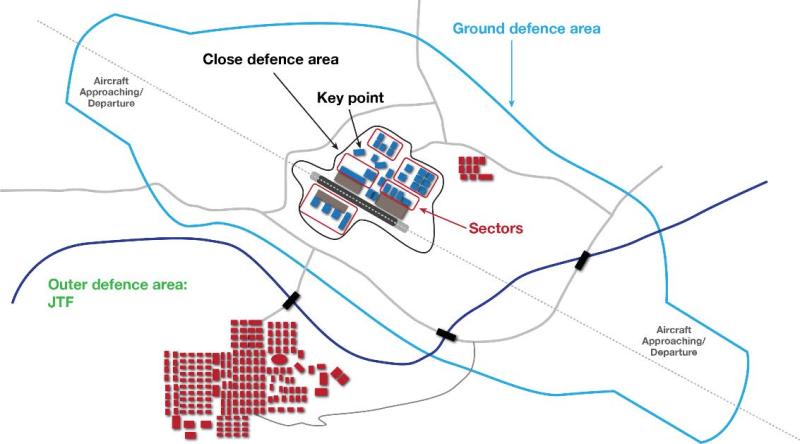
Generic Airbase Ground Defence Areas (Airbase Operations – Integration Doctrine)
To mitigate external threats to the airbase operating environment, the airbase operations commander may be assigned a ground defence area. The ground defence area is defined by the geographical boundaries of the tactical area of responsibility assigned to the airbase operations commander, who has the authority to control assigned forces and coordinate operational activity. In most cases, the airbase operations commander will not be assigned an external ground defence area – outside the tactical area of responsibility – where security activities will be the responsibility of the host nation or other friendly force. A degree of coordination with adjoining formations is required where ground defence area boundaries are shared.
Why Army and Not an Expanded RAAF units?
A fair observer might ask whether an expanded RAAF force protection capability could meet the demands of modern airbase defence. However, the nature of today’s threat environment suggests otherwise. The RAAF’s organic protection model is generally limited to manoeuvre within the Close Defence Area and limited reach into the Ground Defence Area, as defined in airbase security doctrine. This model optimises static defence within a defined perimeter.
In contrast, contemporary threats – including persistent surveillance, indirect fire, and the proliferation of unmanned systems – require a more agile and layered approach. Airbases are now vulnerable well beyond their fences, and disruption to enabling infrastructure such as power, water, and logistics can render them combat-ineffective without ever targeting runways or aircraft. As static assets, airbases cannot manoeuvre to avoid threats; they must be protected through depth, dispersion, and integration with broader joint operations.
Army’s SRTUs are trained to operate in this extended battlespace. Their ability to secure terrain beyond line of sight, conduct area denial and route protection, and integrate with joint manoeuvre elements makes them uniquely suited to protecting airpower as a system, not just a site. This layered, mobile, and integrated approach is exactly what future operations require.
Building on Established Integration
This is not a novel proposal for 2 (AS) Div. SRTUs regularly train with 38X Squadrons (notably RAAF’s 381, 382, and 383 Squadrons, the RAAF deployed airbase specialist squadrons) and with RAAF Security Force Squadrons (1SECFOR SQN and 2SECFOR SQN), maintaining alignment on tactics, techniques, and procedures for airbase security. This embedded cooperation forms a strong foundation for expeditionary joint operations. This capability is already in practice, proven, and ready for deployment.
Rather than building an entirely new structure within RAAF, Defence can leverage an integrated, Army-led protection force, aligned with Air Force operating concepts. This model also provides a platform to address emerging capability gaps, particularly in countering small un-crewed aircraft systems (SUAS) and light civil aircraft. The proliferation of these threats has outpaced traditional base defence models and a layered, integrated approach is now essential.
There is a clear opportunity to develop a joint counter-UAS capability, with Army contributing manoeuvre and denial operations, and RAAF providing detection and response integration. Within 2 (AS) Div, the 9th Regiment, Royal Australian Artillery, is well positioned to assume a lead role in this space. Expanding its remit to include counter-UAS operations would not only address a critical capability gap but also enhance its relevance within 2 (AS) Div and the broader force generation model.
Scalability, Dispersal, and Organisational Agility
One of the most compelling advantages of the SRTU is its scalability and adaptability. These units deploy in flexible configurations, from platoon-sized elements to full battlegroup size SRTU, enabling Defence planners to tailor the force to mission requirements. They are particularly adept at supporting dispersed operations, operating across large areas in small, self-sufficient packets to enable agile air operations. This reflects modern realities that large, concentrated airbases are increasingly vulnerable and future operations will require distributed, resilient basing concepts. The SRTU is an ideal force to support the protection of dispersed air operations in volatile regions. SRTUs already operate in this mode through major integrated training activities and tabletop exercises. During Exercise Talisman Sabre 2025, SRTUs integrated with 38X SQN and SECFOR SQN to deliver a layered and persistent security effect.
Sustained Readiness through Structured Service Category 4
2 (AS) Div’s strength is further enhanced by the current use of Service Category 4 (SERCAT 4) personnel. Through Operational Staffing Documents, SRTUs can generate pre-identified, collectively trained force elements capable of rapid deployment both domestically and abroad. This model provides readiness and predictability while avoiding the personnel strain of tasking full-time units or relying solely on full-time force generation. By utilising part-time and specialist skillsets, the ADF maintains operational flexibility and scalability aligned with Defence’s Total Workforce System objectives.
Conclusion
The strategic rationale is clear. 2 (AS) Div, with its homeland defence roots, scalable SRTU structure, and established integration with RAAF units, is ideally suited to serve as a deployable Protection Force for RAAF facilities. This role complements its domestic mandate, relieves pressure on overstretched combat and air security elements, and enhances the ADF’s ability to operate effectively during peacekeeping and humanitarian operations up to low-intensity conflict and limited war.
By formalising and investing in this role, Defence will not only close a critical capability gap but also make smarter use of existing force structure, enabling a more agile and resilient joint force posture in the Indo-Pacific and beyond.



What is actually required is for the RAAF to define what is required in future operational theatres and build an appropriate force. Yes some augmentation from reservists may be required in a large scale conflict but let’s not forget that we won’t be operating alone and if we forward deploy aircraft it will be to a coalition airbase.
As threats are easily capable of engaging airbases from beyond the perimeter of an airfield, at what point does local force protection encroach into broader defensive operations?
RAAF / Army already integrate these layered defensive effects as outlined in the piece, formalising these arrangements and introducing capability to address modern threats seems to be the point argued here…
Increasing investment to defeat modern threats is absolutely what should be occurring.The ADF however is almost always late to the game.
The use of drones is nothing new, we were exposed to UAS threats in Iraq as early as 2015 and the US was already working on countering the threat then. European countries are investing heavily in counter drone technology while we sit idly by with minimal investment despite have a world class domestic technology provider in drone shield. Yes we have recently commenced a small program to look at counter UAS solutions but like everything we do we lack serious funding and taking the threat seriously.
Thank you for the comment.
I agree that in large scale conflict SERCAT 5 will play a part and that is clearly outlined in the Theatre Missions.
What I was drawing out in this concept is that in situations below global conflict the ADF can make better use of the resources they have rather than increasing the Full-time forces to cover every contingency.
Historically SERCAT 5 has been used to conduct similar operational tasks to good effect.
Regarding the RAF vs RAAF use of ground forces. I discussed the expansion of SECFOR to defend Airbases with a few RAAF colleagues. There has been a change to how SECFOR are employed, have a look at the RAAF transformation 1 and 2 for SECFOR.
Looking forward to discussing further.
RP
Lead argument — ownership and accountability. The sustained shortfall is in RAAF’s own force‑protection capacity. Handing the mission to Army creates a backfill mindset where a domain‑specific requirement remains under‑resourced because a generalist Land formation can be surged to cover it. Airbase protection is not merely a perimeter‑guard function; it is an integrated airbase operations system—sensors, C2, counter‑UAS, hardening, dispersion and recovery—optimised for Air power effects. Proposing to fold this into 2 Div because it can “reach” into the Ground Defence Area diffuses ownership and blurs accountability across the joint force. Capability adjacency (e.g., Army contributions to CUAS, survivability, counter-surveillance etc) is not the same as capability ownership for airbase defence. The lead—and the enduring resources—should remain with the service whose operational effects are at stake: the RAAF.
Principle of self‑protection. The logic that each service must be capable of its own immediate self‑protection is longstanding and sound. As Churchill warned in 1941: “Every airfield should be a stronghold of fighting air‑groundmen, and not the abode of uniformed civilians in the prime of life protected by detachments of soldiers.” That isn’t an argument against joint integration; it is a reminder that primary responsibility should rest with the service whose critical node is at risk, with joint enablers augmenting as required—not substituting as the default.
On “freeing up combat forces.” Your article argues that assigning 2 Div to airbase protection would “allow other combat forces to focus on their core operational missions, rather than being diluted or over-tasked by static security responsibilities.” The irony is hard to miss: 2 Div is, in essence, an infantry‑heavy combat formation. Anchoring it to static guarding roles risks diluting its core reason to exist, division‑level war-fighting and enabling mobilisation. If persistent base defence is the enduring requirement, that strengthens the case for resourcing RAAF’s organic force‑protection and airbase operations system, not for diverting an Army division into a quasi‑garrison supplementation posture.
Doctrine and language matter, precision counts. The National Defence Strategy sets the strategy of denial and the ADF’s five tasks but does not assign an expeditionary airbase‑protection remit to 2 Div. The Defence Strategic Review frames Army’s land contribution and—importantly in Chapter 8—describes Army Reserve brigades for enhanced domestic security and response, including area security for the northern base network and critical infrastructure (not garrison duties). These strategic documents do not use “Homeland Defence” as a term of art, nor does it link that term to 2 Div. Army’s own 2024 publication is explicit: “2nd (Australian) Division — Domestic security and response operations, and force expansion base.” That is distinct from the expeditionary protection role proposed in your piece.
Bottom line: Your article helpfully spotlights a real vulnerability and you should be commended for that contribution to our professional consideration. But the fix should reinforce, not dilute, service self‑protection: resource RAAF to own airbase defence end‑to‑end, then integrate layered multi-domain contributions in depth by design—not by default.
From your detailed analysis and comments it looks like there might be a good follow up article.
I agree that in the extreme all RAAF should be prepared to protect their own bases.
I still believe there are a lot of scenarios between peace and full conflict where 2(AS)DIV and RAAF can work in an integrated environment to do more with what we have and cover some of these gaps.