
Article Summary
David Hill reviews Supply and Steel, a two-to-three-player micro wargame that recreates the logistical challenges of the Allied breakout from Normandy in 1944. By making supply a finite resource that constrains movement and combat, the game provides an accessible way to explore sustainment, operational reach, culmination and interdiction. Hill proposes its use as a short unit PME activity, with particular relevance to an Australian Army preparing for dispersed littoral operations across the Indo-Pacific.The article concludes that simple print-and-play games can help commanders embed continuous PME into unit battle rhythms.
The Australian Army is actively engaged in the reinvigoration of wargaming as an element of Professional Military Education (PME). The Army Battle Lab has led this effort through the development of original Australian-based wargames such as Australian Platoon Commander and Australian Combined Arms, which support unit training and courses across the Land Combat College.
This resurgence is part of a global trend; military institutions worldwide are recognising wargaming’s unique capacity for experiential learning, allowing practitioners to explore and test complex ideas across diverse scenarios and environments. Consequently, a rich ecosystem of both commercial and military games has emerged to address varied operational challenges.
Commanders can leverage these easily accessible games to support professional development. This article explores one such game: Supply and Steel.
Set against the backdrop of the summer of 1944, Supply and Steel places players squarely in the immediate aftermath of the D-Day landings. The beaches of Normandy have been secured, but the true test of operational endurance is just beginning.
The game distils this campaign into an asymmetric duel of supply chains. As the Allied commander, you face the monumental task of funnelling a mountain of materiel through congested beachheads to sustain the momentum required for a breakout across France.
Conversely, the German commander must orchestrate a stubborn defence in the dense bocage country, husbanding scarce resources while enduring relentless Allied air interdiction targeting their rear echelons.
The game provides the opportunity to experience the same friction that plagued General Eisenhower and Field Marshal von Rundstedt, where the ambition to manoeuvre is strictly governed by the harsh arithmetic of logistics.
Historical context: From Stalemate to Breakout
Rather than a generic history lesson, Supply and Steel focuses on the critical operational pivot of the 1944 Normandy campaign. To understand the game’s friction, we must look at the two distinct phases of the breakout:
| Campaign Phase | Tactical Reality | The Logistical Friction |
| The Normandy Stalemate (June–July 1944) | Allied forces were bogged down in the bocage, dense hedgerows and sunken lanes that favoured German defence and choked armoured movement. | Allied forces were contained in a shallow lodgement. Massive amounts of materiel piled up on congested beachheads, unable to be pushed forward to support a decisive manoeuvre. |
| The Cobra Breakout (Late July 1944) | Operation Cobra shattered the German lines south of Saint-Lô, allowing Allied armour to rapidly pour through the gap and encircle the German Seventh Army. | Grinding positional war suddenly transformed into a war of rapid movement, instantly stretching Allied supply lines to their absolute breaking limits. |
Game Mechanics: Simulating the Friction of Supply
At its core, Supply and Steel shifts the traditional wargaming focus away from tactical manoeuvres and places it firmly on the logistics 'tail'. The game’s mechanics are elegant but unforgiving, relying on a resource management system that forces players to grapple with the realities of sustainment, operational reach, and culmination.
As a micro wargame, there is a high degree of abstraction to allow the game to flow quickly while enabling an immersive simulation of corps/divisional-level logistics planning. Each of the Allied land units, infantry and armour, represents one corps while the German land units represent a series of divisions; these units include all their enablers such as indirect fire such that although they are not directly represented in the game, they are factored into each unit’s combat value.
In addition to the land units, the Allies have access to heavy bomber wings and two groups of fighters. The game employs a point-to-point map of the Normandy area of operations; a point-to-point wargame is one where units move between specific strategic locations (nodes) along a network of predefined paths (links).
Finally, combat within the game is resolved with a six-sided die (d6); the result of a d6 roll is compared to the unit’s combat value and any terrain modifiers to determine if an enemy unit has sustained damage.
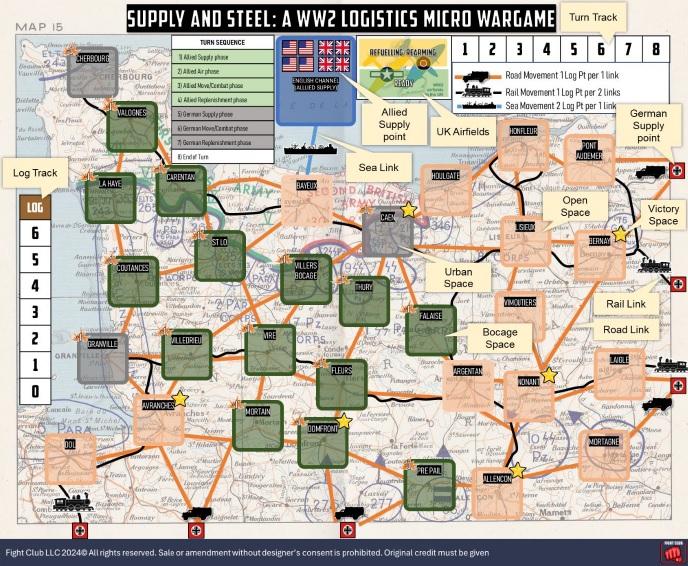
Figure 1: The Supply and Steel game board.
Some of the specific features of Supply and Steel include:
- The Supply Economy: Rather than simply moving combat units to initiate engagements, players must actively manage a finite pool of logistical resources, represented in-game by supply points or cubes. These resources do not magically appear at the front; they must be physically moved from rear-area depots (such as the congested Normandy beachheads) along vulnerable lines of communication to the frontline fighting formations.
This mechanic simulates the 'tyranny of distance'. The further forward a unit advances, the more time and resource-intensive it becomes to sustain them, requiring players to build and protect a viable supply chain before they can confidently launch an offensive.
- The Combat vs. Sustainment Dilemma: In Supply and Steel, commanders are forced to prioritise their efforts, weighing the tactical benefit of pressing an attack against the risk of overextending their supply lines. Combat actions within the game are not free; every attack, movement, and defensive stand consumes logistics. Players quickly learn that a rapid, sweeping advance can leave their leading elements isolated, out of supply, and highly vulnerable to counterattack. Through this mechanic, Supply and Steel replicates the very dilemmas that plagued commanders during the historical post-D-Day breakout.
- Asymmetric Operational Challenges: The game also excels in demonstrating the differing logistical hurdles faced by opposing forces. The Allied player is burdened with the friction of pushing massive amounts of materiel through narrow bottlenecks to maintain offensive momentum. Conversely, the German player is forced to master the art of husbanding scarce resources while conducting a stubborn, delaying defence. This forces players to not only plan their own sustainment but to actively target and exploit the logistic vulnerabilities of their adversary.
Implementing Supply and Steel into Unit PME
Supply and Steel is available as a print-and-play game from Decisive Edge via ADELE (O:S) on the DPN (download link via Decisive Edge); alternatively, members of Fight Club International can access it via the Fight Club website.
The true value of any wargame lies in its application. As a micro wargame, Supply and Steel features a small physical footprint, an accessible ruleset, and a relatively short playing time. This reduces the barrier to entry, making it an ideal candidate for integration into a unit’s regular training battle rhythm without requiring days of dedicated time.
Focusing the After-Action Review (AAR)
As with all experiential learning, the game itself is merely the vehicle; the true PME value is extracted during the AAR. Facilitators should guide the post-game discussion away from mere 'dice rolls' and toward doctrinal concepts.
Questions should focus on operational reach:
- “At what point did your attack culminate?”
- “How did the friction of moving supplies dictate your offensive tempo?”
- “How would these constraints apply to our current operating environment?”
By tying the game’s historical lessons to contemporary Australian Army doctrine, Supply and Steel transitions from a recreational activity into a rigorous intellectual exercise. The following table provides a ready tool to assist AAR discussions.
Tactical Considerations: Allies vs. Germans
| Operational Focus | Allied Commander Considerations | German Commander Considerations |
| Primary Objective | Maintain relentless momentum to achieve a breakout; anticipate supply needs two steps ahead to avoid culmination. | Delay the advance and buy time for reinforcements; force the Allies to overcommit and consume their supplies for minimal gains. |
| Logistics Management | Push supply cubes aggressively forward early on; stockpile at critical nodes but beware of outrunning your logistics network. | Maximise efficiency of scarce supplies; position them in the rear so units can retreat onto them, avoiding vulnerable frontline stockpiles. |
| Terrain & Movement | Use airpower and fresh armour to punch through defensive bocage; once in open terrain, aggressively seize victory objectives. | Anchor defence in bocage and urban centres (e.g., Caen) to create choke points; use spent units as strategic roadblocks. |
| Interdiction & Counterattack | Use bombing/strafing runs to sever German rail hubs and supply bottlenecks, paralysing their ability to reinforce. | Watch for Allied units advancing beyond their supply lines; use mobile Panzer reserves to counterattack and cut off overextended elements. |
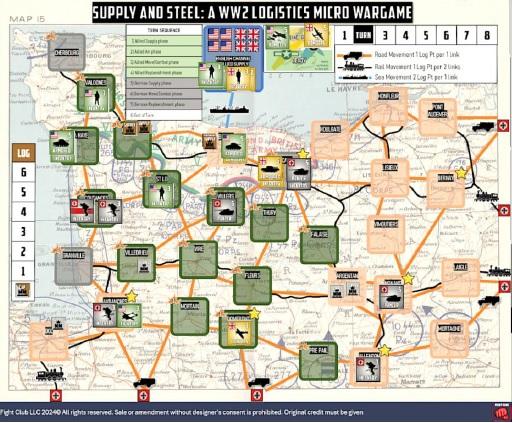
Figure 2: A game of Supply and Steel in action.
Conclusion
Ultimately, Supply and Steel is much more than a historical simulation of the 1944 Normandy campaign; it is a highly effective, accessible platform for developing the intellectual edge of our combat leaders and logisticians alike.
By deliberately shifting the focus from tactical manoeuvre to the relentless friction of sustainment, the game forces players to confront a reality that is as true today as it was eighty years ago: operational ambition is strictly tethered to logistical capacity.
For an Australian Army reorienting towards littoral manoeuvre and operations across the Indo-Pacific, mastering logistics constraints is more critical than ever. As Army continues to expand its wargaming ecosystem, print-and-play games like this offer commanders a practical, engaging way to embed continuous PME into their unit’s battle rhythm.
By taking these lessons from the tabletop to the training environment, we can better prepare our people for the complexities of modern conflict, proving once again that while amateurs study tactics, professionals master logistics.
Game Summary
Supply and Steel: A two- to three-player micro wargame that explores the issues of logistics in Normandy during the 1944 breakout. Players must move supplies forward to their frontline units to continue the advance or shore up their defences without creating opportunities for their opponent.
- Complexity: Low
- Number of players: 2-3 (Allies can be played as a single player or split between two players)
- Time to play: 60-90 minutes
- Learning Value: Logistics planning
- Potential training audience: Corporal – Major
Publisher: Fight Club International: https://www.fightclubinternational.org/supply-and-steel
Still Interested?
Why not also read: Introduction to Wargaming by Andrew Somerville.
Cove+ also has short learning courses on similar topics, including Modern Warfare.



A how-to-play video would be helpful.
The original map had open terrain in the south, where it's actually called "Normandy's Switzerland," :-) and when I pointed that out, they very responsiively made the correction.
Free Print and Play games of mine on www.CoatneyHistory.com which might be of interest to you folks are:
Postcard Coral Sea
Postcard Guadalcanal
WW2: the Med, with supplies being the ground combat factors.
Debacle (Malaya and DEI, 1942)
Mongoose vs. King Cobra: Indian Ocean Carrier Raid Apr42 (After I designed it, I discovered the book "The Most Dangerous Moment of the War: Japan's Attack on the Indian Ocean 1942" which unfortunately has a KGV battleship on the cover.
Fleet Train: Central Pacific Logistics
War Gets Norway? ... which has suddenly become worrisomely real.
30? years ago, I was in a 1/700 hypothetical "Battle off the Malayan Shore" with a young Andrew Waller who had his grandfather's Perth at the head of the Allied battleline.
My GGG Granduncle Brigadier Alexander Jack engineered the subduing of Kangra Kot/Fort to end the 1st Sikh War on 28May1846, and I have a game about that. He and youngest brother Andrew just visiting from Australia both died in the 1857 Cawnpore Massacre. Alexander was not in command.
The hedgerows were impenetrable, even for tanks. And then a young private from the Appalachian hills suggested putting hedge cutters in the lower front hull to uproot them. His buddies laughed at him, but a sergeant from New Jersey heard him and thought of all those German beach obstacles ... and put them to use as tank-mounted hedge cutters.
A Sherman so equipped literally burst through a hedgerow in a demo for Gen. Bradley who had them installed on hundreds of tanks, and the British did too.
And this was a double advantage. While our tanks suddenly had cross-country mobility through the bocage, German vehicles were still confined to roads and easily flanked.
Thus, the German western flank completely disintegrated, and how to build such a decisive advantage into a simple game is a good challenge. I have it problematic for my own little D-Day and Normandy game, with a compensation victory point if the Allies don't ever get it.
Free to print off and play at www.CoatneyHistory.com/DDayNmdy.htm