


It is 0200. The aircraft lands in a marginal landing zone under night vision goggles. The side door slides open and a soldier is slung in a soft litter. Over the noise of the engines and spinning blades the CFA says “we’re still mopping up from a contact, he’s been shot a couple of times and has a tourniquet on his leg. Sorry, for this but I’ve gotta go” and hops off the aircraft, sliding the door shut behind them. The power rises and the aircraft lifts into the air. You are now responsible for an unknown, unstable deteriorating patient with limited access, limited light, and limited time.
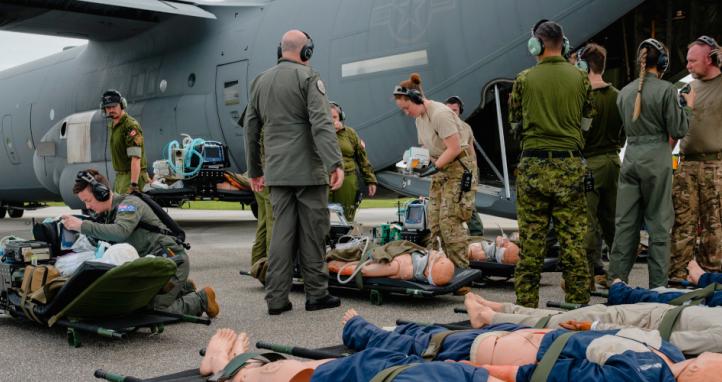
Whilst not every day this is the reality of military rotary-wing aeromedical evacuation (RWAE) in previous conflicts and in future conflicts. To prepare our clinicians for this environment they attend a five-day RWAE course delivered by the ADF School of Health.
This course is a training solution – it is not capability development. If Army is serious about enhancing survivability, it must recognise the simple truth: aeromedical care is not an exposure skill – it is a specialty.
The Problem: Training for Presence, Not Performance
The current five-day RWAE course provides essential familiarisation with aircraft safety, loading procedures, and basic considerations of care in flight. It ensures clinicians can operate safely within the aviation environment. However, it does not and cannot develop the depth of clinical and operational expertise required to deliver effective care in flight.
It prepares clinicians to be on the aircraft, not to practice medicine within it. Rotary-wing aeromedical evacuation requires clinicians to operate in a degraded clinical environment where standard assessment tools are unreliable, interventions are more difficult, and decision-making must occur rapidly and often with incomplete information. These are not skills that can be meaningfully developed in such a short course.
Why This Matters: Risk in the Rotary-Wing Environment
The rotary-wing environment introduces both clinical and operational risk. Clinically, assessment is degraded as auscultation is often impossible, vital sign monitoring is limited, and subtle changes in patient condition can be easily missed. Airway management, haemorrhage control, analgesia, and patient communication all become more complex when performed in a vibrating, noisy, and confined space.
Operationally, these missions often occur in time-critical and sometimes non-permissive environments. Clinicians must integrate with aircrew, understand aircraft limitations, and contribute to mission planning. This includes considerations such as landing zones, alternate extraction points, and routing to appropriate medical facilities. Without adequate training, clinicians are forced to adapt in real time. This reliance on improvisation increases cognitive load and introduces unnecessary risk.
What Right Looks Like: The US Model
The United States Army approaches aeromedical evacuation as a specialised capability. Their flight paramedic pathway is built on deliberate, progressive training. This includes initial paramedic qualification, followed by critical care training and aviation integration. In total, this can take several months to complete and is supported by ongoing currency and validation requirements.
The intent is clear: produce clinicians who are experts in delivering care within an aviation setting. This investment has been driven by operational experience, which demonstrated that higher levels of training directly improve patient outcomes and survivability.
The Contrast: Five Days vs Months
When compared directly, the difference is stark; five days provides exposure only. It introduces clinicians to the environment and basic considerations of flight. Months of structured training produce capability. They build clinical confidence, decision-making ability, and integration with aviation systems. This is not simply a difference in duration. It reflects a fundamental difference in how capability is understood and prioritised.
This Is a Lived Gap
This gap is not theoretical; all clinicians operating in rotary-wing environments, both civilian and military, experience it routinely. It is felt when you cannot rely on your usual assessment tools. When you are managing sedation without full monitoring capability. When you are required to brief a pilot on clinical urgency while still forming your own assessment. It is seen in the hesitation that comes with unfamiliarity, and the cognitive load associated with working outside of trained experience. Over time, individuals adapt; they build their own experience and develop workarounds. This is not a system, it is an informal and inconsistent approach to capability development.
The Real Issue
The core issue is not the five-day course itself. It serves an important purpose in providing baseline safety and familiarisation and should be included in the initial employment training of all military clinicians. The issue is that Army does not formally recognise RWAE as a specialised role requiring sustained training, structured progression, currency, and a professional identity just as underwater medicine, CBRN, and special operations medicine are.
A Better Way: A Tiered Program
A more effective approach would be the development of a tiered flight medic and nurse program. This program is based on embedding these clinicians within aviation units, ensuring integration with crews, familiarity with aircraft, and participation in mission planning and execution.
Tier 1 would retain the current five-day course, ensuring broad exposure and safety operation by all Army clinicians.
Tier 2 would introduce a flight-qualified clinician pathway, including additional training in aviation physiology, advanced trauma care in flight, crew resource management, and mission integration.
Tier 3 would develop advanced specialists, with training aligned to paramedic or critical care standards. This would include advanced airway management, ventilation strategies, pharmacology, and prolonged care principles.
This model allows capability to be scalable, while ensuring that a core group of highly trained clinicians exists within the system.
What This Achieves
The development of a dedicated aeromedical workforce would improve patient outcomes by ensuring that clinicians are better prepared for the challenges of flight. It would reduce cognitive load, allowing clinicians to focus on patient care rather than adapting to the environment. It would improve integration with aviation units, enhancing mission effectiveness and communication. Most importantly, it would shift aeromedical evacuation from an adjunct task to a recognised and professionalised capability ready to support Army’s mission set.
Conclusion
Rotary-wing aeromedical evacuation is one of the most complex clinical environments in Army. Yet we continue to prepare our clinicians with a five-day course, while our allies invest months in developing the same capability.
Five days is enough to get on the aircraft; it is not enough to own the environment.


I do also think that considering the current paradigm of multiple dispersed role 2 health elements providing surgical capability with minimal holding capacity; RW assets are the only evacuation platform that have the ability to rapidly manoeuvre to the health elements that are experiencing bedlock to clear post surgical patients and enable continued patient flow.