
Training and Education: Why Army Needs Both
Recent commentary following the Defence Strategic Review has made one thing clear: Army faces challenges not seen since the Second World War and must continually adapt to remain ready. At the same time, soldiers and officers across the force are constantly engaged in training – within units, on exercises, and through career courses.
So if we are training hard, what else is required to ensure we can address the nation’s most significant strategic risks? Part of the answer lies in understanding the difference between training and education, and why Army needs both to prepare for an uncertain future.
What Is Training?
Defence describes training as a ‘deliberate and structured process that develops the knowledge, skills, attitudes, and behaviours required for individual and collective performance. It prepares individuals and teams to execute specified tasks to a required standard in current and future contexts’.
Put simply, training equips soldiers to apply standard solutions to known or anticipated problems, even when those problems are encountered in unfamiliar, hostile, or stressful environments.
What Does Training Look Like in Army?
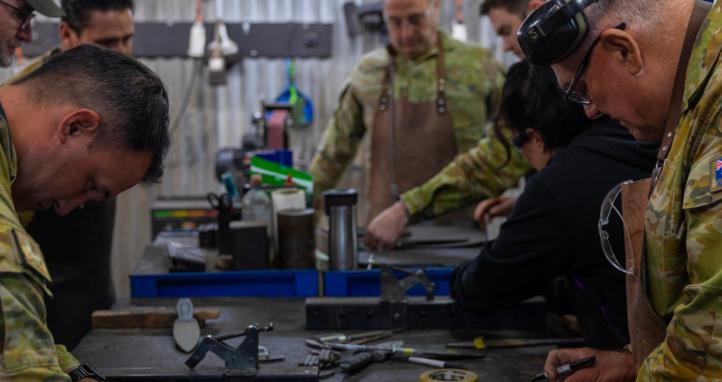
Training in Army encompasses individual and collective activities and occurs in both formal and informal settings. Formal training includes initial employment training, trade‑specific courses, and promotion courses. Informal training usually occurs within units and focuses on developing and maintaining job‑specific skills through on‑the‑job instruction and practice.
Regardless of where it occurs, Army training is designed to ensure soldiers can perform reliably in situations they are likely to encounter. For example, individual training on first aid for battlefield injuries such as gunshot wounds, or weapon handling drills to clear stoppages. Examples of collective training include urban clearance procedures and the suppression of enemy positions. These are foreseeable challenges, and it is through repeated, structured training that soldiers and officers are able to respond quickly and effectively.
What Is Education in Army?
Defence defines education as the ‘acquisition of knowledge and skills through formal and informal learning experiences, within or outside Defence, to enable professional mastery, ethical judgement and operational capability’. Put simply, education develops soldiers who can think critically, apply knowledge, and solve problems that don’t have an established or doctrinal solution, often under conditions of uncertainty and ambiguity.
What Does Education Look Like in Practice?
Education encompasses both formal and informal learning. Formal learning – such as at secondary school education, university study, or Cove+ modules – has defined outcomes and assessment, and often leads to a recognised qualification. While such study includes discipline‑specific content, its enduring value lies in developing transferable skills such as critical thinking, problem‑solving, and communication.
Informal education, on the other hand, does not result in a qualification but is no less important. In Army, this includes PME activities such as the Apex Course, reading a book from the Chief of Army’s Professional Study Guide, reading or writing on The Cove, and participating in unit‑led PME discussions. These activities expose soldiers and officers to new ideas, perspectives, and ways of thinking – building intellectual agility rather than task proficiency alone.
Why Does Army Need Both?
Training and education are complementary, not competing. Training prepares soldiers to perform effectively in known or likely situations, using established methods to achieve a defined standard. Education, on the other hand, develops the cognitive skills required to operate in unknown and evolving situations, where judgement, adaptation, and initiative are critical.
As Army prepares for a future defined by complexity and uncertainty, readiness will depend not only on how well we train, but on how well we think. We require mastery of both – training to perform specified tasks to the required standard, and education to apply judgement and solve complex problems when tasks, context, or solutions are unclear.

Training provides the high-fidelity, predictable foundation required for immediate workplace application under stress. Education, conversely, develops the intellectual agility and critical thinking required for transferability, ensuring soldiers can navigate and solve problems when there is no established doctrinal script.
Ultimately, true operational readiness means assessing not just how well a force can perform a task, but how effectively they can think and adapt when the environment changes.