This article is based on an address given by the author on Remembrance Day in 2025. It is published today to mark Anzac Day, the 111th anniversary of the Gallipoli landings.
‘Sing, Muse, of the anger of Achilles’.
So begins Homer’s epic story of the war of the Trojans against the Achaeans, first spoken over three thousand years ago.
And thus began a tradition of using words to record – and to remember – the experiences of war.
Words of remembrance – most often found in poetry and oratory – have captured over the centuries the twisted faces of the Janus that is war.
They give a sense of war as the most intense of human experiences: as a crucible of loss and pain, but also one of love and sacrifice.
Given the depths of emotion that rise both in and from the battlefield, it is perhaps no surprise that war has inspired so much poetry and oratory.
It also means that war, and remembrance, can mean many things to many people.
Words of remembrance often rightly focus on the horrors of war, a testament against the vile glories perceived to lie within violence, written by those who have lived the reality.
I recall as a schoolboy reading Wilfred Owen’s fevered nightmares of the First World War. Soldiers ‘bent double, like old beggars under sacks. Knock-kneed, coughing like hags, we cursed through sludge’. ‘Gas! GAS! Quick boys! – An ecstasy of fumbling’. ‘Watch the white eyes writhing in his face. His hanging face, like a devil’s sack of sin’.
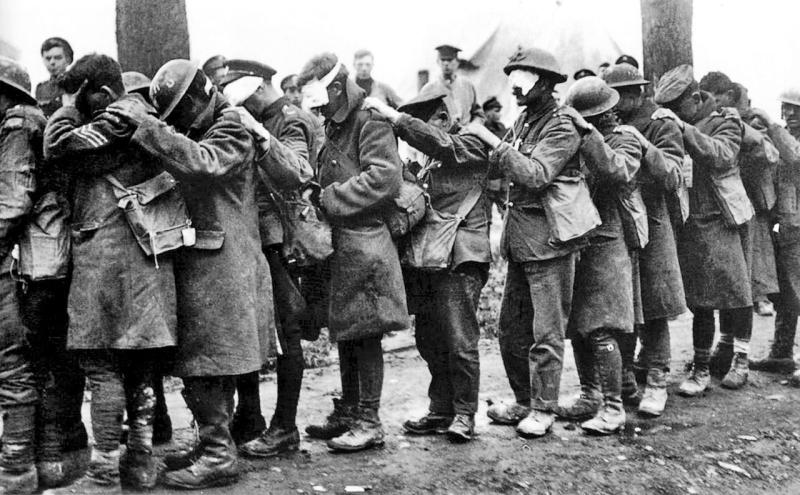
War, Owen told us, was ‘obscene as cancer, bitter as the cud’. Those who had seen it would never ‘tell with such high zest, to children ardent for some desperate glory, the old Lie: Dulce et decorum est pro patria mori’. It is right and proper to die for one’s country.
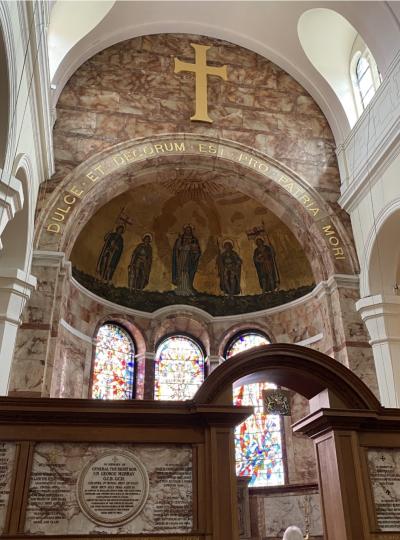
Having decided to become a soldier, I then remember walking into the Chapel at the Royal Military Academy in Sandhurst to see the same words, emblazoned in gold leaf, on the archway of the nave. Engraved there in 1913, they intended each Sunday to stoke the spirits and patriotism of young officers like myself.
They did their job well, despite Owen’s fever dreams. My cohort left Sandhurst wholly committed to our profession … ready and willing to give our lives for our country, or to take the lives of others in its defence. It was our turn to embrace the ‘old lie’, and we did so with all the enthusiasm of youth.
Indeed, we were right to do so: the burden of defending a nation must fall to each successive generation, and if we would not pick it up then who should? To whom should the honour fall? So go the contradictions of war.
For soldiering and remembrance are not always about horror.
At times, they are about the camaraderie and thirst for life that can only exist in war … a place where one burns with a brightness that is only found when looking into the face of death.
Winston Churchill, a man as familiar with war as anyone, once quipped that ‘nothing in life is so exhilarating as to be shot at without result’. He was right.
The experience of combat binds soldiers tight. Just over a year ago I returned from Australia to the United Kingdom – to Warwickshire, to be precise – for a ten-year reunion of a particularly lively tour of Afghanistan.
I was nervous, worried that the vagaries of both time and distance would have pulled us apart.
I didn’t need to be. Within moments hugs were exchanged, stories traded, and glasses were raised to the fallen. A decade faded away in an instant, and we were back together again in the dusts of Helmand, burning brightly.
Sat in the late afternoon sunshine, in a country pub in Shakespeare’s county, I reflected on how well the Bard captured the enduring camaraderie of war in the words of Henry V, some five hundred years earlier.
On our day of reunion, as had those after Agincourt, we as soldiers 'stood a tip toe when our day was named’, stripping our sleeves and showing each other our scars.
There was no regret … ‘if we were mark’d to die’, we remembered, ‘we were enough to do our country lost’. Back together again, we were truly ‘the few, the happy few, the band of brothers’.
That day was our very own St Crispin’s Day, given in honour of King and Country.
For remembrance can also be about patriotism.
The character and strength of nations often lies on the foundation of the sacrifices of those that defend it.
At the 1919 Paris Peace Conference, where the Treaty of Versailles was to be negotiated, US President Woodrow Wilson famously challenged Australian Prime Minister William Hughes’ right to speak.
Who was Hughes, Wilson argued, to intervene in great world affairs with a nation of only five million people?
Hughes response was as poetic as it was simple. ‘I speak’, he said, ‘for 60,000 dead’.
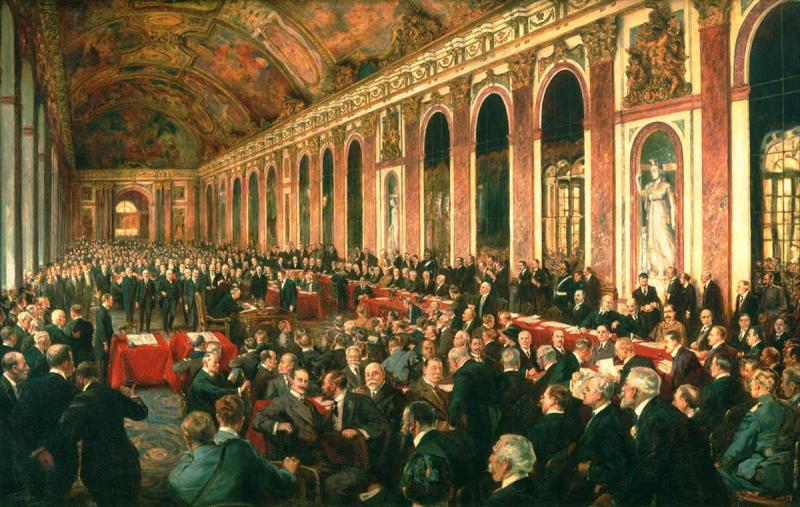
On that day those lost on the shores of Gallipoli, and on the fields of the Western Front, became the foundation for the authority of Australia … a nation which, at just eighteen years old, was considerably younger than most of those who had just given their lives.
This is how I prefer to think of the Anzac legend: as a bedrock of the Australian national character.
The historian Charles Bean, who himself landed at Gallipoli, captured this best when he wrote the following of the Australian soldiers of the First World War.
‘What these men did nothing can alter now … it rises, as it will always rise, above the mists of ages, a monument to great hearted men; and, for their nation forever’.
In closing, I turn to the topic most often related to the spirit of remembrance: that of sacrifice … the acknowledgement that the cost of war is always high, and that this cost most often falls upon the young.
This audience will likely know by heart the Ode of Remembrance, drawn from the poem ‘For the Fallen’ by Laurence Binyon …
‘They shall grow not old, as we that are left grow old:
Age shall not weary them, nor the years condemn
At the going down of the sun and in the morning
We will remember them’.
These are profound words. But when acknowledging the youth of those who have made the ultimate sacrifice, it is best to turn to the third stanza of Binyon’s poem.
‘They went with songs to the battle, they were young,
Straight of limb, true of eyes, steady and aglow,
They were staunch to the end against odds uncounted,
They fell with their faces to the foe’.
The average age of the Australian soldier to fall in the First World War was 26. It was the same one hundred years later in Afghanistan. In Vietnam, it was just 19.
It is the young Australian who most often signs what we call ‘the contract of unlimited liability’, who most often gives their all for the nation.
All contracts have two sides, and it falls to society to meet our collective obligation to the fallen, and to those inevitably injured in war. We must care for them, and for their families, in gratitude for this sacrifice.
This is a duty that requires constant attention, and one that has no end. The ranks of the veterans of the Second World War have mostly left us, but in their place stand the veterans of Korea and Vietnam.
They will be replaced in turn by those who fought in Australia’s longest war in Afghanistan, a young generation of veterans that is forming up in front of us as we speak.
It is by caring for our veterans that we ensure that the spirit of remembrance goes beyond 25th of April, or indeed the 11th November, each year.
Every day becomes a day of remembrance, as we honour and support those who have sacrificed in the defence of Australia.
Thank you for the privilege of speaking to you tonight. We live once again in a dangerous age, where the spectre of great power war haunts the international stage.
As a soldier, I can only hope that the leaders of all nations recall the immortal poetry of the American singer Edwin Starr, who rightly said that ‘war, huh, what is it good for … absolutely nothing’.
War in the modern age, in the nuclear age, is in no nation’s interest. Be assured that the modern Australian soldier, sailor and aviator strives to maintain the peace, each and every day.
But we also know that we must maintain a tragic sensibility, accepting the world as it is, and not how we might wish it to be. The long history of war, from Troy to Ukraine, reminds us that violence between states is the norm, rather than an aberration.
It is the soldier’s duty to prepare for war, as much as it is our task to seek to prevent it. Be assured that we also stand ready to do all that is required to defend Australia.
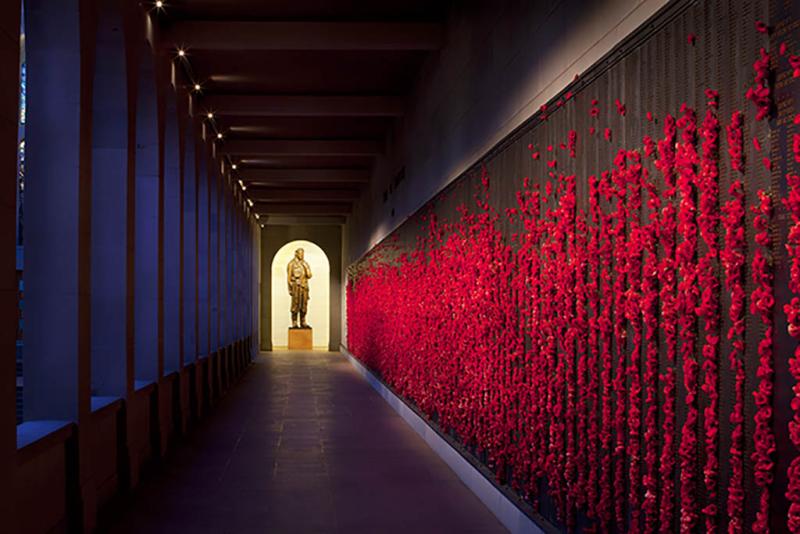
We do so inspired by the 103,000 names etched into the walls of the Australian War Memorial. We fight to defend what they died for, a nation of beauty rich and rare.
Lest we forget.
The views expressed in this article are entirely those of the author. They do not represent the views of any Government department or organisation. AI was not used in the writing of this article.