Article Summary
On the eve of the retirement of Major General Michael Krause, after 46 years of service, Chris Field argues that MAJGEN Krause's most enduring contribution is to the professional military education of the Australian Army. Pairing MAJGEN Krause with Colonel E.G. Keogh, founding editor of the Australian Army Journal, Field presents the two as rare exemplars of the Army educator across a seventy-year span; Keogh giving the post-war Army its intellectual voice, while Krause refined the modern Army's grammar through commander-centred planning doctrine.
Its central challenge is that the Army cannot keep relying on a handful of exceptional individuals; the author appeals to their fellow professionals to self-educate, write, teach and mentor rather than wait for "the system," and so become the successors the Army rarely produces by design.
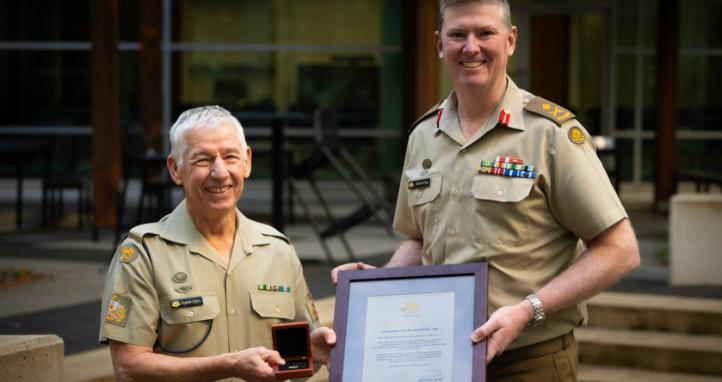
Major General M.G. Krause retires in 2026, concluding 46 years of Australian Army service. Farewelling Krause from the Army, means, arguably, we farewell Army’s best tactician (noting the enemy always gets to vote on our tactics) and, certainly, in the last 15 years, Army’s best educator.
Krause demonstrates, through personal example, the responsibility of every Army leader to continuously do the work and self-educate, rather than wait for “the system” to deliver professional military education through mandated courses.
For Krause, education is not a luxury of peace, but a preparation for uncertainty. Encouraging officers and soldiers to read, write, and argue professionally is not an indulgence; it is a core attribute of our profession of arms.
In this sense, Krause’s retirement is an opportunity for our Army to reflect upon and appreciate the contribution Krause made to our Army through educating other Army leaders.
Anyone who knows Krause, understands his unique mastery of the military profession, tactics, planning, warfighting acumen, and operational execution. As Commanding Officer, 2nd Cavalry Regiment and Commander 1st Brigade, Krause focussed on training and educating many future Army leaders in combined arms tactics, armoured manoeuvre, and campaigning.
Upon his transfer from full-time to part-time service, Krause’s impact on Army was not by command appointment, but from sustained personal gravitas as a self-enabled educator, mentor, and intellectual steward of warfighting.[2]
Importantly, for the decade of Krause’s part-time service, he educated, coached, and mentored Army’s formation commanders, commanding officers, sub-unit commanders, and key staff. He also reimagined and reenergised the Combat Officers Advanced Course (COAC), and then successfully transferred course responsibility and leadership to the next generation of Army educators.
Amplifying Krause’s uniqueness, the purpose of this article is to compare his contribution to Army, with the contribution of another leader in the Australian Army’s professional education and excellence: Colonel E.G. Keogh.
Colonel Eustace Graham (E.G.) Keogh and Major General Michael G. (M.G.) Krause each made rare and complementary contributions to the Australian Army’s education and intellectual development. Arguably, Krause is the Australian Army’s most significant contemporary successor to Keogh.
Importantly, our Army rarely produces educators of Keogh’s and Krause’s calibre.[3] As Professor Jeffrey Grey articulates:
The Australian Army, like Australian society generally, is usually mistrustful of intellectuals and uncomfortable in dealing with them. This may be because, in both cases, they encounter the genuine article but rarely.
In the course of its history the Australian Army has produced thinking soldiers, well-educated soldiers and well-read soldiers as well as plenty of capable practical ones who were good at their core business – the management of organised violence.
It is most unlikely ever to produce a major theoretician of war – an antipodean Clausewitz – but equally it only rarely produces someone capable of prolonged and sustained thinking and writing about the business of soldiering and the art of war.[4]
Therefore, with Krause’s retirement, it is imperative we reflect upon how, through deliberate education, can our Army identify, develop, nurture, and support educational practitioners, like Keogh and Krause, in the future?
How can our future Army recognise that intellectual readiness must be cultivated as deliberately as physical readiness? Is our future Army content to rely on education from a few exceptional individuals, or can our Army formally prepare, incentivise, scale, preserve, and institutionalise education as a fundamental Army capability?
Our urgent need for Army educators, means Krause’s retirement is not simply a farewell. Instead, this is an opportunity and a moment of decision about whether Army allows Krause’s legacy to fade, or we deliberately continue Krause’s intellectual momentum enabling Army to continuously learn, adapt, and change.
Keogh’s voice and Krause’s grammar
War has a grammar, but not a policy logic, of its own.[5] Carl Von Clausewitz explains that there remains an enduring requirement for policy and strategy to understand both the ‘grammar’ of war, ‘how war works as war… [as] physical conditions and tactical challenges…[and] action wherein people live and die in combat’, and the policy ‘logic’ of war.’[6]
Through the concept of war’s grammar and policy’s logic, Professor Colin S. Gray emphasises that ‘the threat and use of force is not a self-validating exercise.’[7] He notes that ‘military action has political meaning only through its strategic effect.’[8] For Gray, ‘war is not what strategy is about, any more than is battle. Strategy is about achieving the policy goals that translate as peace with security, whatever those two contestable concepts may mean to particular communities.’[9]
Borrowing Clausewitz’s and Gray’s ideas of the ‘grammar’ and ‘logic’ of war, this paper describes Keogh’s voice and Krause’s grammar in enabling Army’s education.
Keogh gave the post-World War II permanent Army its voice, creating the mechanisms through which Army members could critically think, write, and debate as professionals, even while the Army was continually deployed and fighting in our region.
Krause refined Army’s grammar, reshaping how Army professionals plan, decide, act, and lead in the contemporary operating environment.
Together, Keogh and Krause illustrate two essential dimensions of education’s contribution to military intellectual power: first through creating a culture of critical thinking; and second, through translating critical thinking into professional mastery.
For future Army, both dimensions must remain central to the Army’s identity as an adaptive and learning profession.
Training and education in the Australian Army
If it were a person, the Australian Army would be a house builder. Pragmatic, practical, mistrustful of abstractions, questioning of government and not much interested in living in the realm of ideas. Like the builder, the Army applies its skills well in practical situations and can develop and apply innovative solutions to practical problems. Like the builder it doesn't see the need to apply much effort to developing possible solutions to prospective problems.
The Australian Army is not stupid but nor is it curious. Its confidence in its ability to apply its well-developed common sense to real situations can make it appear arrogant. The Army reads newspapers but not books, it's good at suburban house building but hates dealing with 'creative' architects whom it sees as unnecessarily complicating what it perceives as a pretty simple activity. The Australian Army is unlikely ever to get a contract to build a shopping mall or office tower – if it did it would not know how to proceed.[10]
Training teaches people what to do – through knowledge, skills, attitudes, and behaviours; education teaches people how to think – through communication, creativity, critical-thinking and decision-making skills. Professor Grey supported this thesis when he stated:
While the army has generally been very proficient at training (defined as the development of responses to predictable circumstances, or the ability to act), historically it has been much less good at or certain about education (defined as the conditioning of responses in unpredictable circumstances, or the ability to think).[11]
On training, the National Defence Strategy, 2026 mentions training 19 times and the Integrated Investment Program, 2026 mentions training 34 times.
In contrast, on education, the National Defence Strategy, 2026 mentions education six times and the Integrated Investment Program, 2026 mentions education twice.
Objectively measured, these numbers suggest that Defence biases training over education at a ratio of three to one in the National Defence Strategy, 2026 and at a ratio of seventeen to one in the Integrated Investment Program, 2026.
As directed in the National Defence Strategy, 2026 and the Integrated Investment Program, 2026 – the Australian Army trains. Ask a soldier, non-commissioned officer, warrant officer, or officer to describe the formative moments in their career and they will, inevitably, mention their training experiences. These experiences may include training centres – Kapooka, Bandiana, Singleton, Puckapunyal; or training areas – Shoalwater Bay, Mount Bundy, Tully, High Range; or the abbreviated titles of training courses – Subject Course, Basic, Intermediate and Advanced Course.
Education in the Australian Army receives less attention. In casual conversation, a soldier, non-commissioned officer, warrant officer, or officer won’t, usually, rattle off their high school certificate results, academic awards, or degrees they have earned.
Training is what, as an Army, we do. We also train trainers. We celebrate trainers. We elevate trainers. For example, we overtly recognise trainers on their uniforms with Recruit Instructor and Military Instructor badges. However, outside the Royal Australian Army Education Corps, we do not recognise people who educate.
Even the Royal Australian Army Education Corps preferences ‘educational best practice, training systems, synthetic learning environments…[and] strategic education’[12] over delivering education fundamentals including, for example, now discarded, Army education opportunities like the Subject 3 for Education (Corporals and Sergeants)[13] and the full-time Year 12 education program.[14]
There is merit in noting that the discontinuation of programs such as Subject 3 for Education and the full-time Year 12 scheme does not necessarily represent the disappearance of educational opportunities for Army’s soldiers and non-commissioned officers. Many of the functions these programs provided have been incorporated into the Army’s foundation training continuum and are now delivered through a range of Army and Defence education schemes and programs. In many respects, RAAEC's role has evolved from direct delivery to the leadership, management and assurance of externally delivered education solutions.
Amplifying our Army’s bias for training over education, Professor Grey asserts:
As in many other things, the Australian Army is a derivative organisation, patterned on its British progenitor and exhibiting many of that organisation's cultural behaviours overlain with more specifically Australian features. The British Army long professed a disdain for education and professionalism, and it is unsurprising that there is a legacy of such attitudes in its local progeny.[15]
Therefore, with our Army’s intense strategic focus on training: teaching people what to do; our Army, arguably, rarely produces educators: teaching people how to think.
Educating an Army: Colonel E.G. Keogh and Major General M.G. Krause
A key issue is that Army rarely produces educators. Our Army does, however, produce some exceptions.
Two examples of exceptional Army educators are Colonel E.G. Keogh and, more recently, Major General M.G. Krause. Although separated in service by almost 15 years and operating in markedly different strategic contexts, both Keogh and Krause reshaped how the Army thinks, learns, and professionalises. Both leaders, in their own ways, taught people how to think.
Below is a comparative assessment of Keogh’s and Krause’s contribution to Army education:
| Dimension | Colonel E.G. Keogh | Major General M.G. Krause |
| Primary intellectual focus | Military scholarship and culture | Planning doctrine, mentoring, and decision‑making |
| Core contribution | Founding and shaping Australian military literature | Reforming Australian Defence Force (ADF) planning and commander‑led decision‑making |
| Institutional impact | Established the Australian Army Journal and scholarly tradition | Replaced legacy planning doctrine with Decision Making and Planning Processes (DMPP) |
| Orientation | Reflective and historical | Applied, operational, and future‑focused |
| Enduring legacy | Intellectual infrastructure and professional discourse | Planning methodology embedded across Army and ADF |
Colonel E.G. Keogh, MBE, ED
In a succession of roles as a staff officer, author and editor [Keogh] established the foundations of military professionalism in the post-war Australian Army and especially in its new iteration, the Australian Regular Army.
He was not the first army officer to recognise the importance of education and serious and sustained study in the development of the officer corps. He was not the first army officer to write serious history, although he was probably the most prolific to his time. The journal of the profession of arms that he established and edited for nearly two decades was not the first such publication to appear in Australia, although it was easily the most sustained and wide-ranging.
What makes Keogh worthy of note and explains his influence within the army of his day is that he did all of these things and did so for an extended period of time.[16]
Colonel Eustace Graham Keogh, (24 April 1899 – 9 November 1981) created and nurtured military scholarship in the Australian Army. He was born in Rutherglen, Victoria and attended Christian Brothers College in East Melbourne.
Keogh qualified as a civil engineer and surveyor, as a civilian, in the interwar years. He served as a signaller in the Middle East in World War I and, following commissioning in the militia in the interwar period, Keogh served in a wide range of liaison and training roles before discharging in 1946.
He became the founding editor of the Australian Army Journal (AAJ) in 1948, as a civilian employee at the Directorate of Military Training. Keogh served as the AAJ editor until 1965. Through this role, he established, for the nascently professional Australian Army, the first enduring platform for critical debate, professional study, and the development of an Australian military literature.[17]
Keogh’s intent was explicit: to stimulate thought, encourage the study of military art, and give Australian Army members a voice in global military discourse. He actively encouraged members of the Army to write short, analytical articles. Keogh also authored many pieces when contributions were scarce.[18]
His editorial leadership ensured intellectual continuity during the post‑war and early Cold War years, a period when Australia was creating its professional identity in a redefined strategic environment.
Beyond editing, Keogh was a prolific military historian. He authored books including Suez to Aleppo, The River in the Desert, and Shenandoah, 1861-62, which became enduring references for Army education and training.
Keogh also won the Australian Military Forces Gold Medal Essay three times, reinforcing his reputation as the Army’s leading military scholar of his generation. His legacy is formally recognised through the E.G. Keogh Visiting Chair in Land Warfare Studies, which continues to promote rigorous debate on land warfare within the Army.
In summary, Keogh’s unique contribution was foundational and cultural: he built the intellectual infrastructure that allowed professional military thought to take root and endure within the Australian Army.
Major General M.G. Krause, AM
Major General M.G. Krause was born in Melbourne, Victoria. He completed Year 12 at Wesley College, Melbourne, and entered the Royal Military College, Duntroon, on scholarship in 1980. He graduated to the Royal Australian Armoured Corps in 1983.
Krause undertook all his junior regimental appointments in 1st Brigade, mainly in 2nd Cavalry Regiment where he served as Adjutant, Officer Commanding B Squadron, and as the Commanding Officer 2000-01. He commanded 1st Brigade 2008-09.
These formative appointments, combined with the Royal Australian Armoured Corps’ bias toward continual and comprehensive unit and formation professional military education, established a strong foundation for Krause in decisive leadership, armoured manoeuvre, and combined arms warfare.
Krause is an experienced trainer at both the Army Apprentices’ School, where he served as a company commander; and at Australian Command and Staff College, where he served as an instructor responsible for educating students on operational art and planning.
He also held staff appointments: as a major in Headquarters 2nd Division and Army Headquarters; as a lieutenant colonel with the United States Marine Corps; as a colonel in Defence Headquarters and Army Headquarters; as a brigadier in Headquarters Joint Operations Command and Army Headquarters; and as a major general in Defence Headquarters.
Krause’s operational service includes Iran, as a United Nations Military Observer, 1990; Solomon Islands, as a Military Adviser, 2004; Iraq, 2005; East Timor, 2008; and, Afghanistan, 2008, 2010-11.
Krause holds a Bachelor of Arts from University New South Wales, and a Graduate Diploma in Defence Studies and Master of Arts (International Relations) from Deakin University. He also holds a Master of Defence Studies from University of Canberra. He is a graduate of Australian Command and Staff College (1995) and is a Member of The Royal College of Defence Studies, UK, (2006).
He was awarded the Australian Army Journal Chauvel essay prize, in 2006, for his essay on Minimum Mass Tactics. His essay ‘Square pegs for Round Holes: Current Approaches to Future Warfare and the need to Adapt’ was published, in 2007, by Army as a working paper.
Following his retirement from the full-time Army service in 2013, Krause remained active as a part-time soldier, mentoring, often on multiple-occasions over multiple-years, senior officers, leaders, and staff. He emphasised advanced tactics and campaigning at brigade and division levels.
In addition to mentoring Army’s senior officers and their staff, Krause served approximately nine years leading and mentoring the Combat Officers Advanced Course and the Land Warfare Intermediate Course.
Krause has also authored key operational and planning doctrine for the ADF, including: Campaigns and Operations (ADF-P-3), 2021; Military Decision Making and Planning Processes (ADF‑I‑5), 2024; and, Towards a Deeper Understanding of Military Planning, 2025.
The Decision Making and Planning Processes (DMPP), as the ADF’s philosophical basis of warfighting, replaces previous joint and Army planning methodologies, including the Australian Defence Doctrine Publication 5.0.1—Joint Military Appreciation Process and the Army’s Land Warfare Doctrine 5-1-4—Military Appreciation Process.
DMPP places the commander at the centre of the planning process and introduces a clearer distinction between decision‑making approaches and systems through the Immediate Decision‑Making Process (IDMP) and the Deliberate Military Appreciation Process (DMAP). Krause’s doctrine emphasises timeliness, adaptability, and disciplined commander‑led planning; while explicitly recognising the roles of command and staff judgement, experience, cognitive bias, and pattern recognition.
This doctrine has since become a cornerstone of Army and joint professional military education, reinforcing Krause’s influence on how the ADF understands, teaches, and practices planning. Through this doctrine, Krause always demanded clarity of thought and intellectual honesty.
Krause’s contribution to the Australian Army is applied, doctrinal, and reformist, focused on how the Army plans, decides and leads under pressure while exposed to conditions of modern warfare. In turn, Krause created warfighting cultures that reward intellectual rigour, critical debate, and doctrinal experimentation.
As stated earlier, Krause refined the Army’s grammar, reshaping how Army professionals plan, decide, act, and lead in the contemporary operating environment. Through the grammar of tactics, Krause’s knowledge, enthusiasm, and intellect humanised the cold pages of doctrine.
Krause emphasised the commander and time available. He connected the planning process with reality. In turn, Krause generated in his students a genuine understanding of warfighting and its consequences. Without Krause’s work our Army, arguably, would lack some of its present tactically adaptability, ingenuity, and imagination.
Drawing on extensive training and operational experience, combined with senior planning appointments, Krause addressed a central professional problem for Army: how to contemporise military decision‑making for joint, coalition and time‑compressed operations.
Conclusion
The purpose of this article is to compare Major General M.G. Krause’s contribution to Army, with the contribution of another leader in the Australian Army’s professional education and excellence, Colonel E.G. Keogh.
Colonel E.G. Keogh and Major General M.G. Krause each made unique and complementary contributions to the Australian Army’s intellectual development.
Keogh gave the post-World War II, permanent Army, its voice, creating the mechanisms through which Army members could critically think, write, and debate as professionals, even while the Army was continually deployed and fighting in our region.
Krause refined the Army’s grammar, reshaping how Army professionals plan, decide, act, and lead in the contemporary operating environment.
Together, Keogh and Krause illustrate two essential dimensions of education’s contribution to military intellectual power: first through creating a culture of critical thinking; and second through translating critical thinking into professional mastery.
Our urgent need for Army educators means Krause’s retirement is not simply a farewell. Instead, this is an opportunity and a moment of decision on whether Army allows Krause’s legacy to fade, or we deliberately continue Krause’s intellectual momentum enabling Army to continuously learn, adapt, and change.
Therefore, how through deliberate education can our Army identify, develop, nurture, and support educational practitioners, like Keogh and Krause, in the future?
Is our future Army content to rely on education from a few exceptional individuals, or can our Army formally prepare, incentivise, scale, preserve, and institutionalise education as a fundamental Army capability?
[1] With thanks to Brigadier Grant Chambers, Major General Ash Collingburn, Major General Giles Cornelia, Brigadier James Davis, Colonel Tony Duus, Brigadier Shane Gabriel, Brigadier Dave McCammon, Brigadier Ben McLennan, Major General Chris Smith, and Brigadier Neil Sweeney for their contributions to this paper.
[2] Nicholas Jans with Stephen Mugford, Jamie Cullens & Judy Frazer-Jans, The Chiefs - A Study of Strategic Leadership, Centre for Defence Leadership and Ethics, Australian Defence College, Canberra, 2013, p. 86
Strategic “Steward of the Profession”: The leaders of the military profession, particularly those at the strategic level, have five major obligations in terms of performing this role. They must:
- understand the critical distinction between the military as a profession and the military as a bureaucracy or even as “an organisation”, and understand what a profession and its component professionals must to do to fulfil their side of the bargain with their host society;
- analyse environmental influences that could affect the nature of the profession’s expert knowledge or situations in which it is to be applied (e.g., its jurisdictions);
- negotiate the institution’s current and future jurisdictions of professional practice, i.e., those situations in which it does, or does not, practise its expert work;
- maintain the profession’s expert knowledge and adapt it to changing demands of the external environment and the client, usually up to a decade forward; and
- conform and align the institution’s professional development systems with its evolving expert knowledge so as to produce professionals and units with the right expertise at the right time.
[3] There are other exceptional contemporary Army educators, including: LTCOL Mark Bali; COL (Dr) Dave Beaumont; Professor John Blaxland; COL (Dr) Nick Bosio; BRIG (Dr) Ian Langford; BRIG Chris Mills; Leo Purdy; and, MAJGEN Mick Ryan.
[4] Jeffrey Grey, A Military Intellectual: Colonel E.G. Keogh, Chapter 8 in The Shadow Men: The Leaders Who Shaped The Australian Army From The Veldt To Vietnam, Craig Stockings and John Connor (eds), University of New South Wales Press Ltd, Randwick, Sydney, 2017, p. 181
[5] Clausewitz, C. Von, On War, trans. M. Howard and P. Paret, Princeton, New Jersey, 1976, p. 605
[6] Clausewitz, C. Von, Ibid, p. 605 and Colin S. Gray, Modern Strategy, Oxford University Press, 1999, Oxford, United Kingdom, pp. 93, 272
[7] Colin S. Gray, Ibid, p. 93
[8] Colin S. Gray, Ibid, p. 63
[9] Colin S. Gray, Ibid, p. 155
[10] N. A. Jans with David Schmidtchen, The Real C-Cubed: Culture, Careers and Climate and How They Affect Military Capability, Canberra Papers on Strategy and Defence, No. 143, Strategic & Defence Studies Centre, Australian National University, 2002, pp. 74-75
[11] Jeffrey Grey, A Military Intellectual: Colonel E.G. Keogh, Op Cit., p. 181
[12] Australian Army, Royal Australian Army Educational Corps, Canberra, Australia
https://www.army.gov.au/about-us/army-corps/royal-australian-army-educational-corps [accessed 03 May 2026]
[13] Nathan Cole, Are Australian Sergeant Majors Adequately Trained?, The Cove, Canberra, Australia, 26 September 2022 https://cove.army.gov.au/article/are-australian-sergeant-majors-adequately-trained [accessed 03 May 2026]
[14] The full-time Year 12 education program that Army conducted at Gallipoli Barracks, Enoggera, in the 1990s, and which produced many competent officers directly from the ranks of soldiers, has been replaced by distributed and outsourced part-time Year 12 programs.
[15] Jeffrey Grey, A Military Intellectual: Colonel E.G. Keogh, Op Cit., p. 182
[16] Jeffrey Grey, A Military Intellectual: Colonel E.G. Keogh, Ibid., p. 183
[17] Australian Army Research Centre (AARC), Contributor Biography: Eustace G. Keogh, Canberra, 2026 https://researchcentre.army.gov.au/about-us/contributor-biographies/eustace-g-keogh [accessed 03 May 2026]
[18] Australian Army Research Centre (AARC), E.G. Keogh Visiting Chair in Land Warfare Studies, Ibid., https://researchcentre.army.gov.au/programs/eg-keogh-visiting-chair [accessed 03 May 2026]