




Article Summary
The article uses the Armoured Cavalry Regiment as a case study in the risks of digitising a force faster than it can integrate the supporting systems. It argues that network-enabled warfare depends on more than technology: mobility, communications architecture, training, doctrine and unit structure must evolve together. Without that alignment, digitisation can create dependency, overload and tactical workarounds rather than tempo. The article concludes that the next question is not whether digitisation can be achieved, but how it changes command and fighting once it is in place.
Digitisation was introduced as an enabler of tempo. What it revealed was a capability gap.
Army moved toward a networked, information-driven force faster than it could integrate the systems required to support it. Equipment, training, and structure did not evolve together. They diverged. Nowhere was this more evident than within the Armoured Cavalry Regiment (ACR). A formation designed to generate tempo through mobility and reconnaissance was expected to operate as a digital force without the integrated capability to sustain it. This was not a question of whether digitisation could be achieved, it was a question of what happens when capability is introduced without integration.
Digitisation Without Integration Creates Risk
Network-enabled warfare relies on more than technology. It demands synchronisation across equipment, training, doctrine, and structure. When these evolve at different speeds, the result is not advantage. It is friction.
Doctrine moved quickly, with concepts such as network-centric warfare, multi-dimensional manoeuvre, and information superiority emphasised tempo, simultaneity, and distributed decision-making. Capability did not follow at the same pace. This created a transitional state: a force expected to fight as modern while still equipped and structured as legacy. The ACR operated within this gap. It was neither fully analogue nor truly digital. It was both, and therefore vulnerable.
Equipment Did Not Match the Way We Fought
The ACR’s role demanded mobility, reach, and the ability to operate forward, often beyond line of sight, while maintaining communication with higher command. Digitisation should have enhanced this. Instead, the lack of fully integrated communications systems forced compromise. Critical capabilities such as beyond-line-of-sight communication, networked situational awareness, and data transmission were either:
- unavailable,
- improvised,
- or reliant on dismounted systems unsuited to mounted manoeuvre.
Units adapted. Platforms such as protected mobility vehicles were repurposed as mobile command posts. Vehicles were locally modified to host digital systems. Legacy equipment was retained to compensate for digital shortfalls. These solutions worked until they did not. They introduced new problems:
- reduced mobility
- increased setup time
- incompatible power requirements
- and fragile interoperability.
What appeared as innovation at the tactical level was, in reality, compensation for an institutional shortfall.
Mobility and Connectivity Were No Longer Aligned
Armoured manoeuvre demands communication on the move. Much of the digitised architecture required the opposite: static employment or significant setup time. This created a fundamental tension: the faster a unit moved, the harder it became to remain connected. This is not a minor inefficiency. It strikes at the core of manoeuvre.
Tempo depends on decision-making, and decision-making depends on information. When connectivity cannot keep pace with mobility, tempo collapses into hesitation.
The Spectrum Became a Contested Domain
The shift to digitisation did more than change equipment, it changed the environment. Traditional communications relied heavily on fixed frequencies and predictable architectures. These were manageable in permissive environments. They are vulnerable in contested ones. Exercises demonstrated this clearly. Single-channel systems and static configurations were susceptible to electronic attack, jamming, and disruption; a pattern now widely observed in Ukraine.
Digital systems offered improvements, including frequency hopping, adaptive networks, and reduced signatures, but they also introduced dependency. A networked force is only as strong as its network. When that network is fragile, degraded, or contested, dependency becomes risk. Digitisation does not remove vulnerability, it reshapes it.
Information Increased Faster Than Our Ability to Manage It
Digitisation introduced a second-order effect: information expansion. Systems such as the Battle Management System enabled unprecedented visibility, messaging, and data flow across formations. This was an advantage until it was not.
Command elements were suddenly required to:
- manage overlays,
- process multiple data streams,
- maintain digital networks,
- and make decisions in compressed timeframes.
Without established practices, this created overload. In practice, systems intended to enhance awareness sometimes replaced other communication methods entirely. When those systems degraded or failed, units lost both. Information superiority requires discipline, not just access. Without control, data becomes friction.
Training Lagged the Technology It Was Meant to Enable
Technology does not determine capability, people do. Digitisation introduced systems that required new skill sets:
- network planning
- digital messaging
- data management
- multi-spectrum communication.
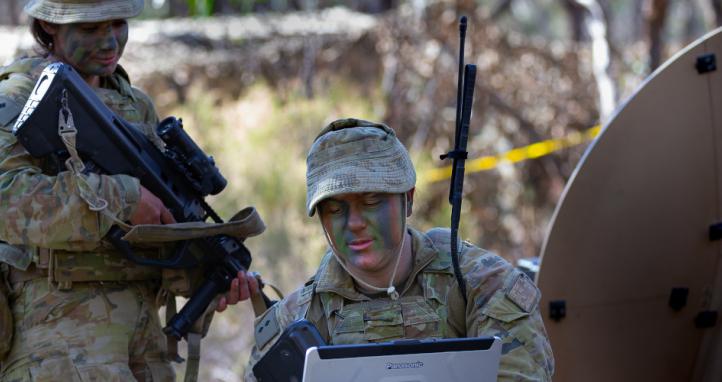
The training system had not yet adapted. Specialist signals detachments provided capability across a wide range of systems, including battle management systems, high-frequency data, satellite communications, very-high-frequency communications, and digital networks but this expertise was not distributed. Units became reliant on small, highly skilled teams that could not scale across the force. This created fragility, for if these teams were unavailable, capability fell sharply. If they were present, the capability was concentrated rather than dispersed. Neither condition supported a highly mobile, decentralised force.
Training did not yet match the system it was meant to sustain.
Organisations Adapt Unevenly
What emerged was not failure but misalignment.
The Army had:
- modernised its doctrine,
- invested in new technologies,
- and articulated a clear vision of networked warfare.
However, adaptation across the system was uneven. Equipment lagged. Training lagged. Structures lagged. At the tactical level, units adapted through improvisation, modification, and initiative. This is a strength. It is also a warning. When adaptation is driven from the bottom up, it often indicates that the system above has not yet solved the problem.
Capability Gaps Are Not Neutral
A capability gap is not simply the absence of something. It changes behaviour. Units adjust how they operate:
- slowing movement to maintain communication
- prioritising connectivity over manoeuvre
- relying on workarounds rather than designed solutions
- centralising expertise rather than distributing it.
These behaviours accumulate. Over time, they reshape how a force fights. The danger is not that the force cannot operate. The danger is that it adapts to operate within its limitations, rather than overcoming them.
Can Digitisation Be Achieved?
Yes, but not in isolation. Digitisation is not an equipment program. It is an organisational transformation. It requires alignment across:
- platforms
- communications architecture
- training systems
- doctrine
- and unit structures.
Without this alignment, digitisation risks creating dependency without resilience, visibility without clarity, and connectivity without tempo.
Closing Reflection
The ACR was not failing to digitise. It was being asked to digitise without the systems required to do so. That distinction matters. Modern warfare demands information, connectivity, and speed. These only create an advantage when equipment, training, and structure evolve together. When they do not, capability becomes fragmented rather than integrated. Technology does not create advantage in isolation, integration does.
When integration is absent, the cost is not absorbed by the system. It is absorbed by the people who operate within it. Even if this gap is closed, a second question remains: What does digitisation do to the way we actually command and fight once it is in place?
Still Interested?
For a related Cove article on digitisation, read The Integrated Digital Soldier System.
Cove+ also has short learning courses on related information and digital-age warfighting topics, including Introduction To Information Warfare.

Bruce
For what it’s worth, I’ve never had an issue with the ACR concept itself or the way it was fielded. The challenges you’ve written about over the years sit at a level well above anything I’m positioned to comment on publicly, especially given the current geopolitical environment.
My intent with the article was simply to explore the human side of readiness. The part that endures regardless of how structures evolve. I’m grateful you found value in it.