Article Summary
The traditional division of the battlefield into deep, close, and rear areas no longer reflects the reach and persistence of modern sensors and fires. The author reframes tactical space as zones of opportunity, risk, and contestation, then proposes reconnaissance, fires, assault, and support systems suited to that geometry. The article draws lessons from Ukraine and argues that force design, doctrine, and logistics must evolve together. It invites Army professionals to test the concept against Australian operating conditions.
Rethinking Tactical Battlespace Design
Introduction
The lessons of recent conflicts require rethinking the tactical battlefield geometry used by Western armed forces, because their doctrines may be too conservative for conflict against a peer adversary. From Nagorno-Karabakh to Ukraine, the traditional model, divided into deep, close, and rear areas, has shown its limits; in the Armenian case, it contributed directly to defeat on the ground.[i] New strike and detection systems demand a genuine revolution in how the battlefield is conceived, and should drive a coherent restructuring of Western forces around an integrated operational requirement rather than the latest available weapon system.
That inherited model is AirLand Battle, developed after Vietnam within U.S. Army Training and Doctrine Command (TRADOC) to offset the numerical superiority of Warsaw Pact forces, a need underlined by Israeli difficulties against Soviet-trained forces in the 1973 Yom Kippur War.[ii]
Building on the “31 Initiatives” begun that year,[iii] the Army and Air Force jointly built a doctrine that historian Harold Winton described as the shared capacity to defeat a Warsaw Pact invasion of Western Europe while remaining below the nuclear threshold – “the single most significant criterion of operational effectiveness for both services” between 1973 and 1990.[iv] Grounded in initiative, agility, depth and synchronisation, it organised the fight across three interdependent areas: deep operations, locating and containing the enemy at long range to curtail their combat power before it reaches the front; close operations, decisive short-range engagement where weapon effects overlap most intensely; and rear operations, protecting and sustaining the whole force and preserving its momentum.
Bounded by control measures to prevent “blue-on-blue” fratricide, this division applies at every echelon. Consolidated in the 1986 revision of FM 100-5, Operations[v], and indirectly validated in the 1990–91 Gulf War, AirLand Battle profoundly shaped NATO doctrine.
With the Cold War's end, this model lost centrality, giving way first to Full Spectrum Operations and (with Operation Iraqi Freedom) to the “Three-Block War” formula. As Western attention has shifted to China, doctrine has evolved further into Multi-Domain Operations (MDO),[vi] built around a cycle in which forces compete, penetrate, disintegrate, exploit, and return to competition. AirLand Battle's foundational idea of the “central battle” – defined by General Donn A. Starry as the point where “the elements of firepower and movement come together in manoeuvre to produce a decision”[vii] – no longer captures a fight reshaped by the cyber and space domains and by hybrid, non-linear conflict.
Within MDO, tactical “combat pulses” allow friendly “joint force packages” to penetrate an enemy A2/AD zone or weapon engagement zone (WEZ), engage multiple targets simultaneously to disarticulate integrated defences, and withdraw before the enemy can react – a rhythm also examined in the RAND literature on contested logistics,[viii] denoting the interval in which a unit can fight, move, or suppress enemy systems before exhausting fuel, ammunition, and battery power. Yet MDO offers no genuine tactical alternative to the old battlefield division, and its offensive orientation says little about how friendly forces should protect themselves from equivalent enemy action.
A parallel “deep battle” concept, born of the uncontrolled proliferation of long-range weapon systems, inverts the traditional paradigm by treating land combat as enabling rather than decisive, useful only once access to the battlefield is secured against enemy A2/AD threats. Some schools of thought push this further, proposing armies built predominantly around artillery, target-acquisition, and air defence in place of traditional armour-infantry-artillery triads – in effect a return to the Soviet “reconnaissance-strike complex” associated with Marshal Nikolai Ogarkov, Chief of the Soviet General Staff from 1977 to 1984.[ix] While it contains valid insights, this concept, like MDO, extends the traditional battlefield without introducing a new geometry to govern it, particularly in the close area.
The modern battlefield
Although conflicts are increasingly “positional at the operational level,” as argued by Dr Amos Fox of the Royal United Services Institute (RUSI),[x] at the tactical level manoeuvre remains essential to gaining a position of advantage over the adversary and seizing key terrain. As in the past, such key points will often be urban centres or centres of power.
Today’s battlefield presents three challenges to the traditional combined-arms system. The first is battlefield transparency, where modern sensors have made it very difficult to exploit surprise as a contributor to the shock action doctrine seeks. The second challenge, connected to and reinforced by the first, is the ability of modern supporting fires to strike almost any target on the battlefield with surgical precision and in extremely short timeframes, thanks to a rapid “killing chain” and “killing web.”[xi]
The high probability of success of both direct and indirect engagements has significantly increased the friction every combat force faces while manoeuvring, while protection systems are not evolving as quickly as adversary offensive capabilities. The last challenge, less widely recognised but equally significant, is that once manoeuvre begins, the combat element remains exposed to contact for the entire operation and across the whole “operational depth,” without real tactical pauses. This continuity of enemy friction reduces the possibility of receiving support and sustainment, limiting the ability to exploit the “momentum” of the action and to convert initial success into a subsequent exploitation phase.
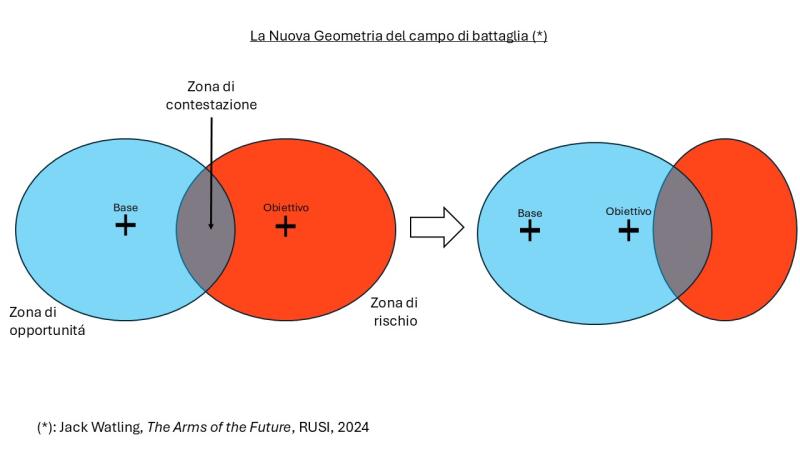
Defining a new battlefield geometry requires starting from basic principles: a base of departure, in theory afforded sufficient protection to mitigate the risk of attack, and an objective. Both, normally tied to physical positions, remain fixed until the base is subjected to enemy assault or the original objective is captured or secured. At that point, a new base of departure can be established – coincident or not with the last objective reached – and a new objective assigned.
Consequently, the zone comprising the base of departure and its immediate surroundings can be considered an area in which enemy sensors and effects are reduced, allowing friendly forces to concentrate. On the opposite side of the battlefield, an analogous zone protects the objective and is controlled by the enemy, who can likewise concentrate and manoeuvre. The intersection of these two areas identifies the zone of contestation between attacking and defending forces, where both are exposed to enemy effects. British military researcher and analyst Jack Watling defines these three areas, respectively, as the zone of opportunity, the zone of risk, and the zone of contestation.[xii]
The mission of forces operating on this new battlefield is to manoeuvre their joint system to bring the objective inside their own “zone of opportunity.” This is achieved by countering enemy ISR elements and reducing their detection capability, striking sources of indirect or medium-to-long-range fire, and disrupting communications and data exchange. This combined action aims to contract the zone of risk, forcing the dispersal of enemy forces and effects and rendering the objective vulnerable to the final assault.
The success of the assault does not by itself guarantee an operational victory; however, it is the rapid planning of the displacement of one's own sensors and joint force into the (former) zone of risk that allows a tactical success to become an operational result, avoiding becoming bogged down in a bloody war of attrition.
Distance is perhaps the most significant change. The contested zone of AirLand Battle, some 20-30 km deep with a frontage of roughly 6 km for a brigade-sized unit, gives way to a contested zone that can extend up to 500 km, within which loitering munitions can strike targets of every kind with extreme precision. A further new element is the conceptual absence of a defined front, along with the reciprocity and mutual support traditionally provided by adjacent units. The new battlefield no longer allows this margin of safety: exposure of one's own zone of opportunity must be assumed to be 360 degrees.
Both sides already apply this new battlefield geometry daily in the Ukrainian theatre. On one side, Kyiv's forces have structured their offensive operations in nearly every sector according to a seven-phase progression: reconnaissance, isolation, fixing, suppression, approach, destruction, and consolidation.[xiii] While it retains some similarities to traditional doctrine in ground actions, the rigidity of this process has become a necessary path to mitigate the threats of the modern battlefield, in particular drones and long-range precision systems.
On the other side, the Russians have created “Rubicon,” the Russian Centre for Advanced Unmanned Technologies, with the declared aim of accelerating the diffusion of new technologies in support of Moscow's ground forces.[xiv] In practice, the centre trains Russian army personnel to locate and strike Ukrainian drone crews, their communications, and their resupply chains, more than it directly supports the manoeuvre of Russian assault forces.
New versus traditional battlefield organisation
To the inexperienced eye, the new battlefield organisation may appear like the traditional one. Closer analysis, however, reveals significant differences:
- 360-degree vulnerability. As already noted, on today's battlefield it is no longer possible to rely on the support of adjacent units to protect the flanks and allow a manoeuvre unit to concentrate solely on its frontal sector. Modern weapon systems, drones in particular, can exploit infiltration and attack axes from any vulnerable sector.
- A new definition of the front line. On the traditional battlefield, the front coincided with the line of contact, where direct-fire weapon systems predominated, and skirmishing developed between opposing forces. Today the front is no longer a one-dimensional line but an area: the sector in which friendly forces win the reconnaissance and counter-reconnaissance battle, gaining the ability to see and strike the adversary while denying them the same capability.
- New force organisation. A new battlefield requires new actors. Facing it with forces organised along traditional lines significantly reduces the chances of prevailing and increases risk to both mission and force survival. Even a small military unit must now integrate and operate capabilities that, in the traditional organisation, were normally available only at the divisional level.
Tasks and effects required of new and future combat forces
Prevailing on the new battlefield requires a different organisation of military forces. Every tactical unit must adopt a combined-arms approach and be structured as a system of systems, articulated into reconnaissance/counter-reconnaissance, fires, assault, and support systems. Here too, beyond apparent terminological analogies, what belonged to a manoeuvre system in the traditional organisation does not necessarily coincide with the same system in the new configuration. In detail:
Reconnaissance and counter-reconnaissance system
In the past, reconnaissance or screening forces were the enabling element for manoeuvre forces. On the modern battlefield, these forces are the true manoeuvre element. As previously noted, the combination of sensors and dispersed elements positioned forward on the battlefield represents the main effort in advancing the zone of contestation and thereby widening the boundaries of the zone of opportunity. Elements operating within the reconnaissance and counter-reconnaissance system must be able to operate for long periods while minimising logistic support, fully exposed to potential enemy action but at the same time maintaining a clear picture of the battlefield (situational awareness) to avoid fratricide.
These forces must concentrate effects only for decisive engagements, then rapidly disperse to avoid being struck in turn. To perform this delicate and fundamental task, new reconnaissance forces must evolve: long infiltration marches to reach an observation point from which to gather information or direct an air strike are no longer the model – what is now required is mobility.
Every single element of this system must possess a high degree of mobility, to be in the right place at the right time and move rapidly; a tactical procedure valid for an uncrewed aerial system (UAS) is equally valid for a member of the reconnaissance force, who is no longer able to rely easily on concealment using the terrain but must be prepared to relocate entirely to another area – completely resetting the adversary's killing chain, and buying themselves time to reorganize for the next action.
Fires system
This system integrates command and control, kinetic and non-kinetic effects, and the link to target-acquisition elements, including the capacity to generate targets with organic means. Its purpose is to build the killing web already described and, in the shortest possible time, employ the most effective and economically sustainable fire source or effect against the adversary. These fire sources must in turn be distributed and protected within the zone of opportunity, to avoid becoming easily identifiable and strikable targets for enemy fire.
Assault system
This system comprises the forces tasked with conducting high-intensity action on the objective. These are the forces traditionally defined as manoeuvre forces, which today can operate effectively only once the battlefield has been sufficiently mitigated and the objective has entered the zone of opportunity, significantly reducing risk to both force and mission.
Within this system, armoured vehicles and capabilities retain full relevance, because of their resilience against residual enemy effects – particularly indirect fire – and their speed of movement across all terrain types. To succeed, however, the system requires two essential capabilities: air protection, including close-in air defence and counter-UAS, and mobility support, needed to overcome natural obstacles such as waterways or artificial obstacles such as minefields, barriers, and ditches prepared by the adversary.
Support system
The final system sustains the systems described above and protects the entire logistic chain. This chain extends from the handover of materiel and logistic supplies procured at the strategic level, through their entry into the zone of opportunity, to their storage and distribution to the other systems. This system also includes a broad range of further activities, from “home depot” logistics to regenerative logistics, through to the chain of recovery, treatment, and stabilisation of the wounded.[xv] It is therefore a foundational system, not only for sustaining the operation of the entire system of systems but also for its most critical dimension – the resilience and motivation of both military and civilian personnel – and for maintaining combat capacity in the persistently contested environment of the modern, extended battlefield.
This contestation across the whole support system represents a new challenge, if not a genuine revolution, for current logistic command elements, which must urgently revise their training systems and associated tactics, techniques, and procedures/standard operating procedures to prepare their personnel to “think tactically” – and plan accordingly – against a threat that was previously experienced, if at all, mainly by “adherent” logistics, and that today extends across the entire logistic chain.
Conclusions
The emergence of unprecedented informational transparency, the extension of long-range lethality, and the continuity of friction across the entire operational depth demand a conceptual revision that moves beyond the paradigms of AirLand Battle and the multi-domain doctrines that followed it. The lessons identified from recent conflicts show that tactical effectiveness increasingly depends on the ability to dynamically shape the zones of opportunity, risk, and contestation, and to field units structured as systems of systems, integrating their reconnaissance, fires, assault, and support components.
This reconfiguration is not a mere technical update but a substantial shift that requires Western armed forces to rethink their doctrine, procedures, and operational culture. Adopting this new geometry could help translate tactical success into operational advantage in an environment defined by persistent threat, the absence of a defined front, and omnidirectional vulnerability.
Still Interested?
Why not also read The Networked Battlefield (Part 3) – Fighting a Networked War Without Adapting to It
Explore Cove+ short learning courses on related professional military education topics.
End Notes
[i] Contextual assessments of Armenian force employment and defeat mechanisms in the 2020 Nagorno-Karabakh war are widely discussed in open-source military analysis of the conflict; see, e.g., analyses collected in International Institute for Strategic Studies and RUSI commentary on the war, cited in the Bibliography under “Nagorno-Karabakh.”
[ii] On the 1973 Yom Kippur War as a catalyst for U.S. doctrinal reassessment, see Wikipedia, “AirLand Battle”, and the Encyclopedia of Military Science entry “AirLand Battle Doctrine” (SAGE), both summarizing the TRADOC record; see Bibliography.
[iii] Richard G. Davis, The 31 Initiatives: A Study in Air Force–Army Cooperation (Washington, D.C.: Office of Air Force History, 1987).
[iv] Harold R. Winton, “Partnership and Tension: The Army and the Air Force Between Vietnam and Desert Shield,” Parameters 26, no. 1 (Spring 1996), pp. 100–119; quoted in David E. Johnson, Learning Large Lessons: The Evolving Roles of Ground Power and Air Power in the Post–Cold War Era (Santa Monica, CA: RAND Corporation, MG-405-1, 2007), p. 15.
[v] U.S. Department of the Army, FM 100-5, Operations (Washington, D.C.: 1986).
[vi] U.S. Army Training and Doctrine Command, TRADOC Pamphlet 525-3-1, The U.S. Army in Multi-Domain Operations 2028 (Fort Eustis, VA: 2018).
[vii] GEN Donn A. Starry's “central battle” formulation is discussed in “LSCO: Is It, Or Should It Be, AirLand Battle 2.0?”, United States Field Artillery Association, and in Donn A. Starry, Press On! The Selected Works of General Donn A. Starry, Vol. 1, ed. Lewis Sorley (Fort Leavenworth, KS: Combat Studies Institute Press, 2009). Author's note: the original manuscript's block quotation attributed to Starry on the origins of “central battle” language could not be independently verified against a primary Starry text and has been rendered here as a paraphrase of the secondary-source consensus rather than as a direct quotation.
[viii] See, generally, Joslyn Fleming et al., Naval Logistics in Contested Environments: Examination of Stockpiles and Industrial Base Issues (Santa Monica, CA: RAND Corporation, RR-A1921-1, 2024); and RAND Corporation, Advancing Combat Support to Sustain Agile Combat Employment (Santa Monica, CA: RAND, RRA1001-1). Author's note: the specific term “combat pulse” reflects the author's own synthesis of MDO “compete-penetrate-disintegrate-exploit-re-compete” language and the RAND contested-logistics literature on pulsed resupply; no single source uses the exact phrase, and it should be read as the author's term of art rather than a verbatim doctrinal citation.
[ix] On Marshal Nikolai Ogarkov and the reconnaissance-strike/reconnaissance-fire complex, see Andrew F. Krepinevich, The Military-Technical Revolution: A Preliminary Assessment (Washington, D.C.: Office of Net Assessment, 1992; republished CSBA, 2002); and “The Russian Way of War in Ukraine: A Military Approach Nine Decades in the Making,” Modern War Institute at West Point, 27 June 2023.
[x] Amos C. Fox, “A Theory of Attrition,” The RUSI Journal 170, nos. 6–7 (2025), pp. 34–47; and Amos C. Fox, “Manoeuvre Is Dead? Understanding the Conditions and Components of Warfighting,” The RUSI Journal 166, no. 4 (2022). Author's note: Dr Fox is a Professor of Practice at Arizona State University's Future Security Initiative and a retired U.S. Army lieutenant colonel; he is a frequent contributor to the RUSI Journal rather than a RUSI staff researcher, and the affiliation in the original manuscript has been corrected accordingly.
[xi] The “killing chain” (F2T2EA: find, fix, track, target, engage, assess) and “killing web” formulation follows the author's original footnote in the source manuscript; for the doctrinal background see U.S. Joint Chiefs of Staff joint targeting publications and general treatments of the F2T2EA construct in professional military literature.
[xii] Jack Watling, The Arms of the Future: Technology and Close Combat in the Twenty-First Century, New Perspectives on Defence and Security, Vol. 1 (London: Bloomsbury Academic/RUSI, 2023), Part Two, Chapter 6, “The Geometry of the Future Battlefield.”
[xiii] On Ukrainian offensive methodology, see Jack Watling and Nick Reynolds, “Emergent Approaches to Combined Arms Manoeuvre in Ukraine,” RUSI Insights Paper (2024–2025); and Jack Watling and Nick Reynolds, “Tactical Developments During the Third Year of the Russo-Ukrainian War,” RUSI Special Report (February 2025).
[xiv] On “Rubicon,” the Russian Center for Advanced Unmanned Technologies, see open-source reporting collated in Institute for the Study of War, Russian Offensive Campaign Assessments (2024–2025 editions), and associated Western press coverage; see Bibliography.
[xv] The “home depot” logistics term follows the author's original footnote in the source manuscript, denoting the use of locally available fuel, materiel or food distribution infrastructure (named for the U.S. home-improvement retail chain) rather than a formal doctrinal category.