1
The movie Pulp Fiction uses a non-linear narrative to tell its story. The film opens and closes with a restaurant scene that, chronologically, occurs in the middle of the story. If one were to watch Pulp Fiction in chronological order, the movie would start with Captain Koons giving Butch his father’s watch and would end with Butch and Fabienne riding off on Zed’s chopper to catch a train.
Bad War Stories uses the same non-linear narrative structure, darting between the author’s four deployments, two each to Iraq and Afghanistan, and a few other postings ‘Stateside’. If someone wanted to read it chronologically, they would need to read the chapters in the following order: Introduction – 4 – 6 – 2 – 8 – 5 – 9 – 7 – 1 – 3 – Conclusion.
2
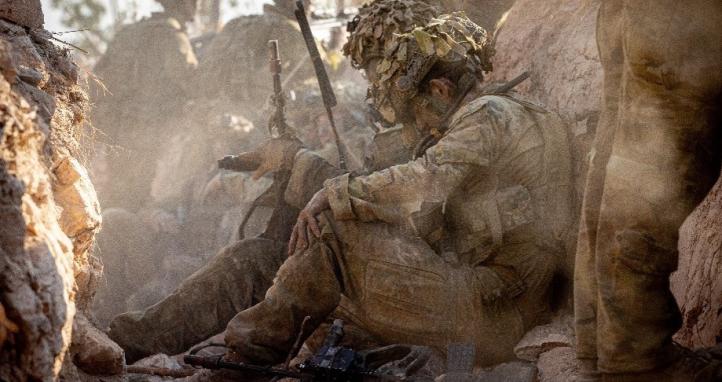
‘Finally, some combat!’ Aaron thought as he read the eighth chapter. This was certainly not the first instance of combat described in Ben’s book, but it was the most intense, at least for the reader. Aaron wondered if Ben, who had lived through this and the other events of the book, would agree with his assessment. The chapter described an airmobile then foot insertion to a cordon and search task. It was the chapter that was the most similar to the content of most other military autobiographies Aaron had read. Yet it was still slightly different. Ben had imagined the insurgents’ motives and unseen actions, as well as the motives of other personnel within the friendly forces, and he had described their perspectives in the same way that he had described his own. The result was a semi-fictionalised account that added additional perspectives that most autobiographies do not contain. Although this approach was taken throughout, most chapters discussed day-to-day events. It was this chapter, with its focus on a tactical mission, that made the contrast between Ben’s book and most other autobiographies stand out most clearly.
3
Several hours later, Aaron looked up from his laptop and glanced about the cabin. He tended to read books on flights, enjoying the peace and quiet that came with the lack of connectivity. Today, he was on a long flight. Perth to Paris. It was 0720 at the point of departure, and 1220 the previous day at the point of arrival. On the plane, it was nighttime, whether real or simulated he couldn’t tell. Most other passengers were asleep, as he had been until half an hour ago. He slept fairly well on aircraft, but waking after six solid hours he had struggled to go back to sleep and so had gone back to reading Ben’s new book, Bad War Stories.
His and Ben’s friendship went back about a decade, the two having met during the height of the ‘military design movement’ of the 2010s. For a while their research had run in close parallel. They had co-authored papers, and both had written Routledge books on the history and development of military design thinking. Ben’s book, published first, had a green cover, and Aaron’s a blue cover, but otherwise they were almost identical in appearance, so they looked good on a shelf together. In the mid-2020s, however, their research had diverged. Keen to see what Ben was now up to, Aaron accepted his friend’s offer: a copy of Ben’s new book in exchange for writing a review of it.
Before he started reading Ben’s new book, all Aaron knew was that it was autobiographical. Or semi-autobiographical. Aaron wasn’t surprised. His generation’s big wars – ‘big’ at least in the sense that they had defined the formative experiences of an entire generation of military personnel who were in or had supported them – had come to an end. Concerningly for Aaron, he and Ben were fast approaching the age where they risked becoming the war college ‘grey beards’ they had clashed with a decade ago due to the latter’s inflexible insistence that the best solutions to any problem had been developed during the Cold War. Now, the world had moved on from Aaron’s and Ben’s own wars, leaving their veterans to figure out how to come to terms with their individual experiences in light of their newly acquired hindsight. Some of Aaron’s friends had done this by writing memoirs. This wasn’t the first time he had been asked to review one, and it probably wouldn’t be the last. He enjoyed reading them. It was like getting to know old friends in new ways.
Aaron paused. A flight attendant had just brought him a snack as he typed. A pulled pork and cheese toasty. His priorities changed, and he prepared to put his laptop away for the time being. He noticed that the flight route map displayed on the in-flight entertainment screen embedded in the rear of the headrest of the seat in front of his showed the aircraft’s position as being somewhere over Afghanistan. Aaron smiled. He had been reading about Ben’s shenanigans in Afghanistan a few minutes ago, before having an ‘ah-ha’ moment regarding the review’s opening paragraphs and reaching for his laptop. He hoped that this opening would mildly frustrate Ben by re-linearising Ben’s proudly non-linear narrative, stirring the stirrer by telling potential readers how to read Ben’s book in a linear sequence. Now it dawned on him that trying to force something unique into a common mould seemed serendipitously appropriate as the aircraft soared over Afghanistan at a high enough altitude that no-one on board could actually see any ground-level details. The analogy for the book’s themes seemed almost perfect.
4
Two weeks earlier, when Aaron started reading Ben’s book on a different flight, what he had found was something unique. This book was a blend of autobiography and fiction. It was told in the third person, enabling Ben to give equal weight to the imagined perspectives of those around him as he did to his own account. The empathy captured within these perspectives was noticeably absent from most other autobiographies Aaron had read. And its content was atypical, too. This book only discussed war stories that seemed typical of the random yet mundane nature of everyday life in a warzone. It was like Ben was trying to balance the bravado and sometimes larger-than-life excitement of other autobiographies by reminding readers that everyday life also goes on within war zones. Waking to strange dreams in unfamiliar quarters, stopping at a café on a different base because the coffee is better than on your own base, witnessing soldiers have panic attacks, setting up briefing rooms for planning workshops by pinning maps to walls, the constant threat of randomly-targeted incoming fire, local allies with their own agendas, and bureaucratic inertia and bizarreness. This book was a series of anecdotes, sometimes amusing, sometimes concerning, sometimes banal.
Reading it constantly reminded Aaron of his own experiences. In particular, one parallel experience discussed in the early chapters stood out above the others. As a major, Ben was the senior officer on a forward operating base (FOB) in Afghanistan in 2015, which the coalition was preparing to hand over to Afghan forces. As a lieutenant, Aaron had been the senior officer on a FOB in Timor Leste in 2012, which was being closed as the stabilisation force’s mission there drew down.
When his flight landed, Aaron messaged Ben. Reading your book today. The closing the Afghan base chapter. I had an amazingly similar experience closing an Aussie base in Timor. Not the exact details, but the bizarreness. Uncanny how similar, actually.
Ben’s reply came. The fact that the military bureaucracy can reach so far into remote spaces of the world where we do these insane rituals just blows my mind.
Cue some bitching about military bureaucracy. Then, Aaron had an idea. Aaron is going to write his review of your book in the third person. The book is radically different in style to any other autobiographical or semi-autobiographical book he’s read, and he feels that an unorthodox approach to the book review will do the book more justice than a standard review format would.
More replies. Ben agrees with Aaron. … This can be Aaron and Ben’s thing for 2026. Third person convos.
So, this was how Aaron came to be writing a book review in the third person for the first time. And using a non-linear narrative structure, too. He hoped that the review would be engaging despite its unique approach. If it was, then it might just capture the spirit and uniqueness of Ben’s book.
5
Reflecting on the book after he had finished reading it, Aaron concluded that he disagreed with Ben’s self-assessment that the book contained bad war stories. Ben’s motive in selecting the book’s content was to buck the usual trend in military autobiographies, and he had succeeded at that. But regarding what constituted bad war stories, he had failed to deliver. In Ben’s own words (pp. viii-ix):
The most common war tropes are so prolific they almost become unquestioned, accepted by the uninitiated as ‘what it must be like to face danger in battle’. This project pivots to wage war against these ideas; the clichés and mainstream narratives must defend themselves instead of dominating the public sphere unopposed. … Readers be warned. [Bad war stories] do not offer the excitement and adventure that many might assume such a book on combat deployments ought to contain. Each chapter centres on a theme where our own military institutions (which are extensions of our societies) are riddled with bureaucratic ineptitude and other tragic designs. [Emphasis in original]
Ben had indeed packed the book with tales of bizarreness, bureaucracy, ineptitude, chaos, randomness, irony, occasional tragedy, and more than a hint of flippancy in the telling. Where Aaron disagreed with Ben’s self-assessment that his stories were bad was that Aaron had not, as Ben promised, found them unexciting or unadventurous. Indeed, the opposite had been true. For instance, Aaron had found the sixth chapter to be the most interesting and entertaining, despite – or perhaps because of – this chapter being about Ben’s posting to the US Army’s Joint Readiness Training Centre as commander of a company of role players simulating terrorists to help train American forces for deployment to Iraq or Afghanistan. This chapter had made Aaron reflect on his own service. In 24 years, he had deployed five times, totalling 19 months. The rest of his service had featured scores of exercises, training courses, and administrative duties. These experiences were the bulk of military life yet seldom appeared in autobiographies except in passing. It was refreshing to see such an experience discussed in Ben’s book.
Aaron had made up his mind. He was going to recommend Ben’s book to the people reading his review. The book was unique, but nevertheless entertaining. Aaron hoped his unconventional review would do it justice.