Article Summary
This article examines the Battle of Shusha, the decisive engagement of the 2020 Nagorno-Karabakh war, to challenge the popular reading of that conflict as proof that drones have displaced traditional combat power. It reconstructs the Azerbaijani campaign – disabling Armenian command and air defence, fixing defenders along the main approaches, then infiltrating company-sized special-forces elements up cliffs the defenders had judged impassable – and shows that the city ultimately fell to close infantry fighting, not to standoff strike. Drawing on the moment when fog grounded the drones and the battle reverted to an infantry duel, it argues that uncrewed systems were decisive as enablers but not as substitutes for the infantry–anti-armour–drone triad that actually took the city. The piece concludes that cities remain decisive terrain, that any defence premised on “impassable” ground creates an exploitable weakness, and that mastering the integration of infantry, anti-armour, and drones across every echelon is the central challenge for modern land forces – including the ADF.
The Second Nagorno-Karabakh War of 2020 is arguably the first conflict shaped and decided almost entirely by robotic systems "teaming" with ground forces – the opening chapter of the latest Revolution in Military Affairs (RMA), whose consequences are visible daily in Ukraine. The Battle of Shusha, the decisive action of that war, is a textbook case of a meticulously planned operation in which the integration of infantry and drones showed its full operational potential.
Operation Iron Fist
Fought from 27 September to 10 November 2020 between Azerbaijan and Armenia, the war showed how new weapons and reconnaissance systems have transformed the contemporary battlefield – an RMA fully embraced by Azerbaijani forces, backed by Turkey and Israel, who delivered a harsh 44-day lesson to the tenacious Armenian army, victor of the first war (1988–1994).1 Baku's intensive use of unmanned aerial systems (UAS) and, for the first time, loitering munitions (LM) rapidly dismantled Armenian air defences and command nodes, pinning down opposing forces with precise strikes.2 This heavily publicised initial "slaughter" opened the way for Azerbaijan's rapid reconquest of the territory lost in 1994.
The animosity between Armenians and Azerbaijanis dates to 1921, when Stalin assigned the majority-Armenian Nagorno-Karabakh (NK) region to Soviet Azerbaijan rather than Soviet Armenia. Over a century of mutual resentment culminated in the first war, which ended in 1994 with the region under Armenian control as the self-declared Republic of Artsakh – an outcome Baku never accepted.
On 27 September 2020, after careful preparation, Azerbaijan launched what would later be branded Operation "Iron Fist," a large-scale offensive against Armenian and Artsakh forces in NK.3 Over 44 days, Azerbaijani forces recaptured most of the lost territory, culminating in the battle for Shusha – the symbolic gateway to Stepanakert. The campaign unfolded in three sequential, overlapping phases.
- Phase 1 – Disabling Armenian C2. In the war's opening days, Azerbaijan concentrated on neutralising Armenia's command, control, and air-defence architecture. Swarms of Turkish Bayraktar TB2 drones and Israeli loitering munitions (HAROP, Orbiter) systematically located and destroyed short- and medium-range air-defence systems (OSA-AKM, KRUG, S-300), radars, and command nodes. The aim was not simply to strike individual targets but to dismantle the decision-making chain through which Armenia might organise a coordinated response. As air defence degraded, Azerbaijan secured air superiority that enabled every subsequent phase.
- Phase 2 – Fixing Armenian forces and shaping the battlefield. With freedom of action in the skies, Azerbaijani forces struck logistics, artillery, ammunition depots, and armoured reserves in depth, located by UAS and hit hard by loitering munitions or long-range artillery. This relentless kinetic and informational pressure served a dual purpose: attriting Armenian units materially while psychologically "fixing" them, forcing dispersal, inaction, or risky repositioning that exposed them to further strikes. Attrition from above, combined with erosion of the Armenian defensive system along the whole front, set the conditions for a breakthrough Armenian command could not counter coherently.
- Phase 3 – The Azerbaijani ground manoeuvre and seizure of key terrain. Only then did Azerbaijani ground forces – mountain infantry brigades and special units – begin their main advance. In the flatter southern sector they achieved rapid penetration, taking Jabrayil, Fuzuli, Hadrut, and progressively the strip along the Iranian border to Zangilan and Qubadli. The more defensible central highlands were bypassed through light-infantry infiltration on difficult routes, sustained by reconnaissance and air support built up earlier. This phase culminated in the battle for Shusha, 4-8 November 2020 – the road junction and symbolic gateway to Stepanakert – whose fall made the Armenian position untenable and led, days later, to the ceasefire that took effect on 10 November 2020.4
At the war's end, both nations accepted deployment of Russian peacekeepers to enforce the ceasefire and protect the remaining Armenian minority in Nagorno-Karabakh.
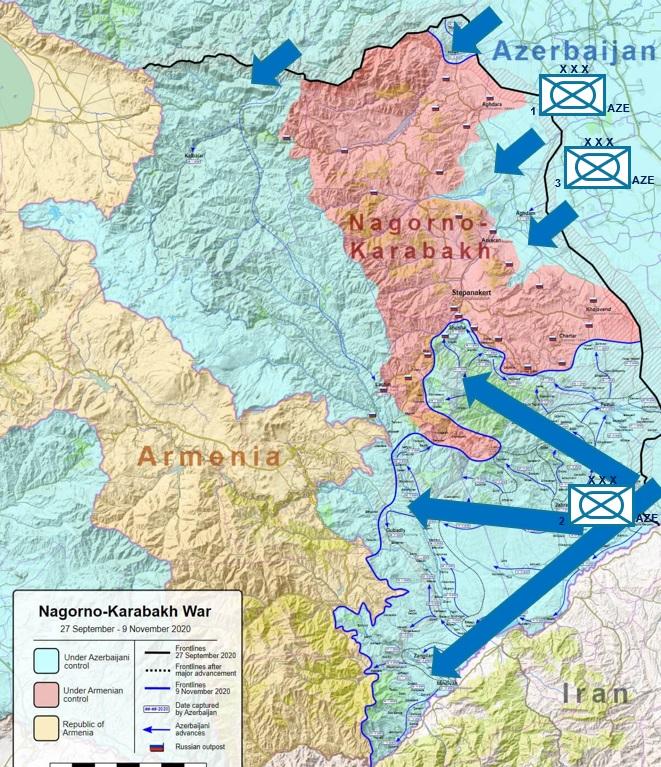
Op. IRON FIST scheme of manoeuvre
What Made the Conflict "Revolutionary"
The 2020 war is often called a doctrinal turning point for how new technological factors combined to produce significant tactical effects.
The most famous element is the large-scale use of the drone-loitering munition pairing as a decisive weapon system. This was not the first conflict to feature drones – they had already seen intensive use in Libya, Syria, and Yemen – but it was the first in which swarms of reconnaissance and strike UAS systematically destroyed the air-defence apparatus, artillery, and armour of a relatively modern army, showing that inexpensive new systems could neutralise costly platforms such as SAM batteries and tanks, inverting the cost-effectiveness ratio that had guided conventional planning for decades.
A second, more structural point follows from this asymmetry: near-total transparency of the modern battlefield. Persistent aerial reconnaissance combined with near real-time strike capability produced a drastically shortened "sensor-to-shooter loop." Concealment and dispersion were no longer sufficient – the battlefield was under almost continuous observation, making traditional manoeuvre riskier for forces lacking adequate countermeasures. Systems such as OSA, TOR, and KRUG, designed mainly against aircraft and helicopters, proved highly vulnerable to swarms of small, slow, low-flying targets, often used as bait to force radars to activate before being struck.
The third, most disruptive element for the armour community was the challenge to the vehicle survivability. For weeks, Azerbaijani media broadcast footage of destroyed Armenian tank columns, fuelling – with some exaggeration – a "death of the tank" narrative later tempered by Ukraine, where armour has continued to play a significant role paired with electronic countermeasures and active protection.5
In sum, the war previewed, on a smaller scale, dynamics – drone warfare, battlefield transparency, low-cost saturation – that later became structural features of modern conflict. Yet drones alone do not win battles: indirect fire, and infantry above all, remained central, as Shusha demonstrates.
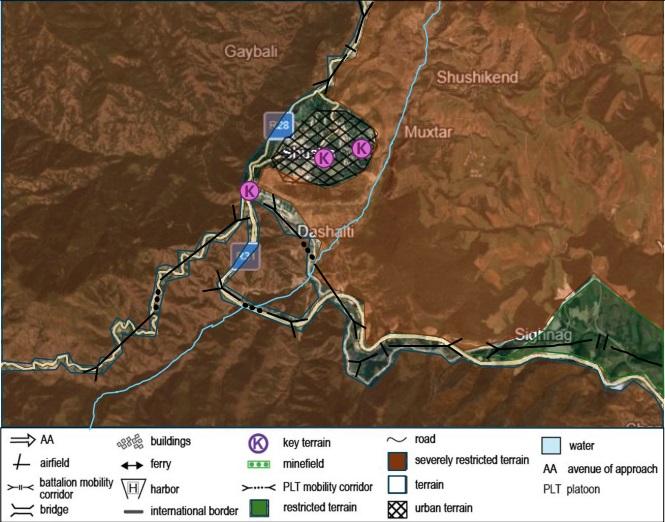
Shusha area MCOO
Intelligence Preparation of the Battlefield: Shusha
At first glance, Shusha does not look like a town capable of deciding a war – a small city with a prewar population just over four thousand, perched on a limestone plateau above the Karabakh valley.6 But its geography makes it key to controlling the entire region. Sheer cliffs fall away on three sides; a single main road runs along its western edge; and from its heights the town commands both the road to Stepanakert, fifteen kilometres north, and the Lachin Corridor, Armenia's only land link to the enclave. As then-President of Artsakh Arayik Harutyunyan put it, invoking a well-worn saying, "whoever controls Shusha controls Karabakh" – a claim borne out by terrain analysis using the OCOKA method.
Observation and fields of fire: the town's elevated position offers observation of the whole valley, its southern and western approaches, and the rear areas to the north – ideal for detecting attacks in force and directing barrage or interdiction fire without dedicated ISTAR assets.
Cover and concealment: the town sits on the steep northern face of the escarpment overlooking the valley, giving natural protection against direct attack from the south.
Obstacles: the valley around Shusha is a dense system of natural obstacles – steep drops, ravines, hazardous watercourses, thick forest – a nightmare for any wheeled or mechanised force.
Key terrain: the town itself is the gateway to the upper valley, and its old fortress dominates it in turn. To the southwest, the junction of the old M-12 highway (now R-28) with the R-31 road forms the only practicable approach.
Avenues of approach: the terrain narrows the viable axes of advance to essentially one – the Lachin Corridor. Aware of this, Armenian forces demolished the M-12 bridges and concentrated defence on that single, obvious southwestern axis.
Order of Battle
No official figures exist for the units involved; both sides ran information campaigns that inflated or deflated numbers, and Armenia still disputes many details. The figures below reflect the most credible range from open sources and should be treated as indicative.
Defenders. The town's defence was organised under Argishti Kyaramyan, a commander from Artsakh's National Security Service, supported by Armenian Armed Forces elements. The garrison and immediate reinforcements numbered roughly 2,000, with additional forces (an estimated 6,000) distributed across the wider Shusha district. Armament was almost entirely Soviet/Russian in origin – T-72 tanks and BMP-2 infantry fighting vehicles used mainly for counterattacks and repositioning between sectors, towed and self-propelled artillery, small arms, and man-portable anti-tank weapons for close defence. Kyaramyan's mission was clear: hold Shusha – the last line of defence before Stepanakert – to deny Azerbaijan the heights and the Lachin Corridor, buying time for a ceasefire or outside intervention.
Attackers. Given its strategic weight, the operation was placed under the Azerbaijani Army's General Staff theatre command. The manoeuvre element was a battalion (-) of special operations personnel (an estimated 400), organised into company-sized groups of roughly 100 advancing along different axes. Fire support came from artillery and multiple-launch rocket systems (including the Belarusian POLONEZ) repositioned near the town, Turkish Bayraktar TB2 drones, and Israeli HAROP loitering munitions (largely grounded 6–7 November by heavy fog).7 A conventional rapid-reaction force of roughly 2,000 – motorised infantry, armour, and combat engineers – stood ready to exploit the town's capture. Azerbaijan's likely mission: infiltrate, seize, and clear Shusha to restore sovereignty over the region and trigger Stepanakert's fall.
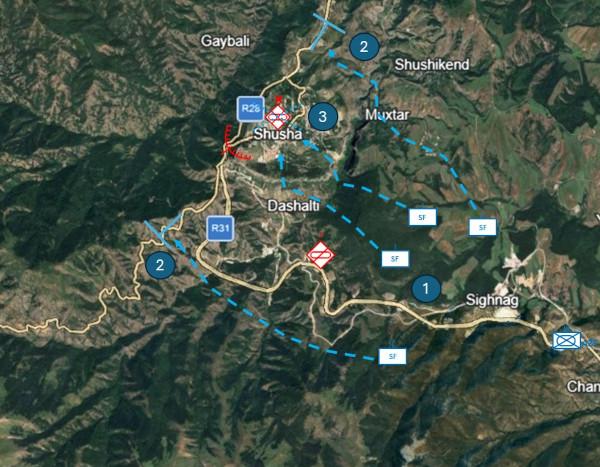
Shusha Battle’s Azerbaijani scheme of manoeuvre
The Azerbaijani Concept of Operations
Riding the momentum of its advance through Nagorno-Karabakh, Azerbaijan initially sought a fast, direct approach to Shusha. A force of tanks, mechanised infantry, and SandCat vehicles pushed along the main roads but was decisively repulsed. Well-prepared ambushes, backed by anti-tank weapons and artillery, inflicted heavy losses on Azerbaijan's 2nd Army Corps – in equipment, in lives, and in the information domain: footage widely shared online showed the wrecks of a dozen BMP-2s and several SandCats, along with dozens of Azerbaijani dead.
As the IPB above suggests, Armenian defenders concentrated their sectors and ambushes on the main south-western and northern approaches, leaving the forest-screened southern sectors comparatively thin. Azerbaijan's revised plan exploited that gap: the steep southern and eastern escarpments – rising over 300 meters and considered impassable by Armenian defenders – were judged passable for specialised light infantry moving unencumbered.
Between 25 and 28 October, Azerbaijani special operations elements slipped away from friendly lines and began a dismounted infiltration through the forests and passes south of the town, deliberately avoiding the heavily patrolled Lachin Corridor, main roads, and villages. Moving mainly at night in company-sized elements of roughly 100 men, they converged on the town from multiple directions rather than along one predictable axis. The operation unfolded in three phases before handing off to conventional follow-on forces.
- Phase 1 – Infiltration, deception, and isolation (25 October–4 November). Special operations companies infiltrated the southern and eastern sectors, scaled the town's southern escarpment undetected, and reconnoitred the approaches. Two of the four companies then severed access routes: one cut the road linking Shusha to the Lachin Corridor; the other swung around the eastern flank to do the same to the north. Supporting forces meanwhile advanced on Dashalti, just south of Shusha, reinforcing the Armenian assumption of an attack along the main routes. By 4 November, Azerbaijani special forces controlled the southern sector along with key stretches of the Lachin Corridor.
- Phase 2 – Encirclement (4–6 November). On the night of 5 November, security elements of the assault force reached the main road north of the town and established a blocking position, cutting off reinforcement from Stepanakert. Combined with destruction of a bridge over the Hakari River, Shusha was isolated on at least three sides with no prospect of relief. Continuous observation, paired with sustained loitering-munition and artillery fire, kept up the pressure, eroding Armenian effectiveness and morale. Local authorities, recognising the encirclement, warned civilians away from the town centre, and, per unconfirmed reports, the officer responsible for its defence abandoned it on the morning of 6 November – a sign the defence was collapsing before the final assault even began.
- Phase 3 – Penetration and clearance (6–8 November). Azerbaijani special forces, already inside the perimeter, began intense building-by-building fighting, relying on loitering munitions, grenades, and man-portable anti-tank weapons to destroy Armenian armour at close range in the streets. Fog on 7 November temporarily grounded Azerbaijani drones, emboldening an Armenian counterattack with the few remaining T-72s and BMP-2s. Azerbaijani troops held, repelled three counterattacks, then resumed the offensive, seizing Shusha's executive government building and clearing the old town block by block. Fighting continued through the night of 7–8 November. On 8 November, Azerbaijan declared the town captured; Armenia initially disputed the claim, but on 9 November Prime Minister Nikol Pashinyan signed a trilateral ceasefire statement with the presidents of Azerbaijan and Russia, ceding all Azerbaijani-held territory, including Shusha, effective the following day and ending both the battle and the war.
Lessons Learned: The Infantry–AT–Drone Triad
Although Nagorno-Karabakh is rightly cited as the case-study of Azerbaijani drone-enabled strike, Shusha tells a more nuanced story that specialists on the conflict's drone war themselves caution against overstating. The decisive action was not a drone strike but a five-day infantry march across terrain the defenders considered impassable. Massed fires and drones shaped the battlefield, covered the manoeuvre, and enabled isolation of the town, but Shusha was taken – and then held – by dismounted troops fighting street to street. Armour proved acutely vulnerable to a new, lethal, multi-weapon triad: infantry equipped with anti-tank systems and supported by reconnaissance and strike drones.
Notably, despite the new technologies, Shusha followed a traditional narrative: cities remain decisive terrain, urban combat still comes down to combined-arms action and close infantry fighting, and any defence premised on "impassable" terrain creates an opportunity trained troops can exploit.
Today's battlefield presents three challenges to the traditional combined-arms system: transparency, the ability of supporting fires to strike any target with precision and speed, and continuous exposure to contact across operational depth. Azerbaijani leadership understood this well: given heavy investment in ISTAR and strike drones, ground troops had trained to employ them optimally, operating as the "human on the loop" to keep manoeuvre synced with drone-delivered pressure.
Despite a determined Armenian defence on multiple fronts, it never had a real chance of blunting Azerbaijan's air superiority. Azerbaijani forces exploited that advantage to invert the traditional principle of "using manoeuvre to engage" into "using engagement to enable manoeuvre." Yet neither manoeuvre nor fire support alone guaranteed operational victory. Rapid repositioning of sensors and forces toward the next "risk area" converted tactical wins into operational success, keeping Azerbaijan from a costly war of attrition.
Conclusions
In some respects, the Second Nagorno-Karabakh War – and Shusha specifically – invites comparison with the 1973 Yom Kippur War, which gave rise to the AirLand Battle doctrine. The 2020 conflict between the two post-Soviet states set off alarm bells within Western armed forces, warnings that became full-blown with Ukraine. Setting aside the debate over tank survivability, the West is racing to field air-defence and counter-UAS systems, lest it find itself in the Armenian army's position. Every tactical unit today needs intensive training in employing supporting drones – a relationship essential at every echelon, from the special operations team up to the division. Shusha continues to push Western militaries to rethink procedures and operational culture around drone employment, without losing sight of the enduring centrality of the human operator and their judgment.