
Article Summary
Repeated low-level blast overpressure exposure in training is recognised as a workplace hazard, with Defence implementing new measures to better understand, monitor and manage the risk. The release of Army Standing Instruction (Force Preservation) 015 – Blast Overpressure is a key step in formally recognising low-level blast exposure as an occupational hazard. The ASI sets the conditions for how blast exposure is to be managed, requiring commanders to actively consider the issue in the planning and conduct of training, ensuring risk is reduced so far as reasonably practicable while maintaining combat effectiveness.
Army training has always pursued a simple principle: train as you fight. Live fire, combined arms manoeuvre, and exposure to realistic battlefield conditions are central to preparing soldiers for combat. Yet as the character of warfare evolves, and as our understanding of human performance deepens, so too must the way we understand and manage risk within the Land Domain Training System.
One such risk, once largely unseen, is now firmly in focus: exposure to repeated low-level blast overpressure (RLL BOP). What has emerged over the past several years is not a sudden discovery, but a gradual recognition that the cumulative effects of routine training exposures may matter just as much as a rare, high overpressure event that results in immediate symptoms, for example the concussive effects from exposure to an Improvised Explosive Device detonation on operations. Army continues to take action to reduce this risk. This is not about reducing realism or limiting capability, it is about ensuring that the force we generate today remains healthy, effective, and ready for the long term.
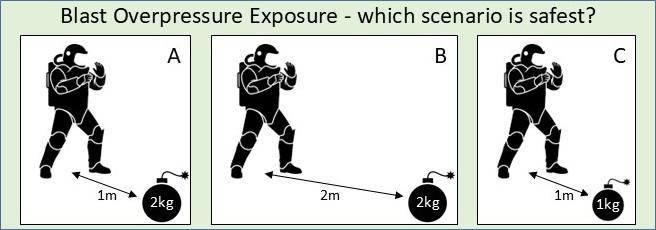
Figure 1. The graphic depicts the importance of standoff. Blast Overpressure decays exponentially with distance. Scaled Distance (SDx) = Standoff Distance / Net Explosive Quantity1/3
SDA = 0.79m, SDB = 1.59m, SDC = 1m; therefore scenario B is safest
Blast overpressure is inherent in land combat training. Every weapon system from small arms, to mortars, to shoulder-fired weapons generates a pressure wave, transferring energy through the air and into the surrounding environment, including personnel nearby. Historically, Army’s focus has been on the immediate effects of high-level blast, where injury is obvious and immediate. In that context, risk is well understood and controls are well established. What was less visible, and therefore less understood, was the cumulative effect of repeated, lower-level exposures over time. Over the past decade, several factors have brought this issue into sharper focus.
Operational experience and training design have increasingly emphasised repetition, realism, and intensity. Live-fire exercises, breaching serials, and instructional roles expose personnel to multiple blast events in relatively short periods. These exposures are often individually benign, but collectively may contribute to subtle effects that are not immediately apparent. At the same time, international research emerging from the United States and NATO partners has highlighted possible associations between RLL BOP exposure and changes in cognitive performance, reaction time, and neurological health. This remains an evolving area of science, but there is sufficient anecdotal evidence - as was presented to the Royal Commission into Defence and Veteran Suicide - to prompt Defence to take a precautionary approach.
Within Army, the challenge was compounded by a lack of visibility. Exposure was rarely recorded in a systematic way, making it difficult to understand cumulative risk across individuals, units, or careers. The hazard existed, but it was not measurable in a way that supported decision-making. Overlaying this was a cultural factor. Army has always valued realism and resilience. Blast exposure, particularly at lower levels, was often accepted as an inherent part of training. In some cases it has been deliberate, such as the conduct of inoculation training or through the integration of Battlefield Noise Simulation in complex training environments. It was something experienced, but not necessarily interrogated.
The Royal Commission into Defence and Veteran Suicide has provided a defining moment. Recommendation 61 directed Defence to establish a more comprehensive understanding of brain health risks, including exposure to blast overpressure, and to respond in a coordinated and evidence-based manner. This marked a shift from implicit acceptance of risk to explicit recognition of blast overpressure as a workplace hazard requiring structured management. Army’s response on behalf of Defence has been deliberate and layered, combining policy, training reform, scientific research, and communication in a single, integrated effort. Commencing with Frago One to the Army Order of 2025-26, Director General Landworthiness, with support from Deputy Army G7 and Director Army Health, were tasked to address this aspect of Recommendation 61 on behalf of the Chief of Army.
A key factor in Defence’s response is the formalisation of blast overpressure within policy. Released on 30 June 2026, Army Standing Instruction (Force Preservation) 015 – Blast Overpressure establishes LL BOP as an occupational hazard and sets the expectation that it will be managed in accordance with Work Health and Safety principles, in balance with the Preparedness and Lethality of the Joint Force. This includes defining the hazard, adopting a 4 psi threshold of concern aligned with US Department of War and partner nation practices, and reinforcing the obligation to reduce risk so far as is reasonably practicable.
Importantly, however, policy alone does not change behaviour. The real impact comes from how these principles are integrated into the training system. Perhaps the most significant shift is the introduction of quantifiable exposure controls. Where once risk was broadly understood, it is now increasingly measurable. Across the land domain, training design is being adjusted to incorporate a more structured approach to exposure management. This is grounded in the familiar hierarchy of controls, but applied in new ways. The next phase of reform will see a comprehensive review and update of Land Publications, including the ADF Land Range Orders and relevant Weapon Handbooks. Over the next 12 months, while temporary controls are in place, known systems of concern will be prioritised to ensure that exposure controls, such as safety distances, rounds per day limits, mandatory recovery periods, and best practice considerations are formally codified in the publications that instructors and range staff rely on. Training sequences are being refined to reduce cumulative exposure. Positioning and distancing are being deliberately considered. Safety staff, often exposed repeatedly across serials, are now explicitly factored into planning. At the practical level, this will lead to changes that instructors and soldiers can see in their day-to-day activities.
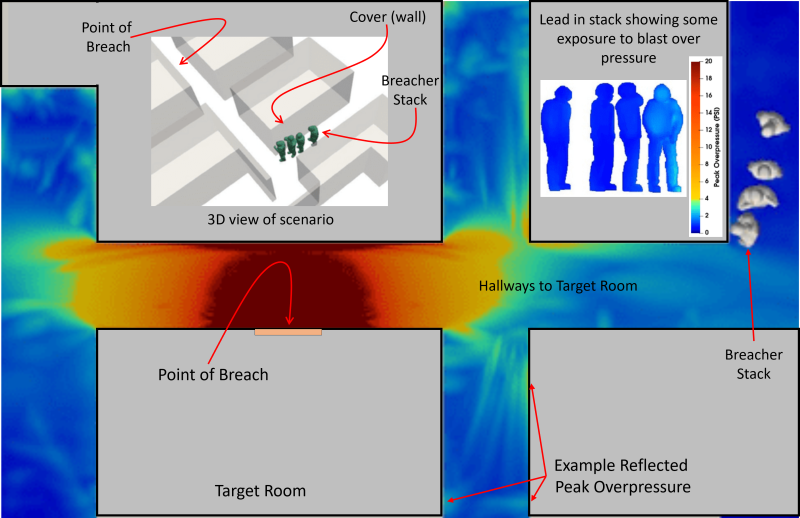
Figure 2. This graphic depicts the plan view of internal door breach and the peak overpressure associated with the charge being initiated. It also demonstrates reflected overpressure, plus the value of standoff and seeking cover.
Alongside this, exposure is now being recorded. Systems such as the Land Range Safety Management Tool provide a mechanism to track who has been exposed, to what degree, and over what period. This is a fundamental change moving from assumption to evidence. Supporting this is the implementation of the Defence Science and Technology Group Blast Monitoring program across the conventional force. From its successful rollout and sampling across SOCOMD in the last two years, the Blast Monitoring captures exposure data through wearable sensors and looks to collate this with cognitive and balance tests, as well as blood biomarkers associated with brain trauma. This data is feeding into broader longitudinal studies to better understand the relationship between exposure and health outcomes. This program is not an end in itself, but a means to provide the data needed to validate assumptions, refine thresholds, and build a more accurate picture of risk. The monitoring program will inform not only training design, but also health pathways and long-term support. While definitive answers will take time to source, this work ensures that policy continues to evolve alongside evidence. The Blast Monitoring Program is currently being executed within the Land Combat College and the 3rd Brigade, with intentions for implementation across the 1st Brigade and possibly Navy and RAAF units in 2027.
Beyond this initial effort, blast overpressure management will become a routine part of capability lifecycle management, with new weapons entering service designed and documented with exposure mitigation in mind. Methods and means of simulation including inert, blank, and sub-calibre munitions are being increasingly prioritised and used to reduce unnecessary exposure in early training stages. Live fire remains essential, but it is now being more deliberately used where it delivers genuine training value rather than repetition for its own sake. In this way, the capability management system moves from retroactive adjustment to proactive integration, ensuring that as Army modernises its equipment and training approaches, brain health protection remains an enduring consideration rather than a temporary reform.
Just as important as the technical changes is how they are communicated and personnel are educated. Managing blast overpressure is not simply a technical problem, it is a human one. Soldiers and commanders need to understand what the hazard is, why it matters, and how it affects them. A key enabler of this transition will be the release of the Blast Overpressure Awareness Training e-learning package, which is being delivered in parallel with the promulgation of the ASI. This course will provide a standardised, accessible baseline of knowledge across the force ensuring that soldiers, instructors, and commanders understand not only what blast overpressure is, but how it applies to them in practical terms. By combining the policy direction of the ASI with consistent, scalable education, Army is reinforcing that managing blast exposure is not a specialist function, but a shared responsibility embedded in everyday training.
This aligns directly with the broader objective of building trust and confidence in the system, ensuring that monitoring and controls are understood as preventative measures that support readiness, human performance, and lethality. The communication effort has therefore focused on clarity and transparency. Blast exposure is being explained in plain language. The distinction between low-level exposure and concussion is being reinforced. Perhaps most critically, the purpose of monitoring is being clearly articulated: it is preventative, proportionate, and designed to protect, not to restrict, capability or careers. This is essential in building trust, particularly in an area where uncertainty still exists. The management of blast overpressure is not a fixed solution; it is an evolving system that will mature over time.
In the near term, Army’s focus is on refining what has already been introduced. As data from monitoring programs increases, exposure limits and controls will be reassessed and adjusted. International partners are continuing to develop their own approaches, and Defence will remain aligned to ensure interoperability and access to the best available science. Over time, blast overpressure management will become increasingly integrated into the broader training ecosystem. It will not sit alongside training as an additional consideration, but within it, shaping how activities are designed, delivered, and evaluated.
Underpinning all of this is a cultural shift. The objective is not to eliminate risk, an impossibility in military training, but to ensure it is understood, controlled, and justified. Blast overpressure is no longer an invisible background condition. It is a recognised part of the training environment, and one that is being actively managed. This reflects a broader evolution in how Army approaches readiness: not just preparing soldiers for the next fight, but ensuring they remain capable throughout their careers and beyond. Army’s approach to blast overpressure represents a significant step forward in aligning training, science, and workforce wellbeing.
Where once the hazard was poorly understood and largely unmeasured, it is now being defined in policy, managed through structured controls, and increasingly informed by real-world data. This will not diminish the realism or effectiveness of training. Instead, it will make it more deliberate, ensuring readiness is maintained whilst minimising exposure.
The work is ongoing. As research matures and experience grows, so too will the system that supports it. What is clear, however, is that Army has moved beyond awareness. It is now firmly in the realm of action.

I believe we have always had an understanding of what blast does to the brain and to the body. Heavy weapons have had limits on firing of rounds and safety supervising those weapons. Anti materiel rifles have daily exposure limits. Where did these limits come from and why were they implemented?
The EOD Pam goes into significant detail on the expects of blast on the body and what pressure does to organs including the brain. Demolitions also speaks to this issue for urban breaching as well as method of entry breaching for both external and internal breaching.
In the early 2000s DSTG did a study on blast over pressure using engineers from 1 CER to conduct breaching activities with sensors in the M113s with soldiers inside, what happened with this data?
MARSOC offered breaching software to Australia that assisted with modelling blast for both external and internal breaching to help plan breaching activities while being able to better understand how the buildings shape would impact blast and therefore the impact on breachers. This would have allowed for a better understanding while also protecting our soldiers better. What did we do with that offer? We rejected it. We didn’t want to even investigate their software and look at the data.
The army preaches being innovative and encourages forward thinking but the reality is if there is potential to highlight a flaw in our systems we don’t want to looking into too far in the hope that it becomes someone else’s problem. It seems that a lot of officers are concerned about things being raised on their watch that may negatively impact their careers or opens a can of worms that consumes them and becomes a hinderance.
Gareth's points above are worth taking seriously, particularly that the EOD and demolitions pamphlets already deal with blast effects on the body, and that round and supervisor limits already existed. If those limits existed, they were derived from something. Locating that derivation would tell Army whether the new threshold is consistent with what has been in use, or whether it supersedes it.
Two technical observations, offered for the next iteration rather than as criticism of this one.
Figure 1. Scaled distance describes incident free-field overpressure. The 4 psi figure the ASI adopts is defined in NATO STO-TR-HFM-338 as peak on-body overpressure, and that report specifically cautions against comparing the two without translation. A note on the figure distinguishing the two metrics would stop an instructor reading a scaled distance calculation as a brain health threshold. On free-field figures, the three depicted scenarios sit at roughly 38, 120 and 209 psi, so the exercise discriminates on lethality rather than on the exposure the instruction is concerned with.
Figure 2. No breaching blanket or shield appears. In Wiri et al., Military Medicine 2024, moving a stack from in front of a det linear charge at 1.8 m behind a blanket to around the corner at over 3 m without one dropped most head gauges below the 0.5 psi trigger threshold. That comparison is the teaching point, and the blanket is an engineering control sitting above positioning in the hierarchy the article describes.
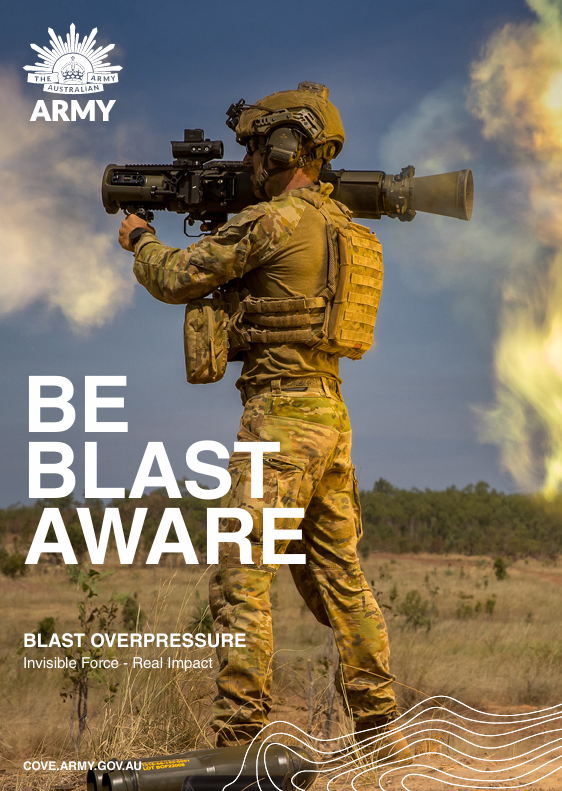
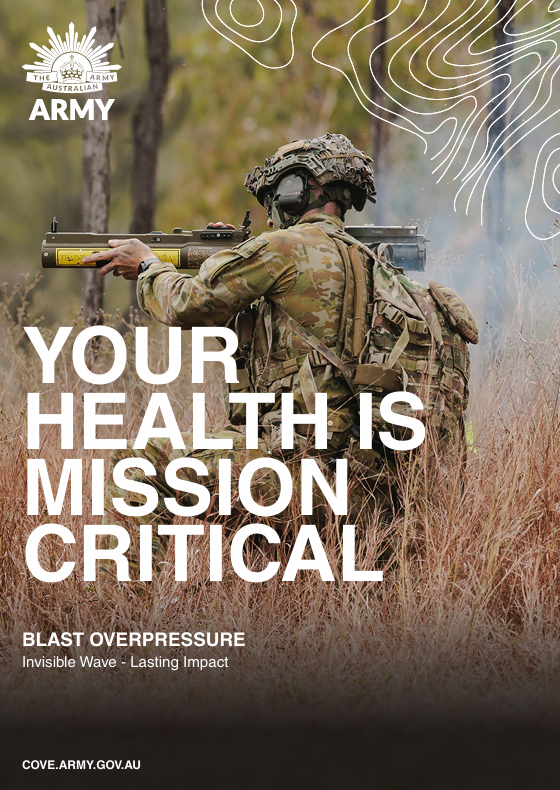
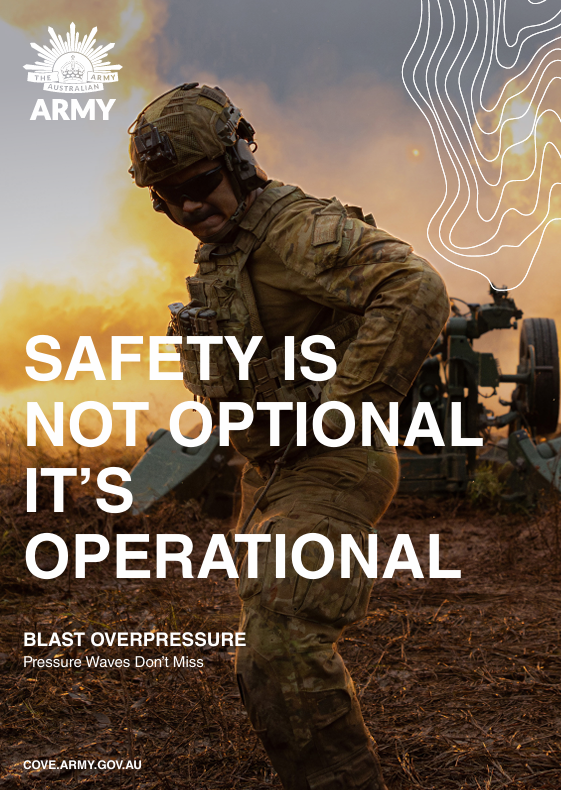
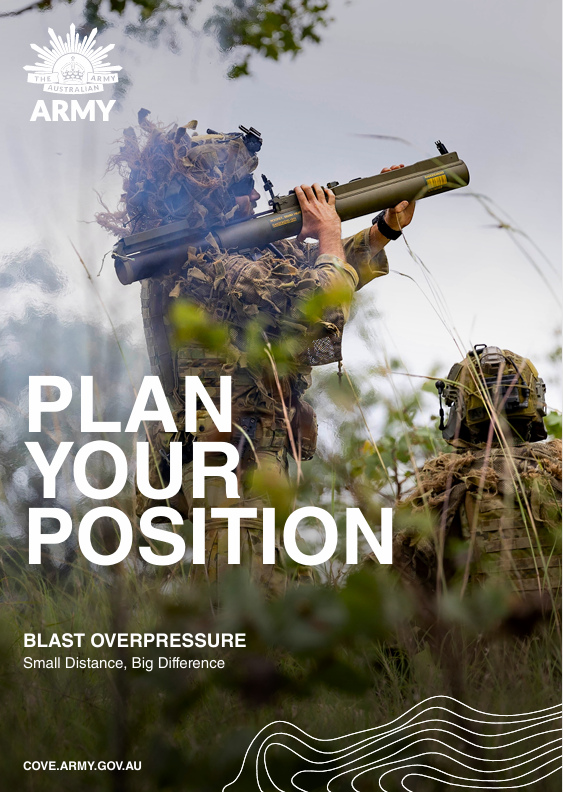
The related poster set is strong on three of four frames. The fourth, PLAN YOUR POSITION, would land harder with visible separation between the firer and the safety supervisor, since that position attracts the highest readings on most shoulder-fired serials and is where the largest reductions are available.
I note the site's guidance that concerns go to the.cove@defence.gov.au. This is not a concern; it is a professional discussion point, but I am happy to take the detail offline and to provide the underlying figures and sources to anyone in Forces Command or Landworthiness who wants them.
Paul Scanlan
Vigil Australia