
Facts and figures
The ‘Know Your Region’ series is designed to support unit and individual professional military education on the Indo-Pacific region. It’s important for all serving members of our military to have a foundational knowledge of the countries and issues in the Indo-Pacific.
On this page:
- A short history
- Social impacts
- Environmental impacts
A short history
In the late 1940s, as the Cold War began to heat up, the United States (US) felt an urgent need to refine its nuclear arsenal. This required a remote, controlled environment where large-scale atmospheric and underwater detonations could be conducted without immediate risk to major American population centres.
The Marshall Islands, then a part of the Trust Territory of the Pacific Islands (TTPI) administered by the US on behalf of the United Nations, became the preferred location. The islands were geographically isolated; they had deep water lagoons that could accommodate a fleet of ‘target’ ships, the winds were predictable, and there was only a small indigenous population.
Between 1946 and 1958, the U.S. conducted 67 nuclear tests in the Marshall Islands, primarily at Bikini and Enewetak Atolls. The cumulative yield of these tests was approximately 108 megatons – the equivalent of 1.6 Hiroshima bombs being detonated every day for 12 years. While this made up only about 6% of the total number of tests conducted by the US during the Cold War, they accounted for nearly 80% of the total explosive yield of all US atmospheric tests combined.
The program began with Operation Crossroads in 1946, which involved two tests – Able and Baker – designed to study the effects of nuclear weapons on naval warships. While Able was an airburst, Baker was an underwater detonation that created a massive radioactive spray, permanently contaminating the target fleet and the surrounding lagoon.
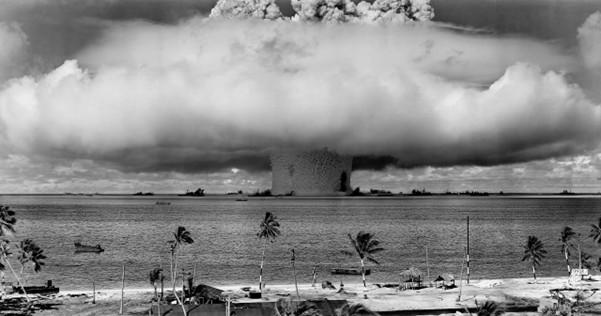
"Baker", part of Operation Crossroads, a nuclear test by the United States at Bikini Atoll in 1946 – Wikipedia
Over the next 8 years, 13 tests were conducted largely without incident; however, that changed on March 1, 1954, with Operation Castle (Bravo), the first test of a thermonuclear (hydrogen) device. Although the blast was meant to be no greater than 5-6 megatons, due to a design error involving Lithium-7, the yield was 15 megatons. The mushroom cloud rose 40 kms into the atmosphere and could be seen from 100 kilometres away. Because of the shifting winds, radioactive "snow" fell on the inhabited atolls of Rongelap, Utirik, and Ailinginae. The residents, who had not been evacuated prior to the test, played in the fallout, unaware it was radioactive debris.
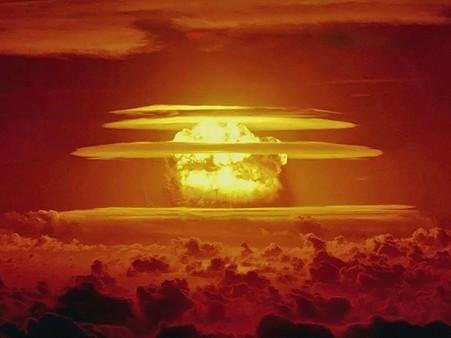
The mushroom cloud from the Castle Bravo thermonuclear weapon test in 1954, the largest nuclear weapons test ever conducted by the US – Wikipedia
It also reached a Japanese fishing boat (the Lucky Dragon Number 5) who was operating outside the officially designated danger zone. The 23 crew members eventually returned to the port of Yaizu with severe symptoms of acute radiation syndrome, including skin burns, nausea, and hair loss.
The death of the boat's chief radioman in September 1954, ignited a firestorm of anti-nuclear sentiment in Japan, with a petition for the abolition of nuclear weapons that gathered over 30 million signatures. The incident also triggered a nationwide "tuna panic" as potentially contaminated fish entered the market, leading to a massive economic disruption and the destruction of hundreds of tons of fish. Relations between Washington and Tokyo became strained, especially given the devastation of Hiroshima and Nagasaki. The US eventually admitted legal liability and paid USD2 million as compensation to Japan. The "Lucky Dragon" became a symbol of the nuclear age, directly inspiring the 1954 film Godzilla, where the monster serves as a metaphor for the destructive power of nuclear testing awakened by the H-bomb.
The US increased the rate of nuclear testing up until October 1958 when a temporary moratorium on nuclear testing with the Soviet Union and the United Kingdom came into effect. When testing resumed in 1962 (Operation Dominic), the US shifted location to Christmas Island and Johnston Atoll, largely due to the extreme environmental degradation and the growing international political pressure regarding the Marshallese people.
Social Impact
The short-term health impacts were immediate. Within hours of the Castle Bravo fallout, residents of Rongelap experienced "beta burns" on their skin, hair loss, and acute radiation sickness. In the decades following, the Marshallese people suffered from a "legacy of cancer”. Rates of thyroid cancer, leukaemia, and other radiogenic malignancies skyrocketed. Perhaps the most heartbreaking impact was on reproductive health; many women reported "jellyfish babies", infants born without bones or recognisable human features who lived for only hours.
Forced relocations turned self-sufficient fishing and farming communities into "nuclear refugees". Displaced to islands like Kili, which lacked lagoons for fishing, the people became dependent on imported, processed foods (like spam and white rice). This dietary shift led to some of the highest rates of Type 2 diabetes and obesity in the world.
Environmental Impact
Several islands were vaporised entirely during tests like Ivy Mike, the world’s first successful hydrogen bomb test. In the late 1970s, the US attempted to clean up radioactive soil and debris by placing it into a bomb crater and covering it with a 45-centimeter-thick concrete dome (Runit Dome). Today, as sea levels rise due to climate change, there are significant concerns that the dome is cracking and leaking plutonium into the Pacific Ocean.
By the time the last bomb was detonated in the Marshalls in 1958, the physical landscape of Enewetak and Bikini had been permanently altered, leaving behind the massive craters and radioactive soil that remain central to the Marshallese struggle for justice.
In 1986, the US and the Marshall Islands signed the Compact of Free Association (COFA). This agreement established a $150 million Nuclear Claims Tribunal to compensate victims. However, the funds proved woefully inadequate. By the time the tribunal's funds were exhausted, hundreds of millions of dollars in awarded damages remained unpaid.
The US government maintains that it has fulfilled its legal obligations, while the Marshallese Government continues to petition for "full and fair" compensation, citing that the original agreements were made before the full extent of the environmental and medical damage was understood.
For more information on nuclear tests in the Marshall Islands, see the resources below:
Videos
- (1011) The Forgotten Nuclear War – Bombs on Bikini Atoll | Full Documentary (50:28)
- Parts of the Marshall Islands just as radioactive as Chernobyl and Fukushima (3:48)
Articles
Know your region
Know Your Region series gives you a shortcut to understanding other nations in the Indo-Pacific region.
https://cove.army.gov.au/article/book-review-mapping-security-pacific