


Article Summary
Part 2 of this three-part series explores how digitisation is transforming the exercise of command rather than simply introducing new technology. It argues that while greater connectivity and battlefield awareness offer significant advantages, they also increase cognitive load, risk centralising decision-making, and place greater demands on trust, mission command, and information discipline. The article contends that the true challenge of digitisation lies not in the systems themselves, but in how leaders use them to preserve tempo, initiative and decentralised command in a data-rich battlespace.
Digitisation is often framed as a capability upgrade. In practice, it changes how command is exercised. It does not simply provide more information; it alters how decisions are made, how authority is applied, and how trust is distributed across a formation. For the Armoured Cavalry Regiment (ACR), this is not a technical shift. It is a command problem. The question is no longer just what systems are needed to operate in a digital battlespace. It is whether those systems will enable decision-making or quietly centralise it.
The Battlefield Is Becoming Information-Centric
Modern manoeuvre is no longer defined solely by movement and firepower. It is defined by the ability to understand, decide, and act faster than an adversary. Digitisation accelerates this cycle. It links platforms, sensors, and decision-makers into a single networked system. Information moves faster. Visibility increases. Opportunities become shorter-lived, but more frequent.
In this environment, the ACR’s role expands. It is no longer just a provider of reconnaissance. It becomes a generator of information: the forward edge of a system that feeds decision-making across the combat brigade. What it sees, captures and transmits will shape how the formation fights. This is not a subtle shift. It changes what matters.
Data Expands Faster Than Capacity
Digitisation enables the collection and transmission of vast quantities of data: video feeds, thermal imagery, radar signatures, UAV reconnaissance, platform locations, engagement data.
The question is no longer, what can we collect? It is, what should we send and why? Without control, more information does not create clarity. It creates noise. Every image, report, and overlay consumes bandwidth. Every transmission competes with another. If everything is treated as important, nothing is prioritised. This creates a new responsibility: information discipline.
The value of data is not in its volume. It is in its relevance and timing.
Bandwidth Becomes Combat Power
In a networked force, bandwidth is no longer merely a technical constraint. It is an operational resource. The ability to move data across distance, reliably, securely and in near real time, becomes as important as the ability to move people or ammunition. Without it, the system fragments.
The ACR operates at range, often forward of the main body and beyond line of sight. This creates a fundamental requirement: to transmit meaningful information across significant distance without degrading tempo. Current solutions remain limited.
High-bandwidth systems often come with reduced range. Long-range systems come with reduced data capacity. No single bearer provides all three: range, resilience, and volume. This is not a simple equipment problem, it is a design constraint that shapes how the force fights.
Visibility Changes the Nature of Command
Digitisation increases visibility across the battlespace. Commanders can see more, faster, and in greater detail. At first glance, this appears to be an advantage. It is not.
Increased visibility creates a temptation toward control. When higher headquarters can observe in real time, the threshold to intervene lowers. Decisions that would once have been decentralised begin to draw upward. This creates friction.
The manoeuvrist approach relies on decentralisation, initiative, and trust. It assumes that those closest to the problem are best placed to act. Digitisation challenges that assumption, not by changing doctrine, but by changing behaviour.
The question is simple: Does more information empower decision-making, or does it centralise it?
Trust Becomes More Important, Not Less
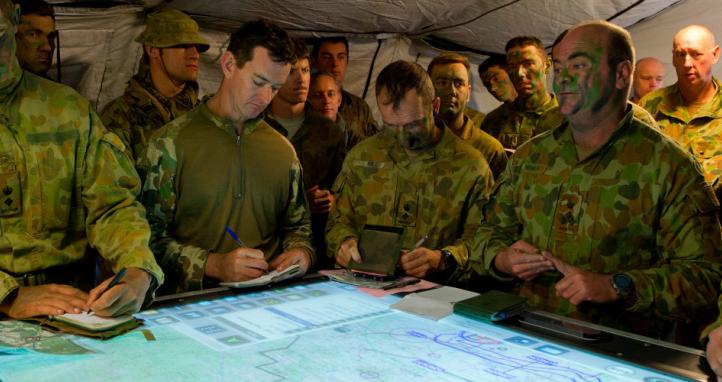
As visibility increases, so does the need for restraint. The digital battlefield gives commanders access to unprecedented information, but it does not provide context. It shows what is happening, not always why. Trust fills that gap.
Higher commanders must trust subordinates to interpret local conditions and act in accordance with intent. Subordinates must trust that they will be supported when they make decisions without perfect information. Without this trust, digitisation becomes counterproductive.
It slows decision-making. It creates dependency on confirmation. It reduces initiative. It introduces hesitation where speed is required. Technology can distribute information; only leadership can distribute trust.
The Risk of Confirmatory Warfare
One of the less visible effects of digitisation is the demand for validation. When imagery, video, and real-time feeds are available, the expectation shifts. Decisions are increasingly expected to be supported by visible evidence. Confirmation becomes routine. This appears rational. It is also dangerous.
The requirement to verify can delay action. It can create an implicit standard that decisions must be justified before they are executed. Over time, this shifts behaviour from anticipation to confirmation. In fast-moving operations, this is a loss of tempo.
Not every decision can, or should, wait for evidence.
The ACR Must Enable Tempo, Not Just Feed the Network
There is a risk that the ACR, as an information-gathering organisation, becomes viewed primarily as a sensor. That is incomplete. Its purpose is not simply to collect and transmit information. It is to enable action. Information only has value when it contributes to decisions and manoeuvre. This requires balance.
Too little information creates uncertainty; too much creates paralysis. The ACR must operate inside that tension, providing enough clarity to enable decisions without overwhelming the system it supports.
Technology Will Not Solve the Human Problem
It is tempting to view digitisation as only a technical challenge. It is not.
The underlying challenge is human:
- what to report
- what to ignore
- when to act
- when to wait
- when to trust
- when to intervene
These decisions are not solved through systems alone. They require judgement, experience, and discipline. No system can substitute for these.
What Do We Actually Need?
The requirements are not only technical. They are organisational.
The ACR requires:
- communication systems that align with how it manoeuvres
- sufficient bandwidth to support meaningful data exchange
- resilient networks that function under pressure and disruption
- disciplined information management practices
- and, critically, leaders who understand how to operate in a data-rich environment.
Without these, digitisation increases complexity without increasing effectiveness.
What Will It Change?
Digitisation will change more than capability. It will change:
- how quickly decisions are made
- where decisions are made
- how much information is expected before acting
- and how trust is distributed across formations.
It will compress time. It will expand visibility. It will increase cognitive load. It will blur the line between awareness and interference. Organisations that do not adjust behaviour will find that technology undermines the very agility it was meant to provide.
Closing Reflection
The move toward a digital battlefield is not optional. But its advantage is not guaranteed. More systems do not necessarily produce better outcomes. More information does not automatically create better decisions. What matters is how these are used and how leaders choose to behave within them.
Digitisation changes how authority is exercised, how decisions are made, and how trust is distributed. It can enable tempo. It can also slow it. Digitisation does not remove friction. It relocates it into decisions, relationships, and the way command is exercised.
The question is not whether we can operate in a digital environment. It is whether we can do so without sacrificing tempo, initiative, and trust. That question is no longer theoretical. It is being tested daily across modern conflict.
Still Interested?
Read the first article in the series here.
For a related Cove article on trust and mission command, read Connecting Good Soldiering and Mission Command.
Cove+ also has short learning courses on related information and digital-age warfighting topics, including Introduction To Information Warfare.