

Article Summary
Prompted by reading The Soldier, the article sets out a personal reflection on the leadership standards the author wants to hold himself and others to. It argues that leadership must be practised at every level and developed through opportunity, failure, accountability and example. The article also explores initiative, teamwork, military history, balance, curiosity, measurable standards and basic human decency. It concludes by inviting readers to reflect on their own leadership attributes and discuss what leading means to them.
In my recent readings of The Soldier as part of the Essentials of Land Warfare series, I was asked about which leadership attributes matter to me and why. When asked this question, I realised I had not deliberately sat down to reflect on the attributes I had been holding myself accountable for during my time as a non-commissioned officer (NCO). I also realised that not having these reflections as I continue to progress in my career was a failure on my part, because if we do not reflect on, or reinforce what it means to lead as an individual, how could we hold others to our expectations of them?
After some consideration, I found the following points to be the leadership attributes I will hold myself to and expect of others.
Leadership exists at all levels. It needs to be nurtured at all levels through opportunities and a willingness to learn from failures. Some of the best lessons come in the form of consequences.
This doesn’t necessarily mean that people should be constantly failing at what they do, but all training needs to present an opportunity for failure rather than make success or victory a certainty. It sets us up for failure, developing resilience and the ability to adapt under pressure when things inevitably go wrong.
Lead by example. Yes, it is a throwaway phrase that is used often; however, words mean nothing without action. Do what is right, own and learn from your mistakes, of which there will be many, whilst you have the chance during times of peace. Actively pursue opportunities to develop yourself and those around you. Do not become a negative influence on those around you or those who look up to you. Regardless of how you perceive the situation, get the job done and do the right thing.
Identify aspects you can control, develop them to improve, and work with what you have; complaining and lowering morale does not help. Most of the time, there will be something that you yourself can do, no matter your rank, that can enhance and develop those around you.
Don’t be afraid to go against the norm. Don’t be afraid to play devil’s advocate to offer another perspective, especially if the norm is constant complaining or people wishing they were doing more. Speak up if you identify something wrong, regardless of whether it is your mate, superior, or subordinate.
If your people are complaining about not doing enough or feeling bored, give them the opportunity to lead training or development. Complaining about sitting around the cages waiting for work or wanting to knock off before lunch because nothing is happening achieves nothing.
It is not hard to ask your platoon commander, sergeant, or section commander to organise training for the team during gaps in the training program, but often your subordinates won’t want to ask or take on the responsibility. Everyone has something that they excel at, capitalise on it and give these people the opportunity to teach or contribute.
Don’t be a lone wolf. As stated in The Soldier, everything we do is as a team, never as an individual. Having the opportunity to command due to your rank does not automatically make you the smartest person in the room. Listen to others’ recommendations, ask for opinions, do not plan or execute in isolation, and don’t be afraid to provide your own thoughts or analysis up the chain. No one knows everything, and it takes more than one to tackle problems from multiple perspectives.
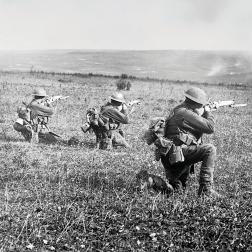
Know your history. Australia has a rich military history, and in my opinion, it is the foundation of Australian society. Warrior culture is a concept that hasn’t been clearly defined and is subject to varying opinions. No matter the view on warrior culture, it does not change the fact that being a soldier is synonymous with being a warrior.
At the commencement of World War I, only 13 years after the federation of Australia, 40% of Australian males aged 18-44 willingly signed on the dotted line to defend this country. The Battle of Milne Bay is widely regarded as the first defeat of Japanese ground forces in the Second World War. These forces were seen as nearly mythical, disciplined, and unbeatable. Australians achieved this victory.
These examples paved the way for Australia’s reputation as a formidable, tenacious, and respected country. Understand the battles that came before that define the present. There are lessons to be learned by everyone.
Balance. Find ways to establish balance between your military and personal life. We must train as though our lives depend on it, because they do, but our families, friends, and loved ones are just as important. Provide respite where you can and where appropriate. Redlining every day of the year is not sustainable for anyone and can be more detrimental to your outputs than increasing your efficiency.
There are no defined core business hours within the military, no attendance awards, and no benefit to keeping people from their families and lives outside of Defence needlessly. If there is truly nothing to be achieved that requires immediacy, allow your people to go home. It is about balance; there is always an opportunity to manage burnout at all levels; you just need to be cognisant of it in the first place.
Don’t keep yourself in the dark. If you come across things in your career that you don’t understand, whether in the form of another service, corps role, an acronym, a planning process or a tactic; don’t stay oblivious to them because you think they don’t apply to you. Research, ask, and learn; we are an integrated force; the mindset of ‘this has nothing to do with me’ is no longer adequate.
The more you understand about how the wider Defence Force operates across all five domains, the more perspective you will have on the ‘why’ you do what you do, and the more you will be able to consider when executing your job as a soldier across all ranks and services.
Metrics. Every aspect of what we do in Defence is for a desired outcome; however, more often than not, we generally train and operate against a set of intangible metrics and criteria. Hard data and a tangible metric should guide the criteria for the success or failure of an activity, exercise, or operation.
After-action reviews tend to become more of an opportunity to complain than to identify and improve, fix, or sustain what can actually be put into practice for a future iteration. It’s all well and good to identify something that should be improved; however, if the actual standard isn’t a measurable set of criteria across multiple levels of competence, the same mistakes will continue to be identified and subsequently forgotten.
For example, scores to identify shortfalls in shooting, or physical testing results. Fieldcraft, tactics, planning processes, and the like should include hard data to form the basis for a tangible improvement, fix, or sustain to execute in the next iteration.
Basic human behaviours. The last attribute, and one of the most important in my belief, is to be a decent human being. If you think that you are better than someone else because of your rank, experiences, and personal beliefs: you are wrong. This mentality narrows your perspective and underpins all the points previously stated. Be humble, be professional, be firm where you need to be, and always be kind.
This job will test your patience time and again. As long as you’re in, you will get angry, lose patience with people, and lash out. It’s human nature, but do not forget what it means to be an Australian Soldier. You are the standard you expect of others.
A good example in day-to-day life is putting your shopping trolley away. It is not hard to put your trolley away after you’re done shopping, yet people still choose to leave it because it’s easier or because someone else’s job is to collect it. Put the trolley away, it is not hard.
In listing these attributes, I understand that ideas of leadership and what that means to you will vary. This is by no means what I consider an objective set of leadership qualities, and I would ask you to share your ideas and thoughts through discussion to open the door for others to consider, if they have not already, what being a leader means to them.
Still Interested?
Why not also read: Leading at the Tactical Level by Major General Jake Ellwood.
Cove+ also has short learning courses on similar topics, including Project Leadership and Teams.