
Trench warfare is not a relic of the past. Wherever depth, prepared defences, and peer or near-peer adversaries meet. Where terrain, engineering, and long-range fires favour the defender, battlefields will harden into networks of trenches, bunkers, and obstacles. Recent conflicts show this is not history repeating itself but history evolving: close quarters fighting stitched together with drones, loitering munitions, electronic effects, and precision fires. If the Australian Army is to remain decisive in that environment, it must relearn some old lessons and write several new ones into doctrine, training, and logistics.
Why trenches again?
Prepared positions remain one of the most effective force multipliers available to a defender. Trenches provide cover and concealment, shape fields of fire, and channel attackers into kill zones. Where an adversary can invest in deep obstacle belts, mines and integrated anti-armour belts, trenches become not just tactical features but operational constraints. In that setting, combined arms and technology determine which side survives and exploits the fight. We must be ready to both break into and hold a trench system with speed, discipline, and a clear plan for casualties.
The modern trench – What’s different today?
The trenches of today may look the same, but they require us to fight very differently. Sandbags, switchbacks, and bunkers still shape the ground, but above them hum persistent drones that can watch and strike without warning. Obstacles are no longer barbed wire alone, but kilometres of mines linked to sensors and long-range fire plans. Fragmentation lethality has multiplied, making every corner a potential kill zone.
What has changed most is not the dirt itself but the layers of technology. A trench is both a physical barrier and a digital signature, tied into constant surveillance, precision fires, and information warfare.
While today’s trench fight retains the geometry of 1916, modern threats layered on top include:
- UAS that give persistent surveillance, early warning, and rapid target identification.
- Loitering munitions and continuous indirect fires that punish exposed movement.
- Deep obstacle belts that demand close engineer support and deliberate breaching.
- Narrow switchbacks and bunkers that limit manoeuvre and invalidate many standard drills.
- Increased blast and fragmentation lethality that makes trenches force multipliers for defenders.
These realities mean trenches are no longer just defensive positions but complex systems that magnify lethality and slow manoeuvre. To fight in them, we cannot simply dust off the manuals of 1916. We need new doctrine, rehearsed drills, and the integration of technology into every stage of the fight.
Tactical implications
The realities of the modern trench change how small teams fight. Geometry that limits manoeuvre, lethality that punishes exposure, and drones that strip away concealment mean that conventional drills cannot simply be applied; they must be adapted. Individuals and teams must rehearse modified drills and integrate grenades and counter-UAS into every action. The following is a high-level summary of the known implications:
- Drills must be adapted to confined spaces. Standard pair and team drills are not always viable for narrow switchbacks and junctions.[i] Team drills remain the baseline, but individual actions and sequencing that allow a single combatant to detect, engage, and respond without immediate physical support must be practised.
- Grenades decide close quarters. Fragmentation grenades are decisive in confined spaces. Smoke and pyrotechnics aid manoeuvre but produce signatures that UAS can exploit. Multiple or layered use of fragmentation grenades (grenade bracketing) is commonplace and severely restricts an enemy’s options to advance or withdraw.
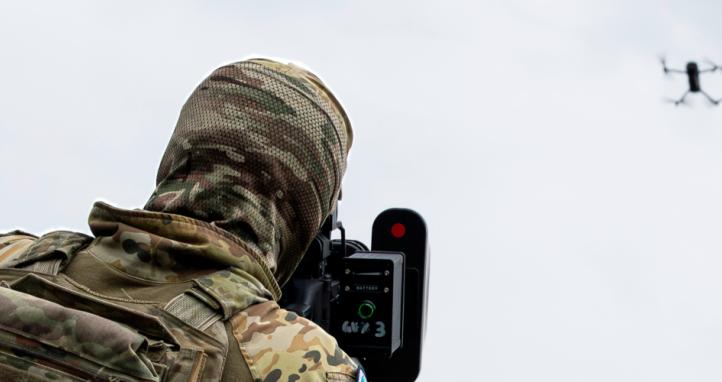
- Counter-UAS is a collective task. Detection, signature management, and leader-directed engagement drills must be conducted at the section and platoon levels. Uncoordinated shooting at drones wastes ammunition and creates a distinctive signature that can be targeted.
- Threat primacy remains. Threats must be dealt with before casualty management occurs. Direct enemy fire is only one danger; combatants are often simultaneously exposed to indirect fire, mines, improvised explosives, ‘dropper’ drones, and First Person View (FPV) systems.
- Casualty care is a combat drill. The aim of Tactical Combat Casualty Care (TCCC) is to perform the correct intervention at the correct time. Executing those interventions in a trench, under the threat of secondary drone or mine strikes, requires rehearsed responses, mine awareness, and rapid concealment techniques.
- Decision-making under pressure. Quick problem solving and rapid, accurate decisions by commanders and every team member are a force multiplier in confined, information-dense environments. Leaders will often face compressed timelines, degraded situational awareness, and competing priorities. Training must therefore embed rapid decision-making frameworks, decentralised command, and simple decision triggers, so that junior commanders can make appropriate trade-offs when centralised direction is not possible.
Practical TTPs to prioritise
The following practical Tactics, Techniques, and Procedures (TTPs) are not theoretical; they are the actions and rehearsed sequences that decide life and death in confined, contested ground. They prioritise repeatability, speed, and survivability: simple, trainable sequences that work in switchbacks and bunkers; engineer-led breaching and bypass options; disciplined grenade and ammunition discipline; and integrated counter-UAS and casualty drills so each section can operate independently when the fight fragments.
What follows are baseline procedures that form much of the detailed TTPs:
- Unopposed clearance of a trench system. This forms the baseline TTP: a standard sequence (approach, prepare, dominate, resume) that makes trench movement repeatable and trainable.
- Junction/corner drills. Small-team and individual sequencing, quartering and bump procedures practised until instinctive. Limit personnel in a switchback to mitigate blast, fragmentation and direct-fire effects.
- Engagement fundamentals. Immediate establishment of fire superiority remains critical. The close confines of a trench mean short-range small arms engagements, often supported by fragmentation grenades, will be the dominant form of combat.
- Alternate engagement techniques. Blind firing (engaging without direct line of sight to suppress or disrupt while minimising exposure) and grenade bracketing must be rehearsed by all members of the assault force.
- Bypass procedures. Explicit plans to egress, backtrack, or exit above the parapet while maintaining overwatch for bypassed sectors. Manoeuvring above the parapet is inherently dangerous and must be executed with caution and with coordinated flanking support.
These TTPs are the difference between improvisation and success under fire. Individuals and teams will need to train in them until they are a reflex, and they must be tested in combined arms environments to ensure that commanders at all levels can apply them.
Load carriage, logistics, and discipline
Trench warfare is fundamentally a logistics fight. When movement is restricted, resupply is contested, and engagements become protracted. What a soldier carries, and how commanders manage those loads, determines whether a section endures or collapses. Load carriage must prioritise sustained close-combat lethality (more magazines, more grenades), robust medical plans, and modular casualty evacuation tools. At the same time, commanders enforce strict expenditure discipline and redundant marking methods for the forward line of own troops (FLOT). Discipline in ammunition use, resupply tempo, and casualty triage turns tactical endurance into an operational advantage.
For operational planning, trench assault load carriage will prioritise:
-
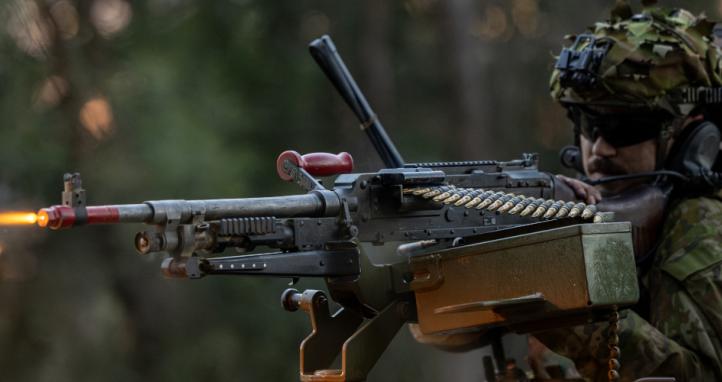
Ammunition. Ammunition loads must be role-based, not ‘one size fits all’. For routine tasks such as patrolling and local defence, apply a practical baseline of 210 rounds per rifle (7 x 30 round magazines) and 800 rounds per Light Support Weapon (LSW). These baselines provide a reasonable balance of lethality and mobility for day-to-day operations.
When preparing for a trench assault, commanders must plan for a far higher expenditure rate. Lessons from allied forces (both Ukrainian and its neighbours) show 10-12 magazines per rifle are commonplace, while LSWs require 1200-2000 rounds to deliver sustained suppression. The operational imperative is sustainability. Assaulting forces must be able to generate and maintain fire superiority long enough to enable the breach into the trench, manoeuvre throughout, and conduct casualty extraction under fire before resupply closes the gap.
- Fragmentation grenades. Corners, bunkers, and strongholds often require multiple fragmentation grenades. The accepted two grenades per soldier will not support sustained close combat in trench warfare. Stocking and resupply plans must reflect the reality of trench warfare, whereby a minimum of four grenades per trench combatant is considered baseline.
- FLOT markers. Conventional markers such as panels, smoke, and flares will be necessary, as will alternative markers such as extendable poles and flags. All markings create signatures and, therefore, must be deconflicted and protected.
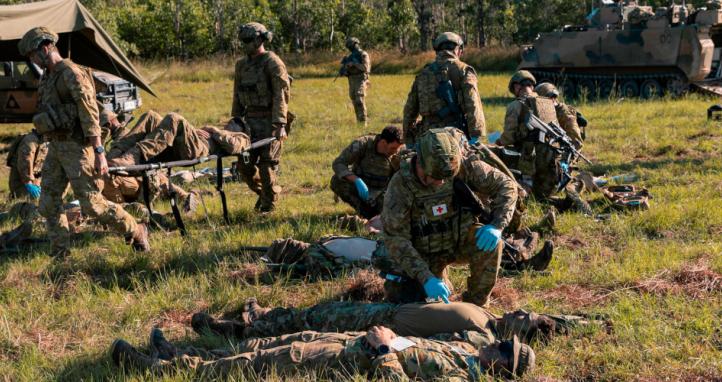
- Medical and casualty extraction. Individual First Aid Kits (IFAKs), section medical equipment, collapsible litters, and rapid advanced medical support must be immediately available. Casualty extraction must be rehearsed as the confined walls of a trench often make a four-person lift unviable; alternative extraction techniques must be trained.
Train as you fight
There is no substitute for moving, shooting, and communicating. Frequent dry, blank, Non-Lethal Training Ammunition (NLTA) and live-fire rehearsals in constructed trench systems that integrate direct and indirect fires, armoured platforms, Explosive Hazard Reduction (EHR) teams, and both friendly and threat UAS will ensure small-team and large-scale manoeuvre is applied. All roles and responsibilities, individual and team manoeuvre, engagement and clearance techniques, must be known by all.
Conclusion
The next trench fight will be decided as much by integration as by small team skills and drills. Success will depend on layered, combined arms effects; dedicated trench assault forces that close with the enemy while flanking mounted platforms fix and clear adjoining sectors. Persistent suppression from LSWs and small arms enables manoeuvre, while indirect fires laid forward of the FLOT create a rolling wall of shrapnel to deny withdrawal routes.
Integrated throughout is a resilient communications network with electronic protection and countermeasures that ensure commanders are linked even under enemy interference. All of this must be supported by a continuous Intelligence, Surveillance, and Reconnaissance (ISR) network of sensors that keep the commander informed and enable timely, precise fires.
Finally, we must understand, learn, and apply trench warfare doctrine at the small team level; prioritise rapid, decentralised decision making; and make the integration of combined arms effects a central axis for training evolution.
End Notes
[i] Switchbacks are zigzagging trench sections designed to reduce the impact of enfilade fire and contain blast effects. They require more effort and resources to construct and they significantly slow troop movement.

The logistical and medical challenges seem to be things we can influence if we set our minds to it. How do we get that extra ammo forward - sled, cart, mini UGV (say just 600rds, or 15grenades each), RPAS, dogs (a dual capability maybe?), extra soldiers? A combination of these for redundancy?
Frag grenades - are our existing F1/F2 too heavy? Can we find smaller (e.g. Mecar or the old V40) grenades to mix up the load and be used for that bracketing that you recommend. WW1 'bombers' apparently carried around 20 Mills grenades, quite a heavy load. Do we bring back rifle grenades (25-100m) or have mini UAS filled that niche?
FLOT markers - extendable poles are a great idea. Could we use auditory markers as well? I am not sure about likely UAS surveillance capabilities, but redundancy will be critical.
Medical - whilst casevac will be crucial, I note reports that in Ukraine casevac is extremely difficult due to the threats you note. Do we invest in more medic training and carry more FA supplies, and then rely on UGV to afford a casevac option when viable? A really difficult choice here, but we do need to think carefully about it beforehand.
Anyway, fantastic work - we look forward to the next chapter.
We seem to be spending a lot of time at the troop level which is really a dusting off of old trench doctrine, though we lack some of the equipment and weapons Diggers once had.
I consider the real value is the synchronisation of drones for reconnaissance, bombing/strike, replenishment and critically 'battle management'. Battle management is the core or efficient and effective action. This will affect our approach to and sequence of planning. For example, I understand that the Russians now focus on their drone plan, before their troop, fires and logistics plans.
We need task commanders focused on physical action, while mission commanders should be using the feeds to monitor, direct, slow, speed up or halt actions from their drone 'eagle view' This akin to air combat. Or even SF in AFG. Sorting out the echelons above section and platoon will drive FIC changes more than the bottom-up approach we're using. While troop initiative is valued, our approach has let concept and capability developers off the hook.
Happy to help out if you'd like.
Your conclusions definitely struck a chord.
I was in the Falklands in '82.
Very much a peer-on-peer event.
Although not classic lines of trenches the defenders were well dug in with standard defensive position features; interlocking fields of fire, overhead cover, etc. and they had had plenty of time to prepare.
Clearing these positions absolutely relied upon 'individual action', usually a pair of young soldiers using their initiative to cover each other and clear the position, with grenades, until they ran out of grenades.
The 66 LAW and M79 were put to excellent use as well as part of the initial assault.
PL SGT's earned their money bringing ammunition forward!
Casualties usually remained in place until it was viable for medics to attend and extract them.
Thankfully we didn't have drones to deal with!