



Introduction
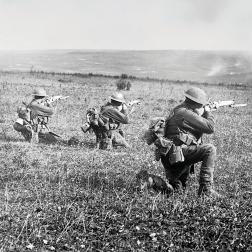
Multi-domain operations are not new; land and naval forces have coordinated across different domains for thousands of years. Close air support, which involves aircraft supporting ground fires and manoeuvres against enemy ground forces, has been in use since World War I. The current challenge lies in integrating space and cyber effects within the same framework. More importantly, the real difficulty is how to consistently incorporate these effects quickly and within a highly dynamic operational environment; a task that rests with multi-domain command and control.
Air Marshal Sir Arthur Coningham established a set of principles for air-land integration that have shaped every doctrinal development since World War II. The New Zealand-born Royal Air Force officer and Commander of the Western Desert Air Force in North Africa emphasised the importance of air superiority, supported centralised command of air operations alongside ground command, and introduced innovative tactics to support ground forces operations. These principles brought consistency to airpower and helped the Desert Air Force secure decisive victories at Alam Halfa and El Alamein, forever transforming the combined arms battle.
Wing Commander Dave Smathers, in his article ‘“We Never Talk About That Now’: Air-Land Integration in the Western Desert 1940–42,” analysed how these principles became effective in practice. He identified five enduring factors as the institutional foundations that allowed Coningham’s revolution to succeed:[i]
- Air superiority as the essential prerequisite for decisive air support operations
- Willingness to cooperate
- Joint planning and headquarters
- Effective and reliable communications
- Robust and recognised doctrine
This article uses both Coningham’s principles and Smathers’ enduring guidelines as paired reference points to examine the challenges of multi-domain command and control today. They emphasise not only what must be achieved—superiority, unity, and support—but also what must underpin those achievements—cooperation, organisation, communication, and doctrine. They also caution that, without a professional steward, multi-domain command and control could fragment into the very incoherence that Coningham sought to prevent.
Air Superiority as the First Duty
Coningham was clear: ‘The first duty of the Air Force is to win air superiority… everything else must be subordinated to this.’ In the desert, this meant denying the Luftwaffe freedom of manoeuvre. This provided the Eighth Army with the operational space to fight and the ability to control the tempo of operations to win at Alam Halfa and El Alamein. Smathers agrees with this in his analysis, highlighting General Montgomery’s remarks that ‘control of the air was the single most important enabling factor in the successful integration of air and land power.’[ii]
The principle of air superiority remains unchanged, although its scope has expanded. It now includes denying hostile surveillance and reconnaissance, countering drones, and controlling the electromagnetic spectrum and space. Instead of viewing superiority as permanent control of the sky, interoperability and vertical integration should enable temporary dominance where and when needed. In practice, control of the air is now a joint, multi-domain effort, and electromagnetic dominance is now alongside traditional aerial control as an equal goal.
Centralised Command, Unity of Effort
Coningham opposed dispersing air squadrons under Army control; he advocated for centralised command to maintain concentration and flexibility. Simultaneously, he promoted unity of effort across various services. As Smathers explains, commanders must collaborate at all levels of planning and executing operations to ensure a shared purpose between the Services.[iii]
The lesson remains relevant today: multi-domain operations, which combine space, cyber, air, land, and maritime elements have the potential to produce significant effects. However, without clear stewardship, they risk turning into a patchwork of conflicting systems. A recent RAND study warned that without defined command authorities, all-domain operations could be slowed by conflicting processes and duplicated efforts; this highlights the danger of institutional seams being exploited in combat.[iv]
In modern terms, centralised control should not mean one node making every decision. Instead, it involves centralised design and doctrine, implemented by a team of trained commanders and controllers across various levels. The Air Force, by tradition and practice, may be well positioned to provide this professional core. If multi-domain command and control becomes everyone’s responsibility, it risks becoming no one's; but a designated steward, supported by specialists from all domains and empowered at the tactical edge, can foster the unity of effort needed to succeed.
Supporting the Battle
Coningham reminded his airmen that ‘the whole Air Force… is there to help the Army. Its one job is to help the Army win the land battle.’[v] He made that principle tangible by establishing air support units, operations rooms, and resilient communications so responsiveness became routine, not ad hoc. Smathers also stressed that effective communication and a willingness to cooperate were the backbone of this system, ensuring that air support was responsive while remaining under centralised control direction.[vi]
The same logic applies in multi-domain warfare. Multi-domain command and control is an enabler, not a scheme of manoeuvre; land and maritime forces still hold ground and secure sea lanes. What is different is that multi-domain operations can deliver decision superiority at the tactical level, where tempo and initiative are fiercely contested. This is achieved through ‘kill webs’ – dynamic networks that connect sensors, intelligence, fires, and effects across domains.[vii] For effective operations, multi-domain command and control must extend kill‑web connectivity to the tactical edge, supported not only by systems but also by trained personnel and shared procedures. Only then can land and maritime power, reinforced by air, space, and cyber, generate the tempo and initiative needed to establish local dominance.
Enduring Principles in Modern Context
Smathers distilled five foundations that turned Coningham’s tenets from rhetoric into reality; each remains relevant and can be interpreted for the multi‑domain environment:
Primus inter pares – first among equals. Control of the air remains essential for everything else. Coningham recognised that control is often temporary, local, and fragile. The key lesson is to synchronise fleeting superiority with manoeuvre. With a contested spectrum, ubiquitous drones, and space-based surveillance, superiority will be even more transient; multi-domain command and control must enable commanders to seize opportunities before they vanish.
Willingness to cooperate was as much a cultural victory as an organisational one. Coningham and Montgomery broke down inter-service suspicion in 1942. Today, cooperation must be institutionalised through joint training, shared acquisitions, and combined exercises. Moreover, integration should be embedded throughout education and career pathways, making multi-domain exposure a core professional value.
Joint headquarters under Coningham fostered unity in planning and execution. Smathers highlights the tremendous power of the RAF working alongside the land forces that made the success possible.[viii] In modern conditions, due to the increased threats from contemporary systems causing communication and decision-making gaps, headquarters must be modular and resilient, able to disaggregate under attack yet still federate effects. The essential shift is cultural: domains are no longer customers of one another but collaborators.[ix]
Effective communications connected controllers, aircraft, and headquarters. Coningham’s radios and operations rooms have their modern counterparts in resilient networks, common standards, and graceful degradation under denial. Crucially, subordinates must be empowered to act when communications fail; mission command must support multi-domain command and control, or connectivity becomes fragile.
Doctrine links the desert system together, clarifying priorities and responsibilities. Multi-domain command and control doctrine must do the same by codifying the integration of kinetic and non-kinetic fires, data flows, and delegated authorities to provide a shared cognitive framework that fosters trust and encourages initiative up and down echelons.
The lesson from Smathers is clear: Coningham’s revolution lasted not because of machines but because of institutions and relationships. Trust, cooperation, doctrine, and clear command structures made temporary superiority practical. Multi-domain command and control must be built on the same foundations.
Who Should Own Multi-Domain Command and Control?
Ownership remains a contentious issue. Multi-domain command and control cannot succeed as a faceless enterprise. Coningham’s unity of command was both institutional and operational; centralised control prevented fragmentation, a fact that remains relevant today.
As previously noted, if multi-domain command and control is everyone’s responsibility, it will soon become no one's; however, if one service takes ownership at the expense of others, stovepipes reappear. A balanced approach is essential. The Air Force may be well placed to oversee multi-domain command and control – not because aviators have a unique understanding of technology – but due to its institutional experience in integrating surveillance, strike, mobility, and electronic warfare at speed with coherent and adaptable command and control systems. Coningham’s Desert Air Force succeeded by embedding a permanent air cadre in the joint fight; multi-domain command and control requires a similar professional approach cadre.
Stewardship must remain inclusive. The Army and Navy should stay focused on their core warfighting tasks: manoeuvre, terrain, and tactical initiative. A joint command and control system should exist to support these outcomes, not to distract from them or become an echo chamber for its own ideas. To stay connected to operational reality, the system must be resourced with embedded domain professionals at tactical and operational levels, ensuring that command and control serves the fight rather than itself.
Stewardship should focus on coherence, not control. The aim is to establish a unified accountability framework that ensures multi-domain command and control doctrine, training, and institutions support the entire joint force. It is not about one service dominating; rather, it's about designing a system that promotes tempo, initiative, and superiority across land, sea, air, space, and cyber. As Coningham reminded his airmen, the Air Force exists to help the Army.[x] Modern aviators should adopt the same principle; multi-domain command and control is meant to support joint outcomes, not to promote service agendas.
Conclusion
Coningham’s foundations, supported by Smathers’ principles, offer timeless guidance. One explains what must be achieved; the other outlines the conditions that make achievement possible. Together, they provide a clear path for multi-domain command and control. With clarity, unity, and disciplined stewardship, multi-domain command and control can extend Coningham’s influence into the multi‑domain fight and deliver superiority, tempo, and integration where it matters most. However, to do this, we must choose a capability steward now; failing to do so could mean re-learning Coningham’s lessons once the next war begins.
End Notes


It is a strong article but I don't agree with the conclusion that and air force can own or steward multi-domain command and control. As cited in the article twice, 'the Air Force exists to help the Army'. This is recognition that, in warfare, the land battle is decisive. That is because naval and air power, whilst significant, can also be fleeting whereas a key characteristic of land power is that it is persistent. Therefore, command and control, multi-domain or otherwise, is probably best left in the hands of Army as land power practitioners.
Having said that, this article does contribute to developing understanding of multi-domain integration. This article introduces and outlines Coningham's principles to help develop that in our professional forces.
Great article, thank you!
Thank you for making the works or Coningham and Smathers accessible to a non-specialist audience.
I have two follow-up questions. Firstly, with the example of Ukraine what are the implications of mutual air denial on the airforces “first duty” of attaining air superiority?
Secondly, how do you think the army best supports what is clearly a priority airforce mission? Is this just a sequencing problem? Attain some degree of air superiority to buy space and time to achieve land manoeuvre?
Thanks again, great article