
“The battle is fought and decided by the quartermasters before the shooting begins.”
– Field Marshal Erwin Rommel, Infantry Attacks 1937.
Introduction
When most of us picture the German Army of the Second World War, we imagine rapidly advancing tanks, precision logistics, and disciplined engineers in spotless coveralls. Yet behind every Tiger and Panther that rolled forward was a maintainer with grease up to their elbows, trying to make sense of shattered gear teeth, leaking seals, and missing parts.
By 1943, many of those maintainers were working miracles to keep a handful of tanks mobile. The story of German tank maintenance is not one of incompetence; it is one of brilliance undone by poor sustainment strategy. While reading German Tank Maintenance in World War II (Department of the Army 1953), I felt something uncomfortably familiar. The same challenges identified by the Germans echo across the decades. They are as applicable to the Australian Army now as they were to the German Army in World War II:
- Are we acquiring vehicles that maintainers can repair quickly in the field?
- Do we privilege new system acquisition and production over sustainment?
- How resilient are our maintenance structures when the environment or the enemy changes the plan?
As the Australian Army continues to modernise its armoured and protected-mobility fleets, we would be wise to revisit the lessons of an army that combined world-class engineering with a tragically brittle sustainment system.
The early war – Perfect supply chains mask system unreliability
In 1939, Germany entered the war with a centralised maintenance concept. Tanks received only minimal maintenance forward of divisional workshops; serious repairs went to rear depots. It was tidy on paper and ideally suited to short, decisive operations. During the lightning campaigns in Poland and France, the model seemed vindicated – most tanks broke down near railheads where depot rearward recovery was rapid and easy.
Then came Russia. By the first winter of Operation Barbarossa, columns stretched hundreds of kilometres into hostile territory. The depots were too far back, recovery vehicles failed to keep up, and spare parts lay buried under snow or bureaucracy (Department of the Army, 1951). US Army post-war analysis records that entire battalions of Panzers became immobile, not through enemy fire but mechanical exhaustion (Department of the Army, 1953).
For Germany, it was a painful reminder that centralisation is efficient only until you start moving. The Australian Army faces the same truth every time we deploy heavy equipment beyond established bases. Distance magnifies fragility on operations, even in our remote training areas. Mobility without maintainability and effective maintenance solutions when problems arise is a maintenance illusion.
Adapting under fire – Werkstatt (workshop) ingenuity
Necessity forced innovation. From 1942, the Wehrmacht decentralised repair and created Werkstattzüge (workshop platoons) embedded within armoured battalions, supported by divisional Werkstattkompanien (workshop companies) and army-level depots. These units recovered damaged vehicles under fire, performed battlefield triage, and fabricated parts from whatever they could salvage. The famous Bergepanther armoured recovery vehicle emerged from this adaptation – a Panther hull converted into a mobile winch and crane that could drag its broken cousins out of combat.
Environmental diversity demanded still more ingenuity. In North Africa, desert dust and heat damaged engines; in Russia, extreme cold caused lubricants to solidify; in Western Europe, Allied air attacks necessitated maintenance to occur only at night under camouflage nets and canvas (Toppe 1952, Dupuy Institute 2003). German maintainers improvised, cannibalised, and adapted continuously. Their flexibility was impressive – but always reactive to the environment and situation.
The lesson is simple: plan maintenance adaptability before the shooting starts. Maintenance policy, tooling, and training must be built for unpredictability. A sustainment system that requires permission to innovate will die of paperwork long before the first rounds are fired.
Engineering brilliance, mechanical fragility
German World War II tanks were technological marvels of their time. The Panther’s 75 mm high velocity gun could destroy any Allied tank; the Tiger’s armour was almost impervious. Yet both suffered chronic mechanical unreliability. Early Panthers averaged fewer than 150 kilometres between major drivetrain failures (Jentz 2000). The Tiger II’s 70-tonne weight strained its transmission beyond its endurance and breaking point (Department of the Army, 1945), leading to early catastrophic failures.
Post-war US Army analysis (Department of the Army, 1953) attributed these issues to ‘…over-complex design and insufficient maturation before fielding.’ Sound familiar? In our own programs, capability ambition sometimes outruns maintainability reality. Modern vehicles are equipped with electronics, software, and bespoke components that require specialised tools and system manufacturer access to correct faults. In combat, a broken sensor can immobilise a multi-million-dollar platform.
Complexity itself is not the enemy; unmanaged complexity is. The Germans proved that exquisite performance on the test track means little if your tradespeople can’t change a gearbox without factory tooling, a perfectly level concrete floor, and special lifting jigs. Army’s next generations of armoured and autonomous systems must be judged not only by what they can destroy but also by how quickly and easily they can be repaired and returned to the fight.
The fatal policy – New tanks versus spare parts
If mechanical fragility was the tactical problem, industrial policy was the strategic one. German industry, under pressure from Hitler’s directives, prioritised new tank output over spare parts. Factories were rewarded for the number of hulls produced, not for tank reliability and readiness. The result was a paradox: gleaming new Panthers rolling off assembly lines while hundreds of older ones sat idle, often due to a lack of a simple, small part.
By 1944, some Panzer divisions had fewer operational tanks than those in need of repair. Cannibalisation became the primary source of spares. In modern terms, the system had accumulated an unsustainable ‘maintenance debt’ – the number of tanks failing outstripped maintenance rates of effort.
This is a trap we must avoid. Defence projects naturally celebrate acquisition milestones – the moment when a system is delivered, marked by a ribbon-cutting ceremony. Yet the objective measure of success is the availability rate years later. Maintainers understand this instinctively; policymakers sometimes need reminding. Every dollar spent on spare parts, training, and tooling is not overhead – it is insurance on the nation’s ability to project and sustain power for the longer term.
Resilience in the field – Lessons in improvisation
Despite strategic failure, German field maintainers demonstrated remarkable resilience. Workshops machined new gears from scrap steel, fabricated cooling fins from aluminium cookware, and re-used worn track links by reversing them. Recovery crews operated under artillery fire, towing immobile 45-tonne wrecks with multiple half-tracks lashed together to provide sufficient horsepower (Department of the Army 1953).
Their innovation was born of necessity, but it highlights a professional mindset: the maintainer as problem-solver, not simply a parts installer. The same mindset should define the Australian Army maintainer of the future – technically expert, authorised to improvise when necessary, and trusted to make risk-based decisions close to the point of need.
We cannot predict the next theatre, but we can cultivate the maintenance managers and tradespeople who must adapt to it.
When the supply lines break
As Allied airpower grew, the German supply system began to collapse. Convoys of parts were strafed daily, and rail lines were cut faster than they could be repaired. The long logistical tails that had fed successful past armoured operations suddenly became liabilities.
For our Army, operating across the Indo-Pacific presents similar vulnerabilities – vast distances, limited ports, and contested sea and air lines of communication. We must assume our supply chains will be disrupted and plan accordingly.
Two traditional military maintenance philosophies deserve renewed emphasis:
- Battlefield sparing analysis – the art of determining which components fail most often and positioning those spares forward, with the supported systems, not deep in warehouses or in transit. The ‘most cost-effective solution’ frequently desired in peace can sometimes undermine war’s strategic objectives. We must accept that readiness for prolonged military action comes at a cost.
- Battle Damage Assessment and Repair (BDAR) – empowering tradespeople to make temporary, field expedient fixes that restore mobility and firepower quickly. We must trust our maintainers to act in the right way at the right time – practice in peace, perfect in war. Time wasted seeking an ‘appropriate authority’ far removed from the battlefield to ‘authorise repair’ can delay systems returning to the fight.
These are not new concepts; the Germans mastered them out of desperation. Our challenge is to institutionalise them deliberately, in peace, before conflict demands them.
Modern reflections – Our own sustainment friction
I feel that the US Army’s post-war analysis of German tank maintenance successes and shortcomings could have been written for us. Our maintenance ecosystem is highly professional, yet we wrestle with familiar pressures:
- Complexity: our modern fighting vehicles integrate complex hybrid drives, mission systems, and active defence.
- Supply chain fragility: we can expect long lead times for imported parts, and the likelihood of adversaries interdicting our air routes and sea lanes must be anticipated.
- Acquisition bias: acquisition projects routinely prioritise capability introduction timelines over sustainment maturity.
- Policy inertia: adjusting spares scales or maintenance doctrine can take years.
None of these is fatal alone, but together they create brittleness. The Germans discovered that brittleness in the harshest possible way. Our task is to build flexibility into our maintenance strategy before it is forced upon us.
That means accepting maintenance as a warfighting discipline, not a combat support service. Commanders must plan for the repair fight just as they plan for fires and manoeuvre. Policy must empower maintainers to act decisively. And rather than counting on enterprise software to save us, we must return to fundamentals.
Enterprise Resource Planning (ERP) systems and platform-level maintenance data have value – but only in peace. In combat, ERP systems reveal their actual utility: a peacetime asset-management tool, not a battlefield repair system. When time and rapid action mean success, data will not turn a spanner. The tradesperson at the point of contact needs the correct spare, in the right place, at the right time – not another dashboard report. Battlefield maintenance success still depends on human anticipation, not just analytics.
Five lessons for the Australian Army
The German Army’s armoured experience offers invaluable insights for the Australian Army, if we choose to listen:
- Design for maintainability. Maintenance engineers and maintainers must sit at the design table. If a component cannot be repaired or replaced in the field using the absolute bare minimum tooling, then the system is a liability.
- Fund future readiness, not just current acquisition. Spare parts and trained people generate availability; shiny new hulls do not.
- Empower forward repair. Formation-level and below workshops require protected mobility, connectivity, and authority to act quickly. Just as we repair forward, we must also position our people forward. Workshops without a full maintenance resource complement are inviting an unsustainable ‘maintenance debt’.
- Re-learn BDAR. Teach tradespeople to improvise, recover, and repair under pressure – even under fire. Perfect repairs can wait; mobility cannot.
- Get the correct spares to the right place. Success in the next fight will belong to the force that anticipates failures, positions its parts forward, and restores systems the fastest – not to the one with the most maintenance and usage data.
Conclusion
The German Army’s downfall in maintenance was not due to ignorance – it was a misalignment. Tactical innovation outpaced sustainment strategy. Complex machines, long supply lines, and rigid policies created a perfect storm that no amount of heroism could fix.
For us, the warning is clear. Our future battlefields will reward armies that can recover, repair, and adapt faster than they are destroyed. Maintenance is not a rear-area luxury; it is the lifeblood of operations.
If we take one idea from the German World War II tank maintenance experience, it should be this: combat power ends where maintenance fails. We are obligated to ensure this does not happen to us.
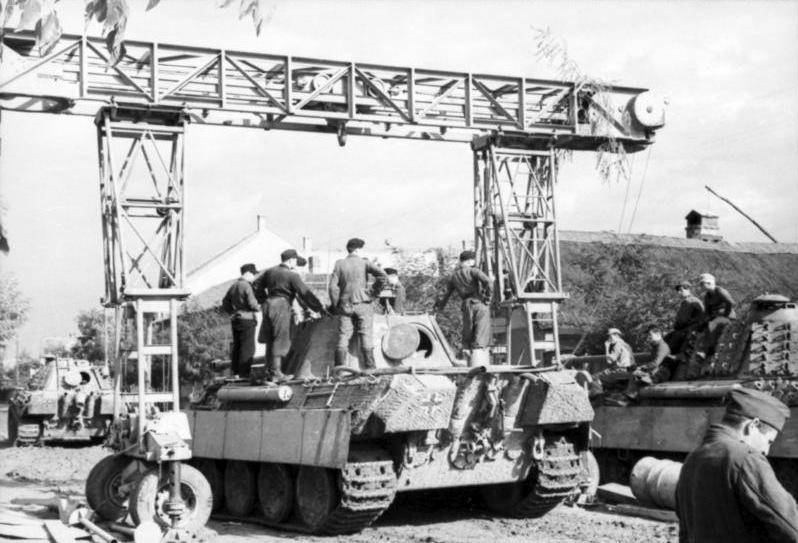
Figure 1. The Strabokran moving gantry was indispensable to maintaining the Panther tank in the field. (Source: en.wikipedia.org/wiki/Panther_tank)
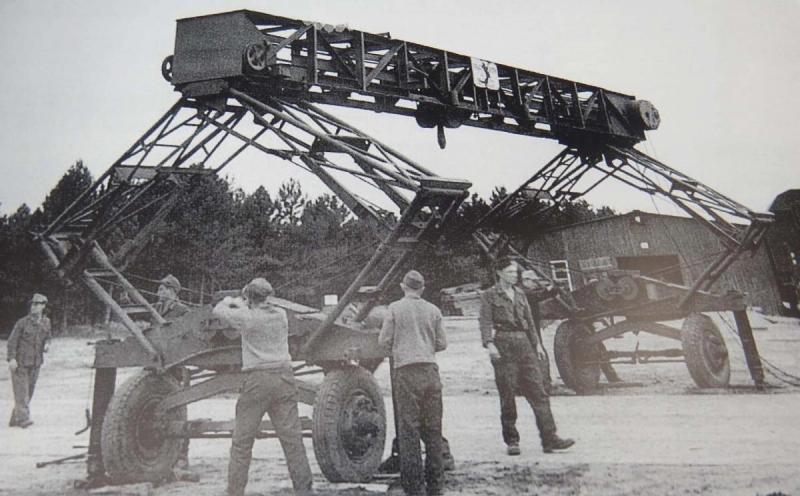
Figure 2. Setting up the Strabokran moving gantry. Mobile gantries could lift Maybach tank engines or turrets. The gantry could be folded for transport and converted into a trailer. (Source: https://www.landmarkscout.com/strabokran-german-mobile-gantry-crane/)

Sadly, my comment also speaks volumes to the lost ground our profession of arms has to make up before our next catastrophe. Your article is a step in the right direction.
I'm reminded of the WW2 Willy's Jeep - super simple, easy to repair - and could be assembled anywhere with simple tools. Whilst obviously not the same as today's equipment I totally agree that if the 'spanners' cannot fix something in situ so it can at least continue the mission then it becomes a liability.
Pleasing to see articles such as yours on a very important subject. I base this on having sat in numerous O Gps at A then C Sqns of 1st Armd Regt in SVN in 1970/71 while OC Tech Spt Sqn briefed all on the current spare parts situation for Centurion and, in turn, how many "runners" were aval for ops the next day. Controlled cannibalisation was sometimes employed. Usually using ex-tk sqn Centurions then with the RAAC det of the fwd del tp and awaiting back-loading to Australia.
Centurion would be vastly less complicated repair wise than Abrams?
RAEME spt for both cav and tk sqns in SVN was excellent as usual. The Americans were very impressed with our M113 configuration with crane. The Nazi Army crane is interesting.
This problem of repair/recovery will be just as important to mech inf and SP btys.
Will you be incl repair/recovery spt for an RAAC fwd del sqn. etc, org in your future papers? Arty and inf might be reflecting on how they receive battle ready replacements and crews too?
Simplicity is important as soldiers tend to reject what is over complex to maintain in battle conditions.
Chad Sutton.
Excellent article thank you for laying it out so well, history must be accessible to be useful for practitioners.
Your term “distance magnifies fragility” is such perfect framing of something I’ve been trying to conceptualise for a while. It captures the physics of military operations so well, thank you.
You are also correct in your summary of the procurement conundrum. I lived this in a motorised infantry battalion. Our maintainers worked so hard to manage the maintenance debt of a very tired bushmaster fleet, whilst the new Hawkeis were essentially unusable due to technical issues. Most of us just wanted bushmasters that had been built in the last decade.
You articulate the fragility of maintenance at distance in a European theatre of war. This should resonate with us loudly as the Australian theatre becomes significantly more complex with projection from beyond out continent.
I think your article hints, convincingly, to an Australian need to repair forward and without complex requirements. You hinted at it, but it’s worth bringing out that this maintenance should also be liberated from the need to communicate rearward or maintain a rear data link (as it would probably not be available anyway).
Great article, thank you!