
It is likely that future large scale conflict will generate prisoners of war, internees, and detainees otherwise known as PWIDs (previously CPERS) from the first point of contact. The Australian Army cannot afford to treat Internment and Detention Operations (IDOPS) as a niche or rear-area function. While the Royal Australian Corps of Military Police (RACMP), particularly 1st Military Police Battalion (1 MP BN), are the Army’s subject matter experts in IDOPS, modern operations demand that all corps possess baseline PWID handling competence. Military Police enable this competence; they do not replace it. Failure to recognise this reality risks loss of tempo, legal non-compliance, and strategic failure.
PWIDs in the Contemporary Battlespace
The war in Ukraine has reinforced a fundamental truth of conventional land warfare: PWIDs are a persistent operational feature, not a post-conflict administrative burden. Ukrainian and Russian forces generate PWIDs through trench assaults, urban clearance, counter-infiltration tasks, and vehicle checkpoints (VCPs). These captures occur under fire, at small-team level, and often far forward of formal detention infrastructure.
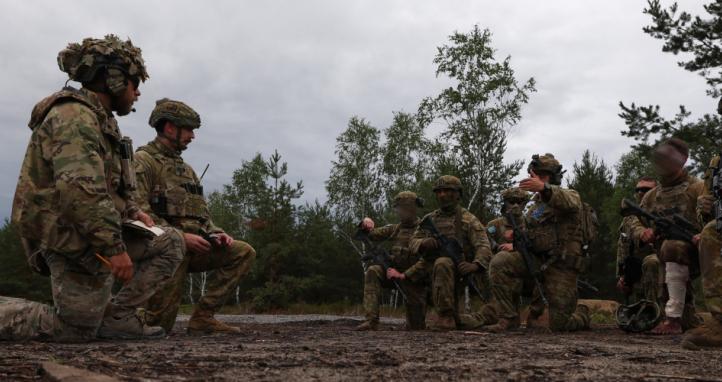
This environment mirrors the conditions the Australian Army is likely to face in future conflict in our near region. Dispersed operations, urban littoral terrain, and hybrid threats will ensure that PWIDs are encountered by all corps, not just infantry. Expecting Military Police to be present at every point of capture is unrealistic.
ADF doctrine is explicit. Detention begins at the point of capture and remains a commander’s responsibility until formal transfer of custody. The capturing force must safeguard PWIDs, prevent reprisals, and ensure humane treatment in accordance with the Law of Armed Conflict (LOAC). These obligations are non-negotiable and carry strategic consequence.
The Point of Capture Is the Decisive Moment
Ukraine demonstrates that the point of capture is where detention either succeeds or fails. Soldiers must transition immediately from lethal force to controlled restraint. Units without rehearsed Point of Capture (POC) drills lose momentum, fix combat power in guard tasks, and expose themselves to unnecessary risk.
Conversely, units that normalise detention procedures maintain tempo and security. This is not a policing function; it is a combat skill. PWID handling must therefore be treated as a core soldier competency, rehearsed alongside casualty evacuation and clearance drills.
PWIDs also represent an intelligence and force protection consideration. Poorly controlled detainees have attacked guards, escaped, or relayed crucial information. Disciplined handling reduces this risk and enables lawful exploitation.
What Soldiers Must Carry and Know
Combat conditions reward simplicity. Examples from Ukraine highlights\ that complex detention systems fail under pressure, while simple and standardised tools enable control and tempo.
The first requirement is to maintain the shock of capture. This is taught as the “Eyes, Ears, Cuffs” rule. The eyes and ears, which can be as simple as sleeping eye masks and 'Bunnings tradie' headphones, allows for the PWID to gain sensory deprivation while the restraints, ('flexi-cuffs'), allows for complete control from the guard force. All of these are lightweight, scalable, and effective and should be carried by each person in the section. Experience shows that improvised restraint leads to injury and reputational damage. Soldiers must be trained to apply restraints humanely, monitor circulation, and understand duration limits.
Equipment control measures, including sandbags or garbage bags, are used to place all the PWIDs belongings in that have not been confiscated for intelligence or criminal investigation purposes, keeping it all together and linked to that specific detainee. The issued ADF capture cards remain a critical enabler. Accurate documentation preserves chain of custody, supports intelligence exploitation, and ensures capture occurs within legal limits. Carriage and use of capture cards should be non-negotiable across all combat elements. These cards are also broken into three: one stays with the PWID, one stays with their equipment in the sandbag, and one goes with the unit.
Backloading PWIDs Is an Operational Enabler
Every soldier guarding PWIDs is removed from tasking. Ukraine demonstrates that delayed or improvised backloading fixes units in place and degrades tempo.
ADF doctrine directs that PWIDs be transferred to designated detention elements as soon as tactically feasible from the capture assembly area. This is where RACMP provide unique operational value. If MPs are not organic to the Battlefield Clearance Team (BCT), with medics and engineers, they must be called forward early. Capturing units should provide accurate numbers, location, and security context.
Once the MPs arrive, they will gather the PWIDs, assume control from the guard force, then backload them when deemed ready – all they need from the capturing unit is the basic information and the capture cards. 1 MP BN is trained to establish and operate Initial Collection and Processing Centres (ICPCs). These centres enable controlled search, segregation, medical screening, intelligence handover, and preparation for transfer to longer-term facilities.
When MPs assume custody, combat units regain freedom of action. PWID handover drills should be rehearsed with the same discipline as casualty evacuation. Military Police are not simply receiving prisoners; they are restoring combat power.
Military Police Forward: VCPs and Manoeuvre Support
A persistent misconception within the Army is that Military Police operate primarily in rear areas or solely within a Joint Military Policing Unit (JMPU) construct. Contemporary operations contradict this view.
RACMP elements routinely conduct VCPs, law enforcement for the local population, vital asset protection, and Manoeuvre Mobility Support (MMS). VCPs are prolific PWID generators, particularly in urban and hybrid environments, with the increase of internally displaced persons. MPs operating forward are often the first to detain enemy personnel, collaborators, or unlawful belligerents.
This forward posture allows MPs to apply IDOPS expertise immediately and advise commanders in real time. Their value lies not only in custody, but also in professional judgement, risk mitigation, and force protection.
The Way Forward
The solution is not to dilute MP expertise, but to amplify it across the force. All corps and callsigns must receive or combine their own training on baseline PWID training delivered with the RACMP. This training should be practical, scenario-based, and reinforced during collective training. This role extends beyond custody to doctrine development, training validation, and operational advisory support. Embedding MPs in planning processes ensures detention considerations are addressed before contact, not improvised afterwards.
Cultural change is required. PWID handling must be viewed as a combat function, not an administrative burden. Military Police are not simply “JMPU” or rear-area enforcers. They are combat enablers who preserve tempo, legitimacy, and freedom of action.
Future conflict will test the Australian Army not only in how it fights, but in how it detains. PWIDs will be generated early, often, and under pressure. The Royal Australian Corps of Military Police, particularly 1st Military Police Battalion, are the Army’s subject matter experts in Internment and Detention Operations. Their effectiveness, however, depends on a force that understands and enables their role.
For non-MP corps, this is a professional imperative. Recognising Military Police as more than “just JMPU” is about combat effectiveness. MPs safeguard soldiers, restore tempo, and protect the Army’s legitimacy in war.
PWIDs are everyone’s fight. IDOPS is a combined-arms skill and empowering Military Police to lead it is a vital force multiplier.
I agree with your point that "Expecting Military Police to be present at every point of capture is unrealistic." I would also offer that Military Police expecting to be present at the point of capture is likewise unrealistic. During Large Scale Combat Operations (LSCO) such as that seen currently in Ukraine, or if we think back to the battles of Mosul in Iraq, or more closer to home the battle for Marawi in the Philippines, the military police were not in the front lines fighting. This is not because they don't have a role, it is just that they are not suited to that particular role like their Combat Arms Corps brothers and sisters.
Having said that the points you have made and arguments for the elevation of consideration for PW handling, classification and intelligence are very important. Units developing their own TTPs right down to section level for how they take, hold, back-load and transfer PW and others is a fundamental part of war-fighting competence. This is something we need to continually train, exercise and rehearse.
This is a well written article and I hope many more people read and engage with it. Thank you!
Your article did a great job at describing how "Sensory Control" actions can positively effect individual security and safety. It also. gave solid advice to individual soldier kit for PWID operations. Well Done!