
Part 1 to this article can be found here.
After Action Reviews and what right looks like
Think about the last AAR you delivered or attended. How many voices spoke? How many stayed silent? What was the impact of the AAR? Did anyone care? Did the issues get rectified? When you did the activity the next time, did anyone read your last AAR points?
If you have the time, I encourage you to read the article a couple of times. When you read it the second time, think about what jumped out at you and why. Think about if it brought up any previous experiences, positive or negative. Try and recall what impact that had and if there was anything in your control to improve similar experiences moving forward. If you want to share any thoughts on that learning, or the article, feel free to comment and get a conversation going.
In part one of this article, I pointed out that the Australian Army conducts a huge volume of training, exercises, deployments, and a range of operations. However, we don’t always learn from it. The problem identified is that if we don’t learn from training, then what is the point? Just because we do something often does not mean we get better at doing it; to get better we need to learn.
In order to learn we must deliberately process what has happened, what worked and what didn’t, and what better options there might be for the future. Often at the completion of a task or training activity a unit will conduct an AAR. Many of which devolve into box-ticking activities. Even worse, many are rank-dominated discussions where egos are either stroked or defended. This only leads to superficial observations that are essentially meaningless. This isn’t because AARs are the wrong tool, it is because we use them in the wrong way. The problem is simple, but the impact is significant because AARs done poorly drift without purpose towards analysis instead of purposeful learning.
The previous article offered a solution: the leader needs to lead, instruct, and facilitate. This article builds on that by offering leaders a guide and some tools to facilitate individual and group learning from any experience. Some of this is drawn from my own experience, some from doctrine and other academic reading. The key underpinning concept outlined here is application of the experiential learning cycle.
This article explores why many AARs fail to generate meaningful learning, what ‘wrong’ looks like, and provides a practical facilitation method leaders can apply immediately.
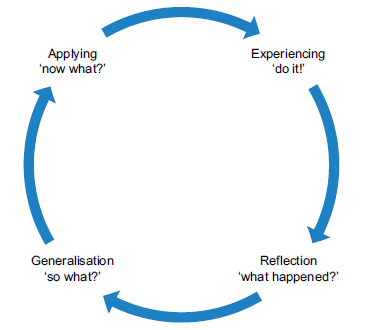
Figure 1: Application of the experiential learning cycle, adapted from David A. Kolb, ‘Experiential Learning: Experience as the Source of Learning and Development’ (1984), p21.
The problem – AARs misused and what wrong looks like
Recently I found myself at the end of a significant exercise. The Australian Army had just spent a significant amount of money, we had fired a lot of ammunition, joint capabilities from other services were involved and, unfortunately, some soldiers had been injured. There was a lot of learning opportunities possible. I was looking forward to the AAR, I knew all the subordinate echelons had already completed their AARs and provided their feedback. I felt ready to contribute!
However, when it came to the conduct of the AAR I was severely disappointed. All of the talking time was dominated by two speakers: the guy at the front, and the most senior rank in the room. The whole time was basically a recap of what happened. I learnt later that the AAR ‘checklist’ was already written before the activity had been conducted. They spent far too much time debating if some token and superficial statements should be prefixed by ‘sustain’, ‘fix’, or ‘improve’. Anytime anyone spoke up ‘from the back row’ they were either ignored or the guys up the front argued that they had a ‘different perspective’. Quickly there were no other voices as everyone waited for the meeting to end.
There is no need to label the organisation or event linked to that AAR. That is a disappointingly common experience that is probably familiar to every soldier. The point being here is that if you have experienced it, that is the AAR misused. The fact that it is so commonly misused is the problem to be ‘fixed’.
Four ways AARs go wrong
- When AARs become dominated by rank, juniors will often close up and shut down. This should not be surprising to us. When we issue an order, we don’t expect debate – we expect our team to get on and carry out those orders. Even when we do ‘open the floor’ to junior soldiers, they will hesitate. Sure, some more assertive or louder voices might step in and dominate but then others will follow and now we are back to the rank problem. The trick is to acknowledge that the AAR is not a set of orders. When we are facilitating an AAR the group should be talking 90% of the time, the facilitator only interjects to confirm understanding and guide the group’s conversation with itself and make sure all voices are heard, not just the loudest or highest rank ones.
- When AARs focus on events and not behaviour, they focus on the trivial and not the important. AARs then get caught up on detail that really doesn’t matter. In doing so we fall down rabbit holes of minutiae details that are rarely relevant. So, often we focus on when things happened, if they happened late or early compared to the program schedule. Sometimes AARs quibble about food quality or types of hats or boots. Discussion, if any, circles the drain on the trivial. The trick here is for the facilitator to keep the group focused on things that had a genuine impact on the success or failure of the group in achieving its assigned mission. Importantly, the facilitator needs to acknowledge the input of everyone – but remind them to focus on the important and continue to encourage their input to the AAR.
- When AARs become a checklist or follow pre-written templates people rush to ‘lessons learnt’ before genuinely exploring what happened and why. A red flag for this sort of template thinking is when observations are pre-label inputs as a ‘sustain / fix / improve’ before they are discussed! These pre-conclusions jump over any opportunity for learning or application of context. In doing so bad lessons are misapplied to inappropriate contexts. Instead, AARs should be a genuine reflection on what was important that happened, why it happened, why it was important in that context, and connect it to other relevant contexts. This is a skill for the facilitator as they need to guide the group, not tell them. The good facilitator in a good AAR will guide the group to answer these questions for themselves.
- When AARs identify issues but don’t change behaviour they aren’t really an AAR, they just become a gripe session. In these poorly delivered sessions, the leaders leave with assumptions unchallenged, and others leave with frustrations and unmet expectations. When this happens, even if issues are identified, no-one is held responsible for them and no commitment to change is made. Unfortunately, these are the worst sessions as soldiers see the issues and wade through the AARs where no one takes responsibility only to re-live the same experience on the next training cycle. To avoid this the facilitator again is vital; their role here is to help the group to identify what needs to be changed and who is best suited to influence that change. Once identified, the group and individuals make commitments to that change right there and then. Importantly, it does not stop there, these commitments are followed through and the group holds itself accountable for the change, particularly before it re-enters the next event to ensure the change has happened.
The solution – well applied AARs and what good looks like
- AARs are adult learning environments, soldiers are adults too. Leaders often find themselves in a parental mindset. This is fine, we want to be protective of those under our command and care. Yet it does not work when we treat these adults as children. As adults, they want guidance and options, not directions and instructions. They want information that will help them to improve through their choices, not being told what to do. Adults learn best in informal situations. Often, they learn better when taking responsibility for the content they require to understand particular goals. Allowing discussion and decision making of problems gives ownership to the adult learner and acknowledges their experiences. Adult learning around problems necessitates mutual goal setting between the facilitator and learner to identify what the learner can do and wants to do. This will identify the gaps to be addressed to assist learners achieve their goals. Simply put, leaders need to guide our soldiers to help them problem solve, if they can’t see the problem then we help them and others to show them what is a problem and why. Once achieved we help them to what they need to be able to solve that problem now and in the future.
- Leaders don’t hide behind their rank. An AAR needs to be open and honest. This means that all the soldiers, regardless of rank, need to feel that they can speak and be heard. As always, conversations must be respectful, it should go without saying, but it is an important ground rule to set up front and explicitly to deliberately frame the conversation. This does not mean that the conversation is ‘parking’ or ‘setting aside’ rank, that never goes away. Instead, the facilitator needs to be explicit by setting the ground rules and acting on them. They need to say: “I want everyone to speak and be heard” and then actually guide the group’s conversation to make space for everyone to speak, regardless of their rank. Leaders and facilitators should avoid presenting themselves as ‘the expert’, as this may make them the focus of resistance or attack. If leaders impose or lecture to the group, they undermine their ability to help the group to learn, develop, and change. Some may fear that this could harm their reputation in some way; however, the opposite is true. Often, the leaders discover more skill and knowledge within their soldiers by doing so. When subordinates know that their leaders will genuinely listen respect and trust is built.
- Leaders facilitate; they don’t dominate. The AAR is not a commander’s brief nor is it a set of orders. It is not a one-way conversation from some ‘sage on the stage’ who has all of the answers or who’s perspective is unquestionable. The facilitator simply guides the discussion. Leaders remember to keep space for others to contribute, they leave observations open so that others can fill in with their perspectives, ideally, leaders speak last after more junior soldiers have had an opportunity to speak. The most effective thing a facilitator can do is pose open ended questions around the group such as: ‘what surprised you about this training event?’, or ‘what did you notice about the communication when we were under pressure?’ and ‘your team-mate just offered their perspective on what happened, what do you think about that?’. In this way the facilitator can bounce the questions and thoughts around the group, encouraging all to speak up and genuinely giving them space to be heard. Ideally, the group speaks 90% of the time in a well guided AAR.
- Focus on context, not just events and generalise beyond the now. After Action Reviews need to delve into the reasons why things were done and their context, not just what was done. AARs that are limited to actions are superficial and deliver next to zero learning. Instead, AARs need to probe deeper. The facilitator needs to start with questions like ‘what happened’, ‘what was a significant event that led to success’ and the like. Once these key issues or events are identified that is just the start. Facilitators need to help the group dig deeper. It is as simple as then asking the group ‘so what?’. When this question is bounced around the group meaning and context is given to the action. Even better is asking ‘so what’ again for deeper meaning, or have the group consider those actions but in a future iteration of what they just did, or what they just did but in a different context. Different parts of the group can now hear others on their perspective of what happened and together they get a better appreciation of what it meant in relation to the whole event. Crucially, everyone gets a chance to understand why things happened or didn’t and why that is important.
- End with clear behaviour-based commitments. After the facilitator has summarised the key learning, the AAR continues. Once the learning, development, or change need has been identified there is now a gap. That gap is where the group is now and where it wants to be. This requires the group, and individuals in the group to make a commitment to that change needed. The facilitator’s role here is to guide the group to say openly to their peers what they will do for themselves and the team to improve. This also has the added benefit of the group holding themselves accountable afterwards.
Some additional AAR tips for leaders
The facilitator’s role is to keep the AAR moving in a useful direction. When doing this, the facilitator can guide the group, acknowledge all the points to start with, but then move though one thread at a time, through the stages of “what?”. “So What?”, and “So What?”, then start again. Once enough threads have been pulled through, the facilitator can summarise and move to the “Now What?” asking for commitments from the group.
- Some examples of “what” questions:
- What did you notice about what the group did today?
- What did you do that really stood out to you as exceptional?
- What significant actions did you see or do that significantly contributed to the success or failure of the group?
- What did you enjoy today? Was memorable today / was miserable today?
- What was something you saw today that was strong?
- Some examples of first level “so what” questions:
- So, you said this…. How did that make you feel?
- So, you identified this …. Why do you think that is important here and in this context?
- Can you describe the impact that what you identified had on the group, its cohesion, and its success or failure in this specific context?
- You said that you enjoyed / hated this … why is that?
- Some examples of second level “so what” questions:
- You said that this…. Made you feel happy / confident / miserable / uncertain, what impact might that have on you if you were to do this again in future?
- You said that this … was important, would it be just as important if the group were to do the same task again? What about if we were to do the same thing, but in a different context, can you describe how would that look?
- You described the impact would have a significant impact on the success or failure of the group, why does that matter in this context? What would the impact be if something were to change to address that?
- Some examples of “now what” questions:
- So, you’ve identified something that needs to change. What can you do that is realistically in your control to make that change?
- What are you going to commit to do that is different?
- Can you give the group an example of how you are going to use this commitment after you leave this activity?
- What will you do to remember your commitment just made? How will you check in on each other and your commitments?
- What behaviours are you going to keep doing?
- What behaviours are you going to stop doing?
- What behaviours are you going to start doing?
- Questioning techniques: use open-ended questions that invite discussion. Bounce the questions around the group, invite discussion.
- Keep the group’s attention, where possible have everyone sit on an equal level in a circle where as much as possible everyone is in the front row. It isn’t always possible but make the group comfortable to speak openly.
- Check responses amongst the group, for example: “Hey your team mate just said this… does that sound right to you?” Alternatively, “Ok so if I read back to you what I’m hearing is this… how about others from the group? Does that sound right?”
- Confirm and compare perspectives amongst the group, for example: “Ok so he/she just said this, is that what you saw? Is that how you understood it?” Additionally, “So she/he says that this …. Is important because of this… does that sound like something you’d say?”
- Where awkward information comes up, or if it doesn’t fit right now, acknowledge it, pause it, and come back to it. If it is unsuitable or inappropriate or if there is no time, acknowledge it again at the end then deal with it outside the group AAR discussion.
A simple graphic guide
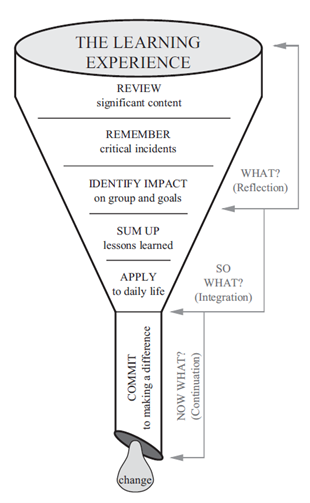
Figure 2: The funnel method of facilitation, from Priest, S., Gass, M., & Gillis (2000) ‘Essential elements of facilitation’ p89.
Conclusion
The way we conduct AARs shapes the way our teams think, learn, and lead. When AARs drift into rank‑dominated monologues, checklist rituals, or superficial commentary, we waste hard‑earned experience. But when leaders deliberately apply the experiential learning cycle – when they create space for honest reflection, explore context and behaviour, and drive commitment to meaningful change – AARs become one of the most powerful tools we have for developing leaders and strengthening Army capability.
Every training activity, every mission rehearsal, every barracks routine contains lessons waiting to be uncovered. Whether we find them depends entirely on how we review our actions. That responsibility rests with leaders.
So, here is the challenge: improve one AAR. Just one.
Set the conditions for genuine dialogue. Let the group speak. Ask better questions. Guide – don’t dominate. Focus on what mattered, why it mattered, and what must change next time. Then – before you pack up – run an AAR on the AAR itself. Ask your team what helped, what hindered, and what would make the next review even better.
If we can learn to learn better, we can train better.
If we train better, we fight better.
And if we fight better, we win.
The next step is yours. Lead the change in how your team learns – one well‑run AAR at a time.



Please do re-read it and post any reflection you might have, write some comments on your own experiences both good and bad. If you found something particularly useful, or jumped out from the article that might be of use to you in the future, please throw in a comment.
Again great article and strong reminders for all.
Through my response I’d like to ask some reflective questions topic of AAR’s and how we improve their value.
Essentially, is there anything else we should be doing to
enhance the use or outcome of AAR’s?
You’ve identified some really strong themes of quite a specific nature about how AAR’s go wrong. For the record, I am in full agreement with these observations and the potential for AAR’s to be diluted, influenced or steered into a less than valuable place.
However, I’d like to pose some questions, perhaps more for the readership of The Cove than just yourself, that relate to how we enhance the value of AAR’s and seek for them to be genuinely developmental for individuals, teams and collective capability.
1. The DMPP is a real centerline for planning in the current environment. Should Chapter 10 expand into not just a summary of training the staff, but some guidance on AAR’s for command teams? The intent is not to create a deep replication of other publications, but to provide a brief and focused prompt on staff development through the use of AAR’s
2. Should we include AAR’s as a point for Commanders guidance? Missions get planned, missions get executed, and the same goes for training. However, should we seek to explicitly have commanders consider their requirements around AAR’s in order to seek the maximum value of each experience for the force element?
3. Within a training environment, and the normal constraints of cost/budget, should we plan on allocating a portion of resources for Post-Activity investment? The premise is that we often choose to halt a training activity, sometimes for a few minutes, at other times for a good portion of a day in order to conduct AAR’s. Should we also plan on explicit investment in time, money, directed effort in remediation/refinement/development of a focused set of AAR points?
I’d enjoy reading the reflections of others around these ideas.
Just on point three ... of course every single Army activity should be doing AARs. It ought to be happening already and be as natural as breathing. Many good units already do this and do it well, to reflect on what they did, learn from their experiences and adapt. many other units do not.
The AAR and indeed the funnel are already in Army leadership and elsewhere in training doctrine, however, we often forget about how much of a resource our doctrine publications are as a codified repository of lessons learnt.
Thanks for commenting!
Lastly, I feel that trainers must always be on the lookout to capture comments regarding tangential effects or "outliers" that influence or detract from the training experience. Sometimes, these out of normal events greatly influenced the outcome, and sometimes the cost of the training prevented the ability to reset or redo the training event.
Thanks again for the effort and well-written article that in itself is very inviting to provoking discussion.
Also, I agree, the trainers and facilitator must be on the lookout for 'outliers'. That is often when the best moments of training and learning can occur. Indeed it is where real innovation and adaptation can exist
Great comments, thanks!.
https://cove.army.gov.au/article/new-approach-collective-training-lessons-drawn-sport-and-music
I couldn't agree more that we ought to at least read our own lessons learnt. It's pretty unusual for us to to something completely new, so there is much to read from our own after activity reporting, checking the lessons repository, or even just talking to the people who were there last time.
Also, the pre-action review, (also known as a before action review, front loading or pre-mortem) are useful when done right. These are not orders, but they are before the activity. They help the group to visualise what they are about to do, how they could move onto a pathway to succeed or how they could move onto a pathway to fail. In doing so they can talk through and mentally rehearse what actions and behaviours they will need to adopt. Importantly, they can also pre-identify indicators and warnings that will alert them to when they or another in the group might be onto a pathway to success or failure.
The whole point of the 'learning cycle' (also under the name of Kolb, Deming or experiential learning cycles), is that it continues!
Great comment Thomas, thank you!
I always think of one of my soldiers who was very quiet. I talked to him and he said it was deliberate because he already knew what he knew, he said if he just kept his mouth shut for a minute he might hear someone else's experience and learn something knew.
His thought stuck with me, but I also offered to him, that there are times when others would also benefit from his understanding and perspectives as well (and I still do). Sometimes is up to the leaders and facilitators to raise these voices and make sure that there is a space for them, and credit them for their shared knowledge and experience.
Thanks for reading and commenting!
A learning cycle closes when behaviour changes. But at the collective level, changed behaviour often demands changed training: different serials, different resources, different design. Perhaps the logical next step of your argument is what happens when the cycle meets the TARP process.
Units reflect well, generalise well, identify what needs to change, then bid for roughly the same training because the resourcing process doesn't systematically ask what was learned. Or at least that was my lived experience. Layer in posting cycles and the people who held the lessons are gone before the next submission is due.
I reckon that's your Stage 4 failure at the institutional level. Until lessons learned have a deliberate pathway into how training is resourced, the cycle you describe will keep breaking at the point where it matters most. Again, mine could be a dated perspective. Would welcome your thoughts and those of your readers.