



Article Summary
The article argues that the brigade-centric force design inherited from Monash’s 1918 combined-arms method is no longer survivable against transparent battlefields, pervasive sensors and cheap precision strike. It identifies the division as the only echelon able to mass effects, fuse ISR and electronic warfare, and hold scarce enablers outside the lethal zone. It suggests stripping brigades back to resilient, self-sufficient infantry battalions while centralising specialist capabilities at the divisional level.
The Australian Army is approaching a strategic moment where long‑standing assumptions about how it fights must be confronted directly. For decades, our force design has been shaped, often unconsciously, by a brigade‑centric interpretation of combined arms warfare rooted in the logic crystallised by General John Monash at Hamel in 1918. While Monash’s method remains timeless, the structures built around it no longer align with the realities of contemporary conflict. Transparent battlefields, ubiquitous autonomous systems, degraded command and control, and long‑range precision strike have fundamentally altered how land forces must fight, survive, and generate operational effects. Persisting with self‑contained brigades built around duplicated specialists and concentrated enablers is not simply outdated; it is operationally dangerous. The Army must restore the division as its unit of action and redesign brigades as dispersed, survivable fighting echelons optimised for littoral warfare. This is not a conceptual preference or a doctrinal debate. It is an operational necessity driven by the changing – or perhaps changed – character of war.
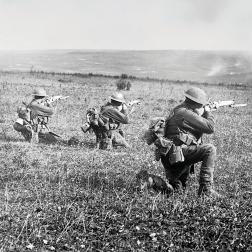
Monash’s achievement at Hamel was not the invention of combined arms warfare, it was the refinement of a method suited to the technology and conditions of his era. He synchronised infantry, armour, artillery, engineers, and aviation to create effects greater than the sum of their parts. His genius was adaptive rather than doctrinally rigid. He understood that new tools or systems such as tanks, aircraft, and creeping fires required new forms of integration. The enduring lesson from Hamel is not the specific combination of capabilities, but the principle that combined arms must evolve with the character of war. Today’s decisive enablers include precision strike, pervasive ISR, electronic warfare (EW), autonomous systems, cyber effects, loitering munitions, and evolved engineer and sustainment capabilities. Leaving these capabilities permanently embedded within every brigade concentrates scarce enablers, expands signatures, and creates vulnerable support areas whose survival can no longer be assumed. To cling to Monash’s 1918 toolset while ignoring 2026 realities is to misunderstand Monash himself. His logic endures; our structures must evolve.
Modern conflict is defined by persistent surveillance and rapid sensor‑to‑shooter cycles. Forces are detected within minutes, in some cases seconds, and precision strike is cheap, ubiquitous, and lethal. Large logistical nodes, maintenance areas, and concentrated or static headquarters are now rapidly detectable and vulnerable. This is not a theoretical risk. It is observable across Ukraine, Gaza, Nagorno‑Karabakh, and the Red Sea. Brigade maintenance areas, brigade logistic nodes, and brigade headquarters are now liabilities. They cannot survive inside the lethal zone of cheap ISR‑strike systems. The Army must reconsider its design for battle and its structures that assume survivability where none exists.
Modern warfare increasingly rewards formations capable of managing operational reach, integrating effects across domains, and adapting specialist capabilities at speed. Brigade‑centric combined arms logic, where each brigade holds its own artillery, engineers, logistics, and ISR is no longer survivable or sustainable. The division is uniquely positioned to mass fires and launch effects at decisive points; fuse ISR, EW, and intelligence into a single operational picture; apportion scarce enablers such as engineers, air defence, and sustainment to the main effort; coordinate multi‑domain effects across space, cyber, maritime, air, and land; and protect high‑value capabilities by positioning them outside the lethal zone. It is also the only echelon capable of shaping littoral campaigns across archipelagic terrain in Australia’s Primary Area of Military Interest.
This logic is already driving change in allied armies. The United States Army is re‑empowering divisions and corps as the formations responsible for integrating fires, sustainment, and operational effects. For example, the 25th Infantry Division – highly relevant to Australia’s strategic environment – is centralising artillery, engineers, logistics, and ISR at the divisional echelon while redesigning brigades for dispersed, infantry‑centric operations. Australia must follow suit or risk battlefield defeat through organisational designs increasingly mismatched to contemporary conflict.
The 2023 Ukrainian counteroffensive demonstrated that tactical success does not guarantee operational breakthrough. Despite capable tactical formations and Western armour, Ukrainian forces struggled to penetrate layered Russian defences. They lacked massed breaching capability, engineering depth, and operational sustainment at scale. More importantly, Ukraine revealed a 40 km “dead zone” dominated by cheap, persistent ISR‑strike systems. Concentration, predictability, and static positioning were punished immediately. This environment places significant pressure on traditional brigade structures and assumptions about concentration, sustainment, and survivability. Support and combat forces must either be pushed forward to the tactical edge or moved rearward to divisional support areas that can be better protected. The division must shape the tactical zone for decision; the fighting echelon must be organised to fight organically at the lowest level.
Brigades should remain the tactical fighting echelon, but they must be stripped back to what can survive forward: infantry battalions enabled by robotic and autonomous systems, resilient command and control, and organic tactical fires. At the centre of combat power remains the infantry battalion; soldiers with bayonets will endure as the final thirty centimetres of political policy. Those soldiers deserve to be protected by effective and modern structures, not legacy assumptions. Infantry battalions should regain organic reconnaissance, resilient command and control, tactical fires, anti‑armour systems, very short‑range air defence (inclusive of counter-uncrewed systems capabilities), and integrated robotic and autonomous systems for sensing, strike, and resupply. They must also regain organic sustainment, health, and pioneer capability. Years of efficiency‑driven reform have hollowed out battalion effectiveness. We have created battalions that are administratively neat but tactically brittle and we have evolved to a point where an infantry battalion requires teams from every unit in a brigade to fight. This is an unacceptable risk in a transparent battlespace.
Armour remains relevant but should increasingly be viewed as an operationally allocated capability rather than a permanently embedded brigade asset. Where armoured effects are required at brigade scale, they should be generated through task-organised formations or specialised armoured task forces. The Army has this now with the 3rd Brigade and it makes sense to leave it designed the way it is. Their employment will require deliberate conditions for success and training in peacetime as an armoured taskforce is the right approach, therefore the most urgent requirement is not to redesign the armoured brigade, but to redesign infantry battalions. Army’s light infantry battalions are built for effectiveness rather than efficiency. These battalions must be capable of infiltration as the primary form of offensive action, not penetration or envelopment. Light, agile, persistent forces will set the conditions for manoeuvre, not the other way around.
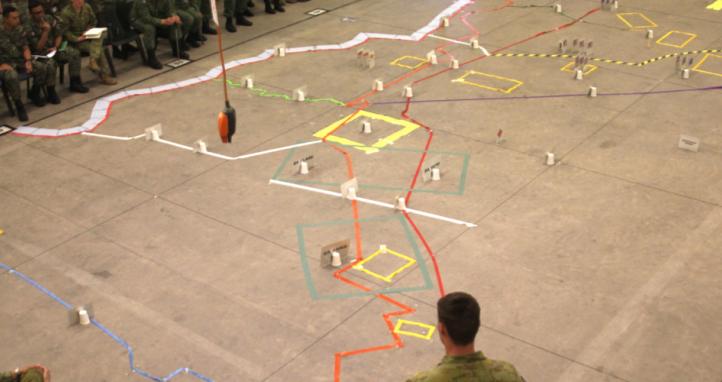
Specialist capabilities such as artillery, ISR/EW, engineers, logistics, and air defence are scarce, technically complex, and operationally decisive. Their employment demands integration and prioritisation that cannot be achieved at brigade level. Centralising these capabilities at division provides operational massing of fires and effects, an integrated ISR/EW/INT enterprise, campaign‑level sustainment and engineering, reduced signature in the fighting echelon, and centres of excellence for continuous adaptation and capability development. This structure restores clarity of purpose: brigades fight the close battle; divisions orchestrate operational reach, sustainment, and multi‑domain integration. The core function of a division is not command for its own sake. It is battle management. Modern warfare imposes a burden of synchronisation across fires, electronic warfare, sustainment, intelligence, cyber, air, maritime, and land domains that exceeds the capacity of brigade headquarters. Division headquarters exist to manage combat power across space and time, determining where scarce resources are concentrated, when brigades (in the close fight) enter and leave contact, and how combat power is preserved for subsequent operations.
Under a division‑led system, specialist battalions and regiments would sit under colonel‑level command within the division. These commanders would serve as subject matter experts and operational integrators. For operations, the division would task‑organise specialist units for tasks or assign sub‑units to brigades as required, then reconstitute them once missions are complete. Brigades would maintain liaison elements to ensure rapid integration and deconfliction. Automated tasking tools and data‑centric command and control would accelerate decision cycles while preserving lean brigade headquarters focused on the close fight. This structure is not a return to the past; it is an adaptation to the present.
This type of proposal risks being perceived as another cyclical structural reform. This must be mitigated by clearly articulating the operational problem: the character of war has changed, and current force structures are not survivable. Concerns about brigades losing initiative are misplaced and aligned to how we have previously designed to fight. Initiative comes from capability, not structure. Rebuilding battalion depth and resilience solves this – effectiveness over efficiency. Concerns about divisional headquarters becoming targets ignore the fact that brigade headquarters already are. The answer is dispersion, hardened communications, and resilient networks; it is not duplication of enablers.
Monash adapted to his battlefield. We must do the same. The Army must restore and enable the division as the unit of action through centralising specialist capabilities (units), and redesign its non-armoured brigades as dispersed, RAS‑enabled fighting echelons built around resilient infantry battalions. This is not simply a proposal for another evolution, it is a necessary correction. The logic of combined arms endures but we must acknowledge its composition must change. This will unlock the capability for the division to be the unit of action and adapt using the same principles Monash applied.

Western armies are wedded to ideas, such as ‘unit of action’. I think the idea is a distraction. Each command echelon has unique responsibilities and thus force design requirements. They are driven by their assigned role. The design principle should be ‘subsidiarity’. Each higher echelon must be able to facilitate the success of its subordinate by making sure it is designed correctly. And should have the resources and assets to stabilise the task space, by blocking external counter actions. This has not been the norm of Australian force design. This has resulted in insufficient ‘enablers’ leading to the desire to centralise. If the elements are needed, they need to be acquired. Or at worst planned for.
The other key issue is that forces needed for defence, need not be alike with elements designed for offence. Sensor-strike condition highlight this. A drone platoon can destroy an advancing armoured brigade. While attacking troops will need to be well versed in small gap (3-6 men) infiltration, area clearance and defeating counter attacks. The two are significantly different. And infiltrating troops must be facilitated by drones, tube artillery, rocket artillery and glide bombs. Defending troops probably don’t. The needs are different, therefore the designs must be different.
We have a tendency to think in terms of the forces we have. One division is irrelevant in general war. Armies and Corps matter as the scale increases. In WW2 we fielded 5 Corps and retained one Corps for operations in Dutch East Indies. Based on populations growth we could generate 40+ divisions (some 12 Corps). With that many Corps, Div Comd aren’t that important. Also how many can Indonesian generate with 284M people.
As we tiptoe through this interregnum we’ll need quite a bit of thought and debate.
Army Lessons is keen to help and a email/call away.
Interestingly, I am also preparing a submission on ‘infiltration under sensor-strike conditions’ — offered deliberately as an independent, contestable concept against yours rather than a convergence with it. We seek the same outcome, a more effective Army, so I would rather pace a competing view alongside your work than agree with it prematurely; contestability sharpens both.
On your second paragraph I agree, with one exception: the Australian Army is unfit for the purpose it is now expected to achieve — namely littoral warfare.
My one dispute is the claim that a drone platoon can defeat an advancing armoured brigade, if taken in absolute terms. A UAS platoon cannot defeat an armoured brigade it cannot see — armour with integrated counter-UAS, dispersion and electronic warfare is not the passive target the absolute version assumes. Which is, in its way, your own point: numbers are not decisive in a manoeuvrist approach, least of all in maritime-littoral warfare.
On the third paragraph I must part company. ‘Fielding’ implies troops in the field, not held in reserve; Australia has never deployed more than a Corps, and an incomplete one at that. And numbers matter less than method — a manoeuvrist would say the arithmetic of divisions is the wrong measure of the problem.
Your strongest point is where you and Colonel Watson diverge, and I would side with you: brigade leadership retains a decisive role — particularly in distributed maritime operations, directing resilient, self-sufficient, littoral-mounted infantry battalions executing combined-arms doctrine. What the division staff does in those circumstances I will leave for Colonel Watson to evaluate, should he grant a hearing.
I will send my submission through in due course.
Greg Chalik
This is incorrect. We fought as a corps in WW1 and then had several iterations of corps in WW2 including 1 AS Corps which executed the OBOE landings. The divisions that landed called upon corps troops and the planning was conducted from corps downwards.
A valuable and overdue article — the changed character of war and the survivability problem are exactly right, and the point that our Army's structures must evolve while Monash’s logic endures is well made.
One element the piece raises but does not resolve. Monash’s deeper lesson was not combined arms doctrine as such; it was the adaptation of new technology — and the logistics of operational reach — to the character of the battle, before the battle. Monash was a construction engineer in civilian profession: in France he built the transportation system that fed his advance and made the synchronisation of tanks, aircraft and fires exploitable. Firepower was adopted, but logistic reach was his adapted innovation.
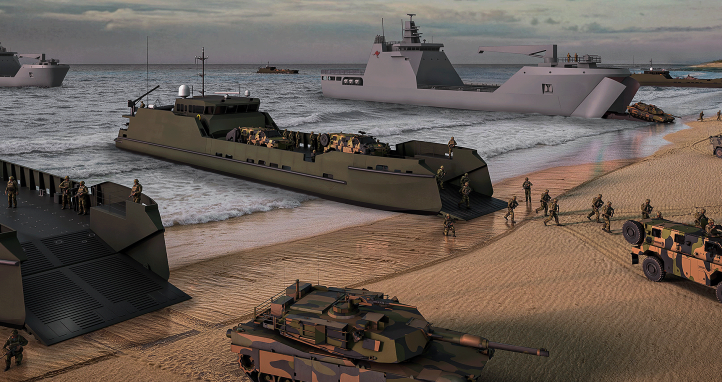
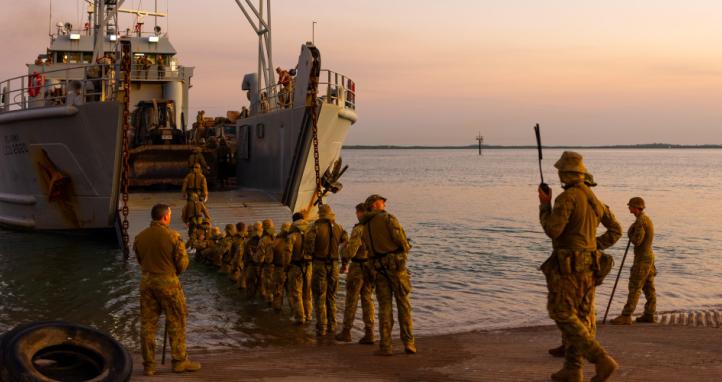
That element — a synchronised combined-arms doctrine adapted for warfare from the sea, and the operational reach logistics that would enable it to be conducted rather than merely attempted — has never been written. In its absence, warfare from the sea defaults to frontal assault. The landing craft the Army now seeks to acquire rest on a design whose logic predates Hamel.
Is the technological and logistical adaptation that Monash’s own method demands not, then, the missing element — and the first thing a littoral redesign must confront?
Greg Chalik
Your sentence “At the centre of combat power remains the infantry battalion; soldiers with bayonets will endure as the final thirty centimetres of political policy.” Defines war at its core, as a human endeavour, through the enduring nature of war.