
Article Summary
Drawing on police, Army, and G-Wagon rollover examples, the article shows how speed can become an easy explanation for accidents while deeper vehicle-handling knowledge remains underdeveloped. It argues that Army must better understand the limits of its land platforms through testing, data, publications, and training. The piece connects expertise, recognition-primed decision-making, and driving to conditions to show why knowledge must reach drivers before incidents occur. It concludes with practical recommendations for testing, publications, authorisation, supervision, and driver behaviour.
Rolling, Rolling, Rolling?
As of mid-2026, Army has rolled 60 G-Wagons. Let’s take that in for a moment. We can come back to the G-Wagons.[i]
Rollover
On a hot mid-morning on 3 August 1999, a series of shootings took place along a stretch of the Stuart Highway south of Darwin. A decorated police officer was killed, a civilian bystander was injured, and the gunman was killed. The story could easily have involved the further deaths of a dozen police officers were it not for the singular bravery of one.
Two Tactical Response Group (TRG) LandCruisers, carrying a dozen officers, were manning a roadblock to the north while two police officers had set up a patrol car to the south. The gunman shot a civilian who was talking with the two officers. Then, while one officer was radioing the TRG, he was shot and killed.
The TRG vehicles sped down the highway. The weather was good, visibility was excellent, and the road was dry. Both vehicles were driven by trained police officers with years of high-performance driving experience. As the vehicles arrived at the scene, both drivers lost control and rolled. None of the occupants were killed, but they were injured and rendered non-operational. It was left to the young Senior Constable to kill the gunman.
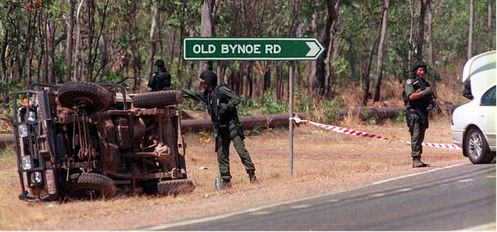
Image 1: Northern Territory Police Tactical Response Group vehicle post rollover
There is an obvious takeaway for Army drivers: if you roll the vehicle, you are out of the fight. My old Squadron Sergeant Major (SSM) from Canungra told me, ‘we are the Australian Army and we choose when and where to fight.’ If you crash your vehicle, that is where you will be fighting.
The film Black Hawk Down is close to the book which, by all accounts, is what happened. Viewers see the battle coalesce around the two helicopter crash sites. In the middle of Mogadishu was not where the soldiers wanted to fight.
Expertise
So why did the TRG drivers lose control in these perfect conditions? Many will jump to speed as a factor. It is a reasonable start, but if trained high-performance drivers can lose control, what of the rest of us?
Army has had G-Wagons lose control in the hands of expert drivers: high-performance, Special Operations Command (SOCOMD)-trained drivers with operational experience. We will come back to the driving, but first we need to talk about expertise.
Experts are a personal favourite of mine; I used to be one. The American psychologist Daniel Kahneman wrote Thinking, Fast and Slow. One of the subjects he researched was expert intuition. He did that work with another psychologist, Gary Klein, whom he sought out because they disagreed about intuitive expert decision-making.
Their joint work is expansive, but their summary on expertise is that real experience underpins recognition-primed decision-making (RPD). Becoming an expert in complex tasks is an intricate and slow process. Expertise is a large collection of mini-skills.
When the current Director Work Health and Safety (WHS) Army wrote a Cove article in 2019 about vehicle accidents, there was a veritable pile-on from ‘experts’. We could consider ourselves experts in transport operations because we have lots of kit and it looks impressive. My position is that we are not experts at all.
Perhaps the first part of the road to becoming an expert is realising that you are not one.
Driver Testing Officers (DTOs) are the experts of our fleet. There have been two significant truck accidents where an experienced DTO was the co-driver. In both cases, the DTO was unable to give the driver relevant knowledge or input to avoid the accident.
Why? I am no expert, but I think the answer is knowledge. RPD requires recognition before an intuitive decision can be made. To recognise an event, you at least need to know about it.
Kahneman wrote, ‘A young platoon commander with no experience of combat will tense up while leading troops through a narrowing ravine because they have been taught to identify terrain that favours an ambush.’ If that wariness is not taught, there is nothing to be tense about. In other words, we do not know what we do not know. So, when it comes to our transport fleet, what do we need to know?
Knowledge
The vehicle user handbook (UHB) for the 40M has more warnings in it than the Chinook helicopter manual. Like many Land 121 publications, it confuses the reader. For example, the UHB describes how to engage and disengage Brakematic in slightly different ways on three successive pages.
There are no handling notes on how the truck will behave in various road conditions or with blown tyres. The Land 121 fleet is military-off-the-shelf (MOTS), so testing should have been done by the original equipment manufacturer (OEM). If it was done, the knowledge was not passed on to us. The testing conducted by Land Engineering Agency (LEA) provided no meaningful input to the UHB or training material.
This essential element of the force, its transport platforms, has not been tested to its limits. The knowledge that comes from such testing has therefore not filtered down through the safety case, training system, risk assessment, supervision, and operating chains to drivers.
Knowledge accrual begins at the foundation stage of developmental and acceptance test and evaluation (AT&E). That is where the organisation can gather the collection of mini-skills that contribute to expertise we may need in combat.
That knowledge begins as data points from instrumented platforms driven by test drivers. Most of the data available for our truck fleet is from the NATO double lane-change test and driving in circles. It is practically useless. We can tell because rollovers are still occurring and there is no coherent reason why. As new platforms are introduced, they are increasingly fitted with data loggers that can be interrogated. G-Wagon is one such platform.[ii]
The G Wagon UHB does not mention rollover at all. However, the 2011 User Manual for the civil version does (see Image 1).
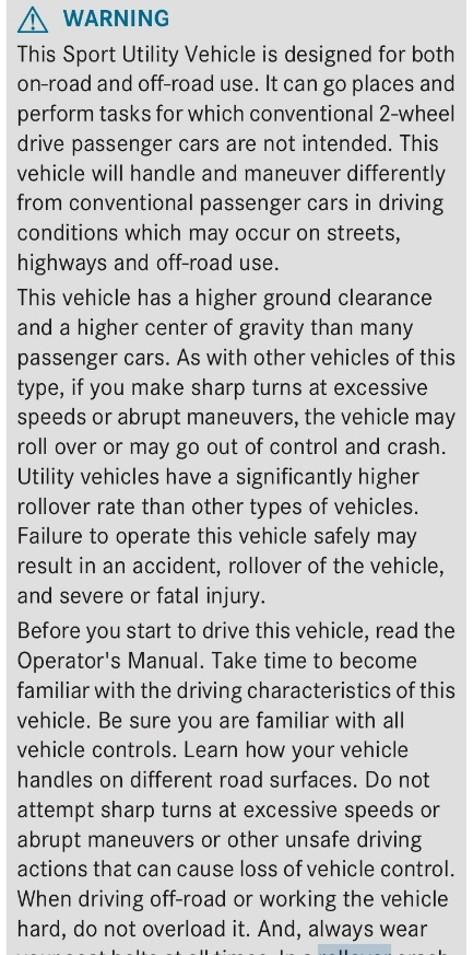
Image 2: Civilian G-Wagon 2011 User Manual
Data
What does the data show? Below (Image 2) is a raw data download from a G-Wagon rollover accident.
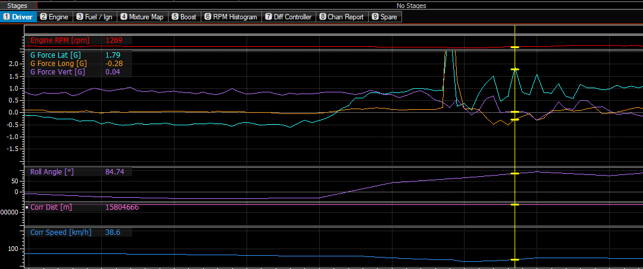
Image 3: G-Wagon Rollover Data
Corrected speed is the first port of call because it is easily understood. In this case, the driver was following a 45M down a state forest road at about 40 to 60 km/h. Selective reading of data has often led to the false conclusion that speed was the cause of an accident.
The three G-force traces, lateral (blue), longitudinal (orange), and vertical (purple), are where most of the analysis should focus. In this case and in other rollover events, they show that the G-Wagon is prone to departing control rapidly and without warning. In this case, rounding a cambered curve, the steering bites hard and the vehicle ends up on its roof.
In his 2019 Cove article, Director WHS refers to a civilian journalist review that describes the benign behaviour of the 2017 G-Wagon. Army has a different suspension generation of the G-Wagon in the test. A more appropriate review may be the Fifth Gear review of the G-Wagon from 2013.[iii] At 04:30, in Test 3: Sportiness, the reviewer finds that the G-Wagon yaws heavily when pushed with aggressive steering. Yaw, G Force Lat in the data shown in image 3, is a fundamental characteristic of a rollover. Each time the test vehicle is pushed, the Mercedes Electronic Stability Program (ESP) asymmetrically applies the brakes to prevent yaw.
Driving to Conditions
As frequently as it may be used, term ‘driving to conditions’ is not actually defined in our documentation. The tendency of investigators to be drawn to speed indications in data has often led drivers to be blamed for not ‘driving to conditions.’ The speed limit on a range road is 40 km/h, and there are sound reasons for that. However, ask yourself: would you buy a car to drive across Australia if it could only drive safely at 40 km/h on a dirt road? Driving to conditions is one of the great grey areas of the ADF road transport system.
Flying to conditions is different. The envelope of every aircraft in the ADF is well established and tested through layers of test and evaluation that spread from the manufacturer, through Aircraft Research and Development Unit (ARDU) at RAAF Edinburgh and the various test and evaluation units, to the operational squadrons.
Pilots know the boundaries of aircraft performance and the environmental limits they are authorised to fly to. Why not in the land domain? The residual value of an irreplaceable 45M Dry Support Bridge is getting close to that of a training helicopter, and we value our soldiers equally.
The Inherent Dangers of the Job
Another Cove article, The Hidden Casualties of War, states that ‘vehicle roll-overs were a major cause of non-battle injuries in Afghanistan’ and that ‘rough terrain and rapid off-road mobility’ contributed to accident rates. Afghanistan was a two-way firing range, so the 40 km/h limit did not apply, but driving to conditions was essential.
A Smart Soldier article from November 2019, Top 10 Land Vehicle Safety Issues, cites ‘Driving to Conditions’ as the number two issue. Speed is first. Yaw, the most dangerous characteristic, is not mentioned at all. So, let’s look at an accident where the crew were driving at an appropriate speed and to conditions.
Gravel flicked up against the floor as the Reconnaissance Surveillance Vehicle (RSV) G-Wagon travelled along the dirt road. Previous afternoon and overnight thunderstorms had given way to a bright and sunny morning. The thick humidity was a sign of more rain later that day, normal for Cape York at this time of year.
Dust billowed in the wake of the six-wheeled vehicle, and the intense glare of the sun had dried the road surface, improving grip. The soldiers knew the road and the area well, and they were driving to the conditions at just under 100 km/h.
Rounding a long bend, the driver saw the road unwind ahead through the trees. Shadows cast across the smooth, graded surface. It happened quickly. Initially, the crew felt as though they were flying. Then there was a violent impact, a cacophony of action, and another impact. Food, drink bottles, clothing, and webbing sitting loose in the cabin flew around the two soldiers. As the heavy vehicle rolled and pitched, the soldiers felt as though it would never be over.
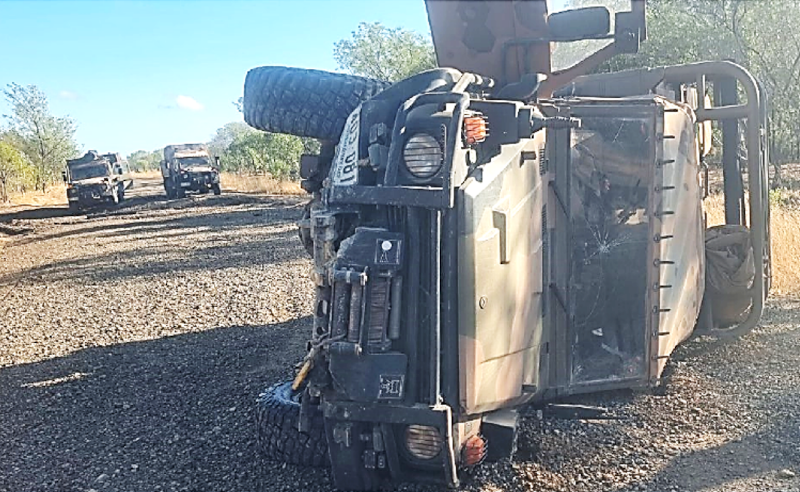
Image 4: The G Wagon post rollover. Note the damaged road in mottled shade ahead of the two other vehicles.
Dirt roads are a common sight in Australia. They criss-cross the country and are a particular feature of the road network across Cape York Peninsula. How a road is constructed may not seem important, but there are some aspects worth knowing. One of them is how water can affect a road surface.
The wet season in northern Australia runs from November to April. It is characterised by wet afternoons and hot mornings. And, by wet… I mean wet. Average rainfall during this period is almost 1.6 metres. Water affects roads by washing away the surface and, more critically, undermining the base.
Mostly, the hot morning sun will dry a gravel road, except where there is shade. At these points, the base stays wet and the road becomes soft and prone to potholes. Sometimes the areas of subsidence become large and deep. Shadows mottle the surface, making imperfections difficult to see.
A 20-metre-long and half-metre-deep washout was concealed by the shadow of the trees. Constant wetting and drying of the road, along with passing road trains, had created ideal conditions for the substructure of the road to deteriorate. The driver reported that there was no warning before the vehicle became airborne.
By the time the G-Wagon came to rest, it was destroyed. The chassis was broken in half and the cabin pushed in. The survival of the crew is a testament to the strength of the armoured pillars that have protected so many of our soldiers during G-Wagon rollovers.
Even driving to the conditions may not be enough.
Conclusion
Vehicle testing. Army has a test track with dedicated vehicles, facilities, engineers, and drivers. Our vehicles carry our capabilities to the fight and protect our people. Testing should include aggressive steering and braking to assess vehicle performance boundaries. The results must then be analysed and distilled into the UHB and training system through DTOs to drivers.
Publications. Platform publications should be informed by the test program. They must be concise and accurate, and they must give soldiers relevant information about the inherent limits of the platform, including in degraded conditions such as loss of tyre pressure or hydraulics.
Authorisation and supervision. Driving to conditions is another article entirely, but the crux is that threats from road surface, weather, platform, driver experience, currency, mission profile, and load must be balanced into a delegation to operate. Authorising officers must ensure drivers are aware of the specific risks of the task and the mitigations for the threats they face.
Drivers. Speed is a factor in many accidents, but vehicles have to move, so it is a necessary evil. Soldiers need to understand that the ADF fleet is not the daily driver. Yaw, the rotation of the vehicle, should be avoided at all costs. Aggressive steering inputs, particularly reversals, will almost certainly result in yaw that exceeds the vehicle’s ability to respond to a directional change and may result in a rollover. Aggressive braking, particularly while yaw is present, will almost certainly make the situation worse.
Where you roll over is where you will fight. A second-class ride is better than a first-class walk.
Still Interested?
For related reading, see The Cove article Training vs Education, which explores how Army builds soldiers who can both perform and adapt.
Cove+ also has short learning courses on similar topics, including Lean Thinking.
End Notes
[i] G Wagon rollovers are tracked by Land Accident Investigation Bureau.
[ii] The NATO lane change test comes from STANAG AVTP 03-160W. The aim of the test is to satisfy the contractual requirements of Project Land 121. Conduct of the test involves a test driver changing lanes within a speed band. Military vehicles such as the Land 121 fleet are designed to satisfy tests like this off-the-shelf.

I was involved in the re-write of ATI-1/9/22-Training for Introduction into Service. In that ATI we decisively split publications responsibility. Employment publications were Army's, while Materiel publications were the delivery agencies responsibility. Materiel publications centered on operating, maintaining and supervising the functioning of the hard/software. The ideal writers are the OEM. They designed it, built it, understand it. How it would be used operationally was clearly Army's choice. Training was likewise split.
The advent of Landworthiness (Lw) requirements emanate from the idea of an operating envelope. Operating envelopes and mission profiles are tightly coupled. Each capability operates in a definable environment with discrete mission profiles that can be extracted from operational plans.
Lw sought to bring some additional structure to doctrine. Publications should have clear mission and support system roles; configurations described; use environments - normal, exception, possible, unlikely defined; SFARP/new/outside normal use delegations; etc.
The combination of the ATI and Lw should have driven the elimination of many of the negative observations you made. But, I'm aware that the combination was seen as burdensome, so I'm not aware of the overall take up. Maybe it's time to resurrect the ideas above.