Article Summary
Cheap, accessible drones could disrupt Australian Defence Force supply chains and critical infrastructure. Drawing on recent conflicts, domestic-support arrangements, and northern Australian conditions, the authors identify vulnerabilities in surveillance, detection, and interagency response. They propose modular counter-uncrewed aerial systems training that uses reservists' civilian expertise and prepares specialist teams to support police and base security. The article recommends routine exercises and clearer response frameworks to strengthen domestic resilience to the risk posed by UAS on home soil.
Eye in the sky: Protecting critical infrastructure and Defence logistics from drone threats
The recent and rapid growth in drone technology and knowledge, including from conflicts abroad, is creating an ever-increasing risk to Australia’s vital assets. While acts of domestic terrorism and disruption, such as those targeting military ports and airfields, would primarily be the jurisdiction of police organisations and civil authorities, Army Reserve forces should be prepared to support civil authorities with counter-uncrewed aerial systems (C-UAS) capabilities.
The risk – using drones to target ADF supply chains
Overseas conflicts, particularly the war in Ukraine, have seen rapid growth and innovation in drone technology and knowledge. From a domestic perspective, there are two primary concerns:
- The availability of information on weaponising commercial off-the-shelf (COTS) drones.
- Tactics on how to maximise the impact of drones.
The threat of domestic attacks on vital assets with drones cannot be underestimated.
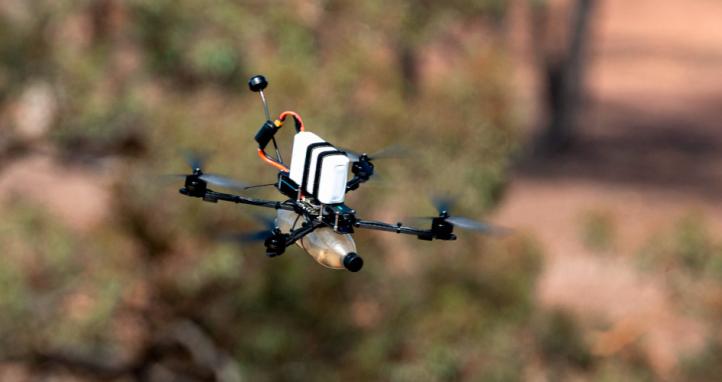
From a manufacturing and acquisition standpoint, some recent analysis assesses that ‘it costs $377 USD for the components required to build a First Person View (FPV) capable of operating out to 12 kilometres with a flight time of roughly 30 to 45 minutes.’ The hobbyist and recreational use of drones is further pushing these costs down, ‘with the cost of making a 7-inch drone that can range to 16 kilometres (without the additional weight of a munition) totalling $150 USD.’
Similarly, online sites such as yeggi, cult3d, and printables all feature attachments that can be three-dimensionally printed at home and attached to commercially available drones. This can turn a commercial drone into a ‘dropper’ drone capable of releasing items while in flight, such as grenades or IEDs.
While purchasing the parts is relatively straightforward, the manufacture and construction ‘requires knowledge and experience in electronics, motors, soldering, radio frequencies, and programming’. However, such skills are taught via relatively short courses, and extensive information is available online for those with the impetus to self-teach. Additionally, the recent shooting in Bondi highlights how Australian extremists may seek overseas training and operational exposure that could increase their capability to conduct attacks domestically. While limited, there are conflict locations around the globe where individuals could travel to receive instruction on the weaponisation of commercial drones.
Those unable to manufacture a drone can purchase commercial drones for less than $300 with a range of up to 7 kilometres. While their weight-carrying capacity is reduced, their relationship to radar or visual observation makes them suitable for clandestine use due to their ability to remain largely below the detection threshold. Regardless of their payload, they can still cause significant damage in a kamikaze-style attack, such as when ingested by a jet engine.
Such drones, however, are susceptible to wind and other weather effects that larger drones can manage, but they are also more likely to remain below the detection threshold. This is consistent with testing conducted by the Australian Army’s Drone Racing Team, in collaboration with AIM Defence and DroneShield, who found ‘that most C-UAS systems struggle to detect, acquire, and defeat FPV drones’. At a similar level, there is limited capacity to respond with frequency denial (such as a ‘drone gun’) in areas such as airfields and ports due to the impact this could have on daily operations and safety.
Further to this, if it became widely known that the standard response to a UAS incursion over vital asset airspace was to utilise jamming technologies, flying a UAS without kinetic effects could be sufficient to degrade and limit capabilities on home soil.
Based on our personal observations during training activities in Northern Australia, sUAS/FPV drones are even harder to operate and detect in tropical environments. High humidity reduces battery efficiency, coastal winds create unpredictable turbulence at low altitude, and dense vegetation around bases provides natural masking terrain. During training activities, sUAS/FPV drones routinely penetrated visual arcs and were only detected within 100-150 metres, demonstrating how environmental factors amplify the threat in the Australian context.
From a force protection perspective, passive defence measures such as dispersion, concealment, decoy placement, and hardened shelters are feasible but resource intensive. In northern bases, long perimeters, open hardstands, and limited overhead cover make concealment of logistic nodes extremely challenging. Integrating UAS detection into existing force protection frameworks requires deliberate planning and cannot be improvised during a crisis.
In 2025, Ukraine conducted an innovative UAS strike on Russian aircraft deep within Russian territory called Operation Spiderweb. Simple, low-cost UAS were smuggled into Russia and then utilised to conduct a coordinated strike on Russian aircraft sitting stationary at airfields. A similar attack, even on a much smaller scale, could degrade Australia’s air logistics and supply chain. This could operate as a delay tactic to prevent deployment of ADF personnel and equipment to the Indo-Pacific region (such as in response to a territorial incursion).
A similar attack on northern bases could be even harder to counter due to the vast, open terrain and limited radar coverage. Aircraft taxiing or parked on hardstands present large, vulnerable targets, and even a single kamikaze drone ingested into an engine could ground a critical and limited strategic airlift platform for months.
|
Vignette: Domestic Drone Attack Scenario: ‘Nightfall at a Fuel Farm’ Location: Defence fuel installation Time: 0210h Weather: Humid, 28°C, light coastal winds, intermittent cloud cover. A small team of hostile actors launches three FPV drones from a concealed position within mangroves 4 km from the fuel installation. The drones fly at treetop height, masked by vegetation and ambient noise from nearby industrial activity. The first FPV drone approaches the perimeter undetected. The sentry on duty hears a faint buzzing but assumes it is insects. The drone clears the fence line and accelerates toward a cluster of aboveground fuel tanks. The second drone follows a different route, using the shadow of a warehouse to avoid visual detection. It carries a small-improvised munition designed to rupture piping rather than destroy a tank outright. The third drone loiters overhead, providing overwatch and adjusting the attack timing based on observed security movements. At 0214h, the first drone impacts a fuel transfer pump, causing a fireball and immediate shutdown of the facility. The second drone drops its munition on a critical valve assembly, causing a cascading failure that disables the backup system. The third drone crashes into a generator supplying power to the fire suppression system. Police response is impeded by limited night surveillance capability and lack of drone detection systems. Army Reserve (ARES) personnel are called out under Defence Force Aid to the Civil Authority (DFACA) to support perimeter security, evacuation, and coordination with police and fire services. The attack does not destroy the fuel farm, but halts fuel distribution to local bases for 48 hours, delaying aircraft movements and forcing emergency resupply from out of the state. The incident demonstrates how three drones costing under $1,000 can temporarily degrade northern ADF logistics and create strategic effects disproportionate to their size. |
The current framework – DFACA and supporting domestic police organisations
Police organisations around Australia are struggling with recruitment and retention, and their capacity to provide standing defence or surveillance on vital assets, such as airfields, shipyards and ports, power plants, water treatment and sanitation plants, fuel dumps, and undersea cable landing stations would be limited.
Other nations are already facing drone attacks on key infrastructure, such as a drone attack that hit a generator outside the Barakah nuclear power plant in Abu Dhabi recently. While police organisations are working to improve both recruiting and retention and building c-UAS capabilities, they are unlikely to provide standing protection from serious and devastating UAS attacks.
In circumstances of heightened risk of attacks on such vital assets, police organisations can be augmented and supported by ADF personnel and services. Part IIIAAA of the Defence Act 1903 (Cth) provides the Commonwealth with power to call out ADF personnel ‘to assist civil authorities respond to incidents or threats involving widespread or significant violence, including a terrorist attack’.
These call outs, responding to a human or biological threat rather than environmental, are not common. As highlighted by Samuel White, ‘since 1901, the federal government has deployed the ADF domestically 13 times outside of flood relief or bushfire assistance’. A recent analogy arises from OPERATION COVID ASSIST where ADF personnel were, in some circumstances, deployed to support civil authorities in monitoring key sites; such as hotels and quarantine stations. This demonstrates how ADF personnel can support domestic policing.
Experience from domestic support tasks, including COVID ASSIST, shows that ADF–police integration is enhanced through alignment of standard operating procedures (SOPs), communications systems, and authority boundaries. Reservists require clear rules of engagement (ROE), interoperable communications, and pre‑established liaison structures to operate effectively alongside police. Without these, response times and decision-making would be degraded significantly during a fast-moving drone threat.
These observations reinforce that any ADF contribution to domestic counter-UAS activities should be designed to augment police and civil authority capabilities rather than replace them. Reserve forces would be most effective when providing specialist surveillance, detection, reporting, and security support functions under existing domestic security frameworks.
A possible solution – building C-UAS capability in the Army Reserve
Recent investment in C-UAS technologies, such as AIM Defence Fractl laser and counter-drone systems, demonstrate recognition of the problem and the need for response options. Further, just as conflicts abroad bring the knowledge and information for those wishing harm to our nation, so too can our allies abroad give us the knowledge and information to counter these threats and embrace new technologies.
Operation INTERFLEX in the United Kingdom has introduced a wealth of knowledge on the technical and tactical use of drones from the conflict in Ukraine. Working alongside partner nations can improve understanding of both UAS and c-UAS technologies, such as working with the Cyber and Electromagnetic Activities (CEMA) Effects Group in the United Kingdom.
Recently, Exercise KASANGGA 26-01 saw members of the 9th Regiment, Royal Australian Artillery conduct knowledge exchanges with UAS operators and intelligence analysts from the Armed Forces of the Philippines. Their knowledge and experience from countering domestic threats, such as the National People’s Army (NPA), provides valuable guidance on how our own military forces could support police and civil organisations with responding to domestic threats.
Knowledge transfer from international partners is valuable, but must be adapted to Australian conditions and training cycles. Reservists often have limited training windows and inconsistent ability to attend extended training programs, meaning c-UAS skills must be taught through modular, repeatable packages. Many reservists possess civilian technical skills such as information technology, electronic engineering, or drone hobbyist/professional experience that can be leveraged to accelerate capability development.
Learning from international activities and allies should be brought home for wider dissemination. This new knowledge can be applied to the Australian domestic environment to find ways to detect and defeat acts of drone terrorism on home soil and deny UAV freedom of movement over vital assets. In particular, these international lessons should be incorporated into reserve units who support domestic support tasks. The Defence Strategic Review also noted the importance of this shift to Reserves providing domestic support, particularly in Northern Australia:
Australia’s northern base network presents unique challenges. Its vast distances, porous perimeters, high levels of tourist drone activity, and environmental conditions that degrade both UAS and c-UAS performance. Reserve brigades are well positioned to augment existing surveillance and security arrangements through the provision of trained personnel, local knowledge, and specialist c-UAS capabilities. However, this role should be integrated with police, base security, and other civil authority responses rather than operate as a stand-alone security function.
Regular base security exercises incorporating drone threats, supported by rapid response frameworks for incursions at vital assets, would further strengthen domestic resilience. Collectively, these measures would provide Reserve units with a scalable and effective capability to augment civil authorities and Defence operations during drone-related incidents, strengthening Australia’s overall security posture.
As the ADF continues to focus on the Indo-Pacific region, it can no longer assume that the domestic environment will remain uncontested. The growing accessibility and demonstrated effectiveness of drone technology means that Australian critical infrastructure, supply chains, and Defence establishments may increasingly be exposed to disruption on home soil. To ensure preparedness for this emerging threat, the ADF must continue to develop c-UAS capabilities through the adoption of new technologies, targeted training, and deliberate planning across both the permanent and reserve forces.
Still Interested?
Why not also read Countering Unmanned Aircraft Systems: Tips from Ukraine
Explore Cove+ short learning courses on related professional topics