
Article Summary: The story of Gull Force - the 2/21st Battalion deployed to Ambon in December 1941 as part of Australia's forward defence strategy - demonstrates the consequences of committing forces to an exposed position without adequate support. James Thewlis argues that the lessons of 1942 remain relevant to the contemporary strategic environment: forces deployed into the inner arc must be resourced commensurately to the threat, supported by clear command arrangements and credible extraction options, and not sacrificed as a tripwire absent genuine combined-arms enablement.
Australia finds itself in an increasingly precarious and uncertain position amid geopolitical tensions, both regional and global, on a scale akin to that witnessed prior to the Second World War. With much of the world’s attention focused on what is occurring in the Middle East and Europe, as well as the increasing sabre-rattling rhetoric in the Indo-Pacific region, there are parallels between our current circumstances and the pre-World War 2 period.
Our commitments to the Middle East have wound down and our regional commitments now focus on enhancing interoperability with regional partners through military exercises and defence cooperation initiatives, mentoring regional forces, and undertaking humanitarian tasks when required. Many of these tasks are also a means of projecting our presence in the near region to counter China's growing influence.
We have recently seen much effort by the current Government in securing defence treaties with regional partners – with varying levels of success – and placing greater emphasis on diplomacy in the Pacific and Southeast Asia. These are the building blocks of mutual defence, providing the ability to stage and project our forces into the near region to counter any threat by China. A forward defence of our northern approaches, which is where the similarities of late 1941 and into early 1942 become apparent. Namely, holding forces at risk in our northern maritime approaches to deter attacks on Australian forces or territory.[1]
The current strategy of denial calls for anti-access/area-denial (A2AD) capabilities. Anti-access is long-range and focuses on preventing an advancing adversary from entering the operational area. In a 1941 context, this could be achieved through strategic bombing (in lieu of a missile-based deep strike capability) and/or undersea warfare. Area denial on the other hand is shorter range and designed to limit an adversary’s freedom of action within a defined operation area; in the case of 1941 this was within our inner-arc and would largely hinge on airpower. Now, as in 1941/42 this area-denial involves the deployment of troops as well as naval and air assets to cover the northern approaches.[2] During World War 2, the islands of Ambon and Timor to the north of Darwin were important for holding an adversary at risk in our northern approaches. In order to achieve mission success flexibility, coupled with effective C2, support by an accelerated logistics chain and robust internal lines of communications would be vital, and the consequences of not achieving those outcomes would be disastrous. The same applies today.
This paper will discuss area denial in the context of forward defence and the approach taken to defending Australian shores from Japanese attack in late 1941 and early 1942 from a land domain perspective. This will be through the lens of the dispositions and preparedness the 2/21st Battalion, Australian Imperial Force, who were to deploy to the island of Ambon upon Japan’s entry into the war.
Setting the Scene
Whilst the war drums of Japan were audible well before December 1941, their near simultaneous attacks on Malaya, Hong Kong, Pearl Harbour, and The Philippines still came as a surprise and the lack of preparedness of Australian, British, and US forces soon became tragically apparent. When Japan entered the war, the 6th, 7th, and 9th Divisions of the 2nd Australian Imperial Force (AIF) were in the Middle East and two brigades of the 8th Division were in Malaya, whilst its 23rd Brigade was still in Australia but soon to be dispersed throughout the near region for forward defence*. The defence of Australia itself was predominantly in the hands of the Citizen’s Military Forces (CMF), which legislation did not permit deploying outside of Australia or her territories; however, Papua being an Australian mandate at the time allowed for the deployment of CMF units to that locality.[3]
The 8th Division was earmarked to follow its sister divisions to the Middle East in 1941. However, due to pressure facing the British Army in North Africa, coupled with Britain’s inability to spare additional formations to Southeast Asia, the 27th Brigade of the 8th Division along with the divisional headquarters, was deployed to Malaya in February 1941 and the 22nd Brigade followed in August. This left one AIF infantry brigade in Australia, the 23rd Brigade, which had begun to move to Darwin in March 1941.
It is worth providing context of what the construct of brigades were then, compared with today. The brigade of 1941 was very much an infantry centric (or armoured/cavalry) organisation. These consisted of three infantry battalions and was lacking in integral arms and services which were held at the divisional level. That said, these assets were often assigned in a direct support role with a corresponding infantry brigade and often they would be grouped together in a “brigade group” formation. While brigades generally had a small integral logistics capability, they would draw upon offensive support and engineer units with additional logistical support from the division.
Posturing Forces Within the Inner Arc
Soon after the 23rd Brigade had completed its long and dusty journey from Victoria to Darwin in early 1941 it was established as a brigade group.[4] By April 1941 the 23rd Brigade Group, under the command of Brigadier Edmund Lind, who had commanded the brigade since its formation at Seymour in July 1940, was employed in the establishment of defensive and fall back positions as well as patrolling in Darwin and the surrounding areas. In the event of imminent Japanese attack the Brigade Group would form a mobile reserve tasked with repelling Japanese airborne and amphibious attacks on the Darwin area.
Brigadier Lind’s task was not enviable, as well as providing defence for the Fortress Darwin area he was also responsible for the Northern Territory as a whole. In May, he was informed that the Dutch colonial possessions of Ambon and Timor were an extension of his task and if Japan entered the war, two of his battalions would provide the nucleus for the garrisoning of these areas in agreement with the government of the Netherlands East Indies (NEI). Soon the formation was to be deprived of the 2/21st and 2/40th Battalions, to bolster Australia’s forward defences in Ambon and Timor respectively.
Ambon
In 1941 Australia had an agreement with the NEI Government to provide troops and aircraft to the island of Ambon, situated 1000 kilometres northeast of Darwin, in the event of Japanese aggression. Just days prior to the Japanese attack on Pearl Harbour and Malaya, the NEI Government had asked for the Australian Government to dispatch aircraft to the island, which given its location was strategicaly important for Australia – in particular for the defence of Darwin. Two flights of Hudson bombers from 13 Squadron RAAF were duly sent on 7 December 1941. A week later, Gull Force, centered on the 2/21st Battalion and under command of Lieutenant Colonel Roach, departed Darwin wharf bound for Ambon.
The convoy duly arrived in the Bay of Ambon on the morning of 17 December and soon after disembarking Lieutenant Colonel Roach and his intelligence officer sought out and made their introductions to the local NEI commanders. The NEI forces on the island numberd some 2,500 personnel under the command of Lieutenant Colonel J. Kapitz who had nominally operational command of Gull Force, however administrive command was still retained by Headquarters 23rd Brigade. There was confusion regarding the command relationship and word didn’t seem to reach Roach’s command that Army Headquarters (AHQ) was to have direct operational control of Gull Force. Roach was immediately concerned upon landing, despite having the opportunity to reconnoiter the island in July 1941. Not only was there a requirement to defend the town of Ambon and its deep water harbour but also the strategically vital airfield at Laha, which was dislocated from Ambon town by the Bay of Ambon.
Whilst the NEI forces had limited artillery (two troops of field guns and two of anti-tank guns along with some coastal artillery) Gull Force had none, nor any coastal artillery to provide a maritime strike capability against an enemy invasion fleet that ventured within range.
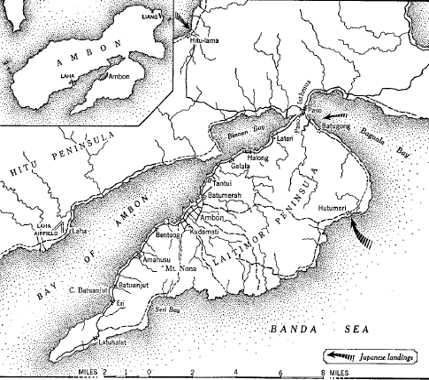
Figure 1: Map of Ambon showing Japanese landings (Lionel Wigmore, Australia in the War of 1939-1945, Volume IV The Japanese Thrust (Australian War Memorial, 1957)
Initially, Gull Force occupied a camp on the northern outskirts of Ambon Town before being tasked by Lieutenant Colonel Kapitz to defend localities on both the eastern and western sides of the island – thus splitting Gull Force. This prompted Lieutenant Colonel Roach to request reinforcements in the form of two troops of field artillery and an additional two troops of anti-tank guns to bolster the capability of his existing single troop. The response to this request from the Chief of the General Staff, Major General Sydney Rowell read in part “… additional units you ask for not repeat not available. Your task is to put up the best defence possible with the resources at your disposal.”[5] On the night of 7/8 January the war reached Ambon with a bombing raid by Japanese flying boats against Ambon town and Laha airfield which damaged four aircraft on the ground and killed three civilians.
After further bombings and the destruction of a number of RAAF Hudsons on the ground, 13 Squadron was withdrawn to Australia on 28 January 1942. With it went any hope of aerial support for Gull Force.
Lieutenant Colonel Roach can best sum up the feelings that were no doubt shared by his peers on Rabaul and Timor as well as his subordinates:
“I find it difficult to overcome a feeling of disgust and more than a little concerned at the way in which we have seemingly been ‘dumped’ at this outpost position…without any assistance whatever…and…with (so far) a flat refusal to consider any increase in fire-power and the number of troops, whilst the cooperation and assistance from the other two arms of the Service must be of a very limited value indeed.”[6]
A subsequent message to AHQ in Melbourne stating that it was estimated that Gull Force could not hold out for more than one day was too much. On 13 January Lieutenant Colonel Roach was ordered home and replaced by Major Scott, who arrived from AHQ in Melbourne.
On 29 January an RAAF patrol aircraft observed a Japanese fleet enroute to Ambon. This news prompted the NEI command to order the naval fuel storage facilities to be destroyed and the demolition of fuel and ammuntion facilities at Laha airfield. The following night elements of the Japanese 229th Regiment and 3rd Kure Special Naval Landing Force (naval infantry) landed on the northern and southern coasts of the island, and paratroopers were dropped in vicinity of Koepang. Within 24 hours the NEI forces had capitulated without informing their Australian allies and the elements of Gull Force defending Ambon town commenced a withdrawal south to the village of Eri where they formed a perimeter and where the bulk of Gull Force surrendered on 3 February. Whilst this was occuring, two companies of the 2/21st were engaged in the defence of the empty and disabled Laha airfield which was attacked on 31 January where some 300 Australians were killed in action or murdered after surrendering.
After the destruction of Gull and its companion Sparrow Force in Timor soon after, Brigadier Lind wrote a memorandum he desired to be included in the war diaries of both the 2/21st and 2/40th Battalions, his key points from this memorandum are articulated below:
“1) Eight months were available for provision of necessary adequate personnel and armament
and for provision of the necessary cooperation with N.E .I ., with the Navy and with the
Air Force.
(2) No satisfactory army liaison with N .E .I . Comd Bandoeng [Bandung] was established with
result that preparations for reception of forces concerned were inadequate and the
capacity for effective cooperation with N .E.I . Forces at Ambon and Timor was not
developed.
(3) No effective L. of C. (lines of communication) was established in the case of either Force.
(4) Forces involved were not informed of arrangements for Naval cooperation—if such
existed—under conditions in which such was essential. Such cooperation did not
materialise.
(5) Effective air support was non-existent—no covering aircraft were available at time of
Japanese attacks at Amboina and Timor.
(6) Forces involved were NOT provided with adequate Fire Power—although eight months
intervened from inception of project to its execution .
(a) No Fd Arty was made available.
(b) No A.A . Arty was made available at Ambon.
(c) Provision of Light Automatic weapons was limited to 26 per Bn and spare parts
were not available.
(7) These forces were embarked and dispatched on tasks of first magnitude without orders
from executive authority at A .H .Q.
(8) Competent authority on the spot was deprived of opportunity to make essential representations relevant to projected operations."[7]
Conclusion
History does not necessarily repeat itself, but it certainly rhymes and many of these echoes discussed in this paper have relevance to our political and military leaders when planning future deployments into the near region. It is true that our ability for rapid strategic lift and the range and endurance of our aircraft, both crewed and un-crewed, do much to increase our reach into the near region. In 1941-42, planners could have only dreamed of these capabilities. With the introduction of HIMARS, precision strike and corresponding land-based maritime strike, our deterrence capabilities and indeed range from a land domain perspective is greatly enhanced. However, all of those assets require bases, which are essential for the ability to project and concentrate forces for a deterrence effect, and for defensive and offensive operations and will be key in any conflict in the Indo-Pacific.
The bare bones that were left, as a contingency to defend Australia and also force project into the inner arc should the threat of Japan entering the war become apparent, were inadequate as was pre-war training and regional exercises with partner nations. The composition and strength of these forces was not commensurate to the task at hand, as the Chiefs of Staff appreciation in December 1941 concluded that at a minimum a brigade group was required in Ambon and nearby Timor.[8] Once recognised that Gull Force did not have the ability to be able to effectively execute area denial and reinforcement was not feasible they should have been withdrawn. Indeed, the withdrawal of the RAAF should have been a trigger for the retrograde of the land component from Ambon.
Undoubtedly, in terms of regional cooperation and readiness, we are in a much better position now than in 1941. Through joint exercises and exchanges in region, we know the human and physical terrain and interoperability with our partner forces would be in a much better position than Lieutenant Colonel Roach was dealing with on Ambon in 1942. That said if ADF forces deploy within the inner arc, be it as a deterrence or reactive to a kinetic threat, the same principles of clearly defined tasks applies. As do adequate resources, training, and planning for contingencies involving a rapid extraction of forces or ensuring that they are fully postured and equipped to counter the level of threat that they would likely be exposed to. Any such force would need to be enabled with flexible and effective C2 and have the capacity to be supported by an accelerated logistics chain and robust internal lines of communications. This would enable reinforcement or withdrawal in a contested environment and leave forces better postured to execute area denial and not act as a mere trip wire to the southward advance of an adversary for no strategic benefit. That was the unfortunate fate which befell the men of Gull Force in February 1942.
Notes
[1] Defence Strategic Review 2023 page 49, para 4.9
[2] ibid, page 49, para 7.3
[3] The 2nd Australian Imperial Force was raised in 1939 upon the outbreak of World War Two and carried on the linage of the 1st AIF which was raised in 1914 for service in World War One. The 2nd AIF was essentially an administrative headquarters for AIF formations. The Citizens Military Forces were established in 1901 and consisted of Militia units. Whilst the AIF was expeditionary, the CMF’s role was the defence of Australian protectorates, such as Papua and mandated territories, such as New Guinea. Upon the outbreak of World War Two, CMF units were mobilised for full time service.
[4] As at July 1941 23rd Brigade Group consisted of the following units: 2/14th Field Regiment RAA, 2/11th Field Company RAE, 2/21st Battalion, 2/40th Battalion, 2/3rd Pioneer Battalion, 2/12th Field Ambulance, 22nd & 23rd Dental Units, 75th and 83rd Light Aid Detachments.
[5] Wigmore, Lionel, Australia in the War of 1939-1945, Volume IV The Japanese Thrust (Australian War Memorial, 1957) pp 422
[6] ibid, pp 423
[7] Wigmore, Lionel, Australia in the War of 1939-1945, Volume IV, The Japanese Thrust (Australian War Memorial, 1957) pp 419
[8] NAA , A5954, 555/10, War in the Pacific. Defence of Australia and adjacent areas - Chiefs of Staff appreciation December, 1941, PP 11

The Dutch were in no position to defend the East Indies and no amount of external forces was likely to change that.
The Allies reaction was inadequate for the Japanese action. In effect the Allies had to wait for the Japanese to culminate and then undertake counter actions.
Future operations in the archipelago, are not operating in 'terra nullis'. Ambon today is not Dutch, but Indonesian territory. Indonesia has as of mid-2025 an estimated population of 284.44 million. They are fiercely nationalistic, industrially productive, have an army of 300 000+ and are not likely to defend inadequately like the Dutch. I think they have had enough of being a colony.
Given the modern context, the question is 'why' would Australia need to help defend Indonesia from external aggression. And what would they need from us? Isn't it enough to secure their rear, act as a supply node, offer a sanctuary for rest and recuperation? If we take hints from Ukraine and Iran, it is evident that smaller, committed, thinking states with adequate backup can stand against the most powerful.