Facts and figures
| Government type | Unitary Parliamentary Republic |
| Notable people |
|
The ‘Know Your Region’ series is designed to support unit and individual professional military education on the Indo-Pacific region. It’s important for all serving members of our military to have a foundational knowledge of the countries and issues in the Indo-Pacific.
Summary
Though sandwiched between Russia and China today, historically Mongolia has been a powerful nation, often influencing or conquering parts of northern China and Central Asia.
From powerful nomadic confederations that controlled vast territories across the steppe, to the Mongol Empire (1206–1368) where the infamous Genghis Khan united the Mongol tribes and created the largest contiguous land empire in history, including ruling the Yuan dynasty in China (1271–1368). Eventually that empire splintered and collapsed and Mongolia was ruled by the Qing dynasty (which also ruled China) from the 1600s until 1911 (See: Information).
Led by a group of Mongolian princes, Mongolia declared its independence from the Manchu-led Qing Dynasty of China in 1911 during the Xinhai Revolution. A period of violent contest between Mongolia, Russia and China ensued until finally at the end of World War II the Republic of China, led by the Kuomintang, was pressured to formally accept Mongolian independence by the Soviets. The Chinese government agreed to recognise the independence of Mongolia if Mongolians voted for independence in a referendum. This referendum was held on 20 October 1945 and the Chinese government formally recognised Mongolia’s independence on 5 January 1946.
From 1924 to 1990, Mongolia was a communist state, officially known as the Mongolian People’s Republic, and ruled by the Mongolian People’s Revolutionary Party. Though nominally independent, Mongolia was a ‘satellite state’ firmly in the Soviet bloc alongside many Eastern European countries and was dependent on Moscow for its economy and resources.
This single-party dictatorship and centrally-planned agrarian economy ended with a peaceful revolution in 1990 – after the fall of the communist Soviet bloc – and Mongolia held multi-party democratic elections, began the process of privatisation, and developed a new constitution that emphasised democratic governance, human rights, and checks and balances.
Politics
Democracy in Mongolia is still relatively young, but it is stable, and free and fair elections lead to peaceful transfers of power. It is a unitary parliamentary republic; meaning it has a Prime Minister and a President, and only one house of Parliament (not a Lower and Upper House). The Prime Minister is chosen by the parliament, while the President is directly elected. Mongolia is administratively divided into 21 ‘aimag’ (states or provinces) and it uses a Mixed Member Proportional Representation electoral system (like New Zealand) to elect 126 members for four-year terms. Major political parties include the Mongolian People’s Party (MPP), Democratic Party (DP), National Coalition, Civil Will-Green Party, and HUN Party.
There are still challenges around women’s political participation and representation, but constitutional reforms in 2023 increased the quota for women among party candidates to 30% and to 40% in the 2028 election.
Corruption involving officials and their families remains in Mongolian politics, and the unexplained wealth of Prime Minister Oyun-Erdene and the lavish spending of his son has led to protests. Decisions regarding mining contracts and taxation can lack transparency and are heavily scrutinised by the public and opposition parties.
From the mid-1990s, Mongolia has pursued a ‘third neighbour’ policy which seeks to engage countries with similar views on human rights, democracy and free markets. Engagement with countries, such as Australia, has helped Mongolia to expand its trade, investment, security and development cooperation, and foreign policy contacts beyond its immediate and dominant neighbours of China and Russia.
Mongolia and Australia
Australia established diplomatic relations with Mongolia on 15 September 1972. Bilateral engagement increased significantly once the communist single-party dictatorship ended in 1990 and Mongolia undertook democratic and free-market reforms. We have a strong and expanding bilateral relationship built on shared principles (democratic, open economies that value human rights), economic cooperation (especially in mining, energy and agricultural sectors), education, and people-to-people ties. Australian companies play a significant role in the Mongolian mining industry, particularly in the areas of copper, gold, and coal (See: Economy). In 2016, our nations signed a Memorandum of Understanding for development cooperation, covering scholarships, volunteers, and mining-sector governance. In 2022, Mongolia and Australia celebrated the 50th anniversary of establishing diplomatic relations.
Australia and Mongolia have shared challenges: logistics over vast distances, climate change, and water scarcity. Mongolia opened an embassy in Canberra in 2008; this helps service the 5,397 people in Australia who were born in Mongolia (per the 2021 Australian Census) and build our relationship. The Australian Trade and Investment Commission (Austrade) opened a trade office in Ulaanbaatar to serve the needs of Australian business in 2011. The Australian Embassy in Ulaanbaatar was opened in December 2015.
Australia and Mongolia are in the process of elevating the bilateral relationship to a Comprehensive Partnership. In 2024, Australia and Mongolia started negotiations on an Air Services Agreement and a Social Security Agreement. We forged new agreements on energy and saw positive progress on our joint mining projects, including Oyu Tolgoi (See: Economy), that will make important contributions to Mongolia’s economic growth. Australia’s development cooperation with Mongolia was strengthened through the signing of two new partnerships to support the Technical and Vocational Education and Training sector and to enhance women’s climate resilience in Mongolia.
Under the Australia Awards scholarship program, every year around 15 Mongolian students are competitively awarded study places at tertiary institutions in Australia. This education cooperation is increasing, with 17 long-term scholarships awarded for 2025. The Australia Awards scholarships in Mongolia have been running for over 30 years with over 750 alumni.
The Australian Volunteers Program has a long history in Mongolia; since 1998 over 300 volunteers have visited Mongolia, with around 30 skilled Australians every year volunteering in high priority sectors identified by the Mongolian government.
The President of the Australian Senate, Senator the Honourable Sue Lines led a bipartisan parliamentary delegation on an official visit to Mongolia in October 2024 (the first parliamentary visit since 2012). Australia’s Ambassador for Gender Equality, Stephanie Copus Campbell, participated in the World Women’s Forum in 2024. Mongolia’s Minister for Industry and Mineral Resources, Mr Tuvaan Tsevegdorj, led a delegation to the International Mining and Resources conference held in Sydney in 2024. Australia was the major sponsor of the National Women’s T20 cricket tournament in 2023 and 2024 (India sponsors the men’s T20).
Mongolia and its Neighbours
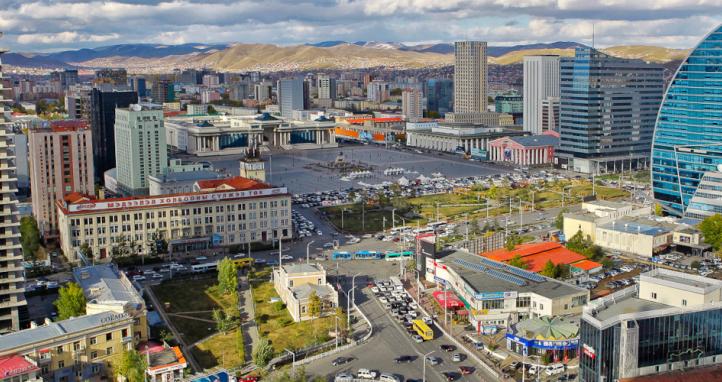
Mongolia is sandwiched between two dominant powers: Russia and China. A land locked ‘prisoner of geography’, since the 1600s this once-mighty nation has been influenced by the military, political, and economic power of its neighbours. Impressively, Mongolia has remained a true democracy since its 1990 ‘peaceful revolution’, despite the influence of its neighbours, but Ulaanbaatar (Mongolia’s capital) needs to be pragmatic about its relationships with Moscow and Beijing. Despite its ‘third neighbour policy’, Mongolia is dependent upon Russia and China for trade, fuel, and electricity. Both relationships are asymmetrical – Mongolia lacks economic leverage and must work hard to maintain autonomy given that reliance.
Russia
For much of the 20th century, Communist Mongolia was effectively a Soviet satellite state, relying on the Soviet Union for security and economic support. The Soviet Union stationed troops in Mongolia, built major infrastructure, supported industrialisation, and became Mongolia’s dominant trading partner. Russian language, education, and cultural exchange were deeply embedded during this period, creating lasting social and institutional links. The nations remain close today with a comprehensive strategic partnership.
Russia wields political influence in Mongolia because it supplies critical amounts of electricity and fuel. Historically, Moscow has stymied Mongolia’s efforts to gain energy independence because it guarantees a market for Russian energy exports. Russia is a small market for Mongolian exports because it is already rich in the mineral resources which Mongolia exports, but it provides approximately 28% of Mongolia’s imports. Mongolia is a movement corridor for Russian exports to China which Russia has depended on to bypass western sanctions, especially fossil fuels, and Moscow is motivated to ensure this movement corridor remains open.
Mongolia abstained from the UN General Assembly vote condemning Russia for its unlawful invasion of Ukraine in both 2022 and 2025, and Mongolian government officials have refrained from expressing opinions publicly about Russia’s ‘special operation’ in Ukraine. Mongolia hosted Russian President Vladimir Putin in 2024 to commemorate the 85th anniversary of a joint Mongolian-Soviet victory against the Japanese at the Khalkhin Gol River. Mongolia is a member of the International Criminal Court (ICC) and did not carry out its obligation to arrest President Putin under an arrest warrant issued in March 2023 for war crimes against Ukraine.
China
Ulaanbaatar and Beijing have a comprehensive strategic partnership. China is Mongolia’s main trading partner; responsible for purchasing 90% of Mongolia’s exports (mostly coking coal and copper) and providing 40% of Mongolia’s imports (mostly consumer goods and machinery). Mongolia depends on Chinese ports and logistics chains to connect to global trade. Understandably, this heavily influences Mongolia’s attitude to and relationship with Beijing, as China is critical to Mongolia’s economic growth. Like Australia, Mongolia respects the ‘One China’ policy.
Oyu Tolgoi, one of the world’s largest known copper and gold deposits, is predicted to eventually produce more than 500,000 tonnes of copper a year. Mongolia owns 34% and Australian mining company Rio Tinto 66% of Oyu Tolgoi. However, Oyu Tolgoi currently imports a large portion of its electricity from China, via the Inner Mongolian grid, and though there is a desire to secure a long-term domestic power source, the mine is vulnerable to geopolitics. The project has been a source of both economic promise and political tension. There have been disputes over taxes, royalties, and government control as Mongolia asserts sovereignty over its natural resources, while needing the investment and expertise of foreign companies (which may be receiving disproportionate benefit).
For further information on Mongolia, see the resources below (a reminder, videos are available to view on your mobile devices or standalone laptops – not on the DPN):
- Videos
- The Uprising Ending the Chinese Empire - Xinhai Revolution (1911-1912) (House of History, 17m15s)
- Australia Awards Mongolia – We Love Australia (Australia Awards in Mongolia, 19m22s)
- Interview with Dave Vosen, Ambassador of Australia to Mongolia (MNB World Sightline, 19m48s)
- Australia-Mongolia Anniversary Grants Program (Australian Embassy, Mongolia, 7m22s)
- Mongolia: the democracy between Russia and China (GZERO Media, 14m12s)
- Mongolia-China Relations in 2023: border reopening and other developments (LSE IDEAS)
- Podcasts
- Geopolitics of Mongolia (The Red Line Podcast, Oct 2020, 1h1m)
- The Sydney school embracing Mongolian language and culture (SBS, 3m24s)
- Articles
- For Mongolia, Australia is a model to copy. The relationship should be closer (The Strategist)
- 50 gold(en) years and counting: Ambassador Davaasuren’ insights into Australia-Mongolia relations (Young Diplomats Society)
- Australia’s Ambassador to Mongolia on Cooperation in Mining, Civil Society, Defense, and More (The Diplomat)
- Putin’s visit to Mongolia defies ICC warrant and tests neutral nation’s ‘third neighbor’ diplomacy (Reuters)
- Putin’s Red Carpet in Mongolia Was a Betrayal of Justice and Accountability (Human Rights Watch)
- Empty Steppes: An Examination of Mongolia’s Ukraine Policy (The Geopolitics)
- Mongolia-Russia Diplomatic Relations at 100 (The Diplomat)
- Grasslands to Global Stage: The Geopolitics of Mongolia (Foreign Policy Research Institute)
- Between a Rock and a Hard Place: Mongolia’s Economic Dependence on China with a Focus on the Mining Industry (The Journal of Contemporary Asian Studies)
- The Trouble With China-Mongolia Relations (The Diplomat)
- Trade turnover between Mongolia and China increases by 38 percent (Montsame)
Know your region
Know Your Region series gives you a shortcut to understanding other nations in the Indo-Pacific region.