


This is Part 2 of a 3-part series. The previous article in this series can be found here.
The first article of this series described Australia’s strategic environment, theories of deterrence, and the littoral environment the Australian Army will likely be operating in if conflict comes to our northern approaches. It has been written that any potential conflict in Australia’s region is likely to occur within littoral, urban environments to our north. In optimising for littoral warfare, a primary method for Army is what I conceptualise as rapid, agile, and deceptive (RAD) manoeuvre. While Australia has no marine corps, David Kilcullen has written that Army’s tradition of rapid expeditionary deployment of light forces in littoral environments positions Army as Australia’s primary sea-to-land capability. Army can leverage this capability and knowledge by further ensuring it is ready for littoral operations under RAD manoeuvre.
Rapid and Decisive
On 4 September 1943, the 9th Australian Division made Army’s first major amphibious landing since Gallipoli during Operation POSTERN, seizing the Japanese defensive base at Lae, Papua New Guinea (PNG). With the distinction of being the first air, sea, and land operation of the Pacific War that included concurrent amphibious, airborne, and air landing assaults, 7th Division deployed alongside US paratroopers to the north-west of Lae the next day. The two Australian divisions then raced each other to Lae, with Allied forces making rapid overland advance through difficult terrain complicated by monsoonal rain and a determined enemy, taking the base within 12 days.
History has shown us that the conduct of rapid littoral operations is key to their success. Swift amphibious assault enabled the 1942 taking of Singapore by Imperial Japan, whereby decisive penetration of dispersed Allied defences facilitated quick seizure of the strategic island. Serhat Güvenç and Mesut Uyar further outline how rapid movement similarly supported Türkiye’s 1974 amphibious invasion of Cyprus. Rapid and decisive movement was key to success of these operations and is increasingly important in the modern battlespace.
The character of littoral warfare has changed with advances of technology. The proliferation of precision-guided munitions enabled by advanced sensor and satellite surveillance has limited the massing of forces and high-signature landing craft off the coastlines of potential landing sites. Neither night nor bad weather will hide attacking forces from advanced early warning systems, with some arguing that only the amphibious raid is the way of the future.
Australian doctrine recognises five types of amphibious operation: demonstration, raid, assault, withdrawal, and support to other operations. The amphibious raid requires landing forces to establish area control, neutralise threats, and accomplish objectives before withdrawing within a limited timeframe. While advancing technologies could restrict littoral operations, they are not panacea.
A reliance on the primacy of technology fails to consider the history of war: the influence of tactics, training, geography, logistics, leadership, and even luck on its outcome. As with critique of amphibious operations, similar arguments for the decline of ground war have been made before in the face of precision air and maritime strike, satellite- and sensor-based intelligence, and high-speed communications, such as during the 1999 war in Kosovo and prior to 20th century conflicts in Afghanistan and Iraq. These wars eventually involved the threat of or actual deployment of ground forces.
Chief of Army Lieutenant General Simon Stuart has said that interwar thinking continues to suggest that the next war will somehow be quick, decisive, and fought at ever-increasing distances beyond the land domain. Similar trends of military thought have been applied to littoral operations. Imperial Japan conducted 30 amphibious landings during the first three months of the Pacific War, 29 of which were reported as successful.
Despite this, Japan’s innovative and aggressive approach to amphibious warfare went against contemporary wisdom at the time, which declared that amphibious operations were too difficult and should be avoided. Similarly in the present, Army is optimising for warfare and manoeuvre known for its difficultly, but that has now been further complicated by advancing technology.
While consideration of the impact of technology is important, littoral capability remains a critical tool of warfare in the modern era for seizing objectives such as airfields and ports, as well as penetrating ground forces into contested, urban areas. As Thomas More Molyneux wrote of littoral war in 1759, “…it comes like Thunder and Lightning to some unprepared Part of the World.” Little has changed. Rapid and decisive littoral action has proved its utility in the past and serves as an important operational planning point and form of Army expertise in all forms of littoral operations.
Agile and Adaptive
Agility and adaptability are key in the multidimensional audacious advance of littoral warfare. The success of Operation POSTERN in 1943 led to a second littoral landing at Finschhafen, whereby 9th Division and Allied forces fought through nine kilometres of jungle to seize territory for air and naval basing, enabling subsequent operations in PNG.
Army continued to utilise an approach of leapfrogging along PNG coastlines via littoral landing craft, destroying further enemy positions. Agility and adaptability in reconstituting littoral forces for subsequent operations and shifting command objectives will be key for Army in preparing for future littoral manoeuvre.
Adaptability will also be essential across differing task types that may be required during littoral manoeuvre, from amphibious landing to jungle-urban clearance, into defensive operations for captured areas. If urban centres are occupied, Army may need to conduct stability operations, humanitarian response, and constabulary tasks. If hostile actors emerge, counterinsurgency activities could be required. Army adaptability does not end at the successful completion of littoral missions and consideration can be given to ’post-landing groups’ that can meet these challenges and taskings.
As Army implemented multi-corps ‘beach groups’ in WWII to establish effective amphibious force flow following beach landing, Army could apply a similar strategy to stability taskings. These ‘post-landing groups’ could consist of engineers, signals, transport, medical, military police, and public affairs, allowing for expertise in a wide variety of taskings and need in stabilised conflict areas. The make-up of these primarily non-combat corps would further protect primary combat capability from being reprioritised to stability tasks, addressing Chief of Army’s warning that Army must not become a jack of all trades in being tasked with a multitude of roles, yet being a master of none.
This is particularly acute when considering Army’s primary trade in the application of military power towards national security. ‘Post-landing groups’ would further maintain Army’s role in humanitarian and stability expertise, a likely expectation of Australian society and international partners as remaining within Army jurisdiction and contribution to Australian Government objectives.
Freedom to develop, acquire, and mobilise new technologies is further essential to Army agility in the littoral. One example is the utilisation of long-range fires, such as High Mobility Artillery Rocket Systems (HIMARS). This capability provides incredible utility during littoral operations: a HIMARS vehicle unloaded by C-130 transport aircraft in the northern approaches can fire its mission, re-board, and take-off in two and a half minutes. Similar manoeuvre was achieved during Talisman Sabre 2023, demonstrating how HIMARS can support littoral operations and air and sea control without providing a static target. Integrated air and missile defence has further been suggested by Peter Dean as a priority in enabling defence of homeland Australia, which HIMARS could support.
One HIMARS can be equipped with six Standard Guided Multiple Launch Rocket Systems (GMLRS) or two Precision Strike Missiles (PrSM). HIMARS are easily hidden, rapidly deployable, and acquired more cheaply and quickly than maritime ship capability. Long-range fires can be combined with drone and other uncrewed aerial systems (UAS) to generate effects of massed fire and manoeuvre that the Ukraine war illustrates is difficult to sustain in the modern battlespace of advanced sensors.
Agility in development and deployment of varying fire and drone capability provides to Army methods of anti-access/area denial (A2/AD) and support to littoral operations. Drone technology is iterating at speed with new battlefield adaptations delivered in only weeks, which can offset numerical advantages between combatants. Automation and AI are further being integrated with drones, as well as artillery and long-range fires targeting and strike coordination. Army must operate at the speed of relevance in leveraging new and iterative systems and technologies.
Peers can provide further inspiration: Sweden has procured sea-mobile artillery platforms with stabilising grenade launchers to provide sustained fires in the littoral environment at high speed and mobility. Despite a limited firing range of 9.8 kilometres, these boats offer utility in riverine waters and deliver multiple round simultaneous impact fire missions. Agility in the employment of innovative platforms such as these may be why Sweden has been described as an expert in littoral operations.
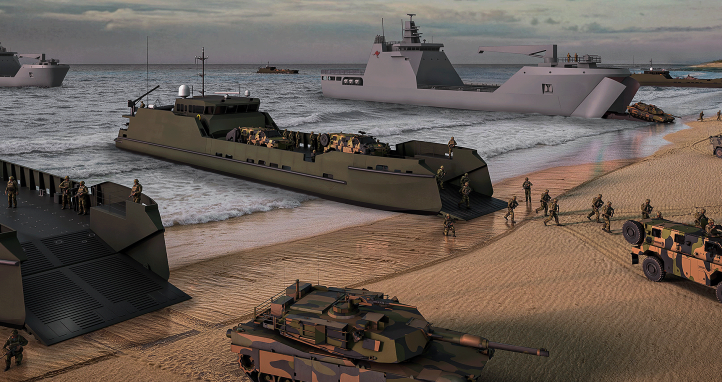
Agility and adaptability are also required in logistics and transport in littoral manoeuvre. Australia is procuring 18 Landing Craft Medium, scheduled for 2026, and eight Landing Craft Heavy for 2028. While these vessels will offer improved Army capability, the number may not be enough; by the end of WWII, Army operated over 1,800 small, medium, and large littoral vessels, likely contributing to success during 1945 Operation Oboe in Borneo along with US naval support. Oboe II alone required the transport, landing, and delivery of 33,600 personnel and 53,600 tonnes of supplies and equipment, described as the zenith of Australian WWII combat operations. While procurement of landing craft remains important, Army may also need other methods of acquiring vessels.
Army could prosecute a variant of the Australian maritime strategic fleet. The Australian Government has committed to establishing up to 12 Australian-flagged and crewed trading vessels that, while commercially owned, can be requisitioned by the Government during crisis. In considering a similar strategy, Army might look to methods of adapting commercial boats and barges to landing craft at a level of minimum viable capability during conflict.
Army could also look to support dual-use boat designs during its investment and procurement processes that can be rapidly modified to ferry troops and conduct riverine operations. Jerry Stahan outlines how in the 1930’s, the US Marines did something similar in redesigning a commercial boat used for traversing Louisiana swamplands into a military landing craft; that boat design eventually iterated over time into the landing craft used during the 1944 invasion of Normandy.
Japan used a similar strategy in utilising 300 small boats during amphibious operations to take Singapore in 1942, while China employed more than 2,000 fishing boats during 1950 landings at Hainan. The ADF has already utilised ships taken up from trade (STUFT) during various 20th century conflicts, and recommissioned Navy liners into landing ships for WWII amphibious operations. Army can once again look to these historical examples in procuring maritime capability to support littoral manoeuvre.
These smaller vessels might also represent reduced target signatures and fall under the cost-ratio calculations currently evident in drone warfare in Ukraine and the Red Sea. This math refers to multimillion-dollar missiles being employed to destroy drones worth only tens of thousands or less. In protracted conflict, this has the potential to sap enemy materiel and may alter their calculus in employing strike capability against smaller vessels. Agility and adaptability apply in littoral manoeuvre, but also to the use of long-range fires, drone technology, and vessel mobilisation to support littoral operations.
Deception and Diversion
The final aspect of RAD manoeuvre is deception and diversion. During 1943 planning of Operation POSTERN, General Sir Thomas Blamey employed a preliminary amphibious landing near the Japanese base at Salamaua as a form of diversion. This had the intended effect of drawing reinforcements and strength away from Lae, supporting the later landing to seize that pivotal base. In future littoral warfare, the use of deception will be essential for the success of operations just as it has been in the past.
James Greer has outlined how Germany utilised deception during their 1940 amphibious invasion of Norway and Denmark, whereby disinformation drew attention away from intended landing areas and delayed Allied realisation of imminent invasion. This allowed Germany to avoid British naval superiority and A2/AD capabilities in the ferrying of troops over long distances across the maritime domain.
Diversion was similarly important during Japanese 1942 landings at Singapore, whereby decoys deployed by Imperial Japan led British forces to narrow their defence on one part of the island while littoral activities were employed elsewhere. British commandos utilised deception during a 1944 operation at Port-en-Bessin, France, coming ashore at a distance from their target before taking the port from land.
Similarly, MAJ Geoffrey Lynch describes how regional African forces employed amphibious landings during the 2012 Battle of Kismayo, Somalia, to deliver an attack from an unexpected direction, surprising insurgent defenders into abandoning their positions. Conversely, a lack of deception is noted as one reason for failure of the landings at Gallipoli, while Israel and Ukraine relied on deception for pivotal 2025 drone operations against Hamas and Russia, respectively.
The use of deception will be important in future planning and execution of Army littoral manoeuvre, but this form of cunning requires an intangible creative quality in planners. Major Adam Scholes has written that Army does not have a tradition of operational deception planning, with one solution being the inclusion of deception planning in professional Australian command and planning courses.
The development of a formal course on littoral operations at an ADF-affiliated university is another opportunity to develop this knowledgebase and understanding in Army planners. This could involve a unit within university courses already offered at tertiary institutions and military colleges, a littoral-specific short course, or potentially a distinct qualification by coursework or research on littoral operations.
The cross-pollination of knowledge around history, strategy, tactics, and planning of littoral operations in the past, present, and how emerging technologies will impact on littoral manoeuvre can assist in developing littoral literacy across Army and the Australian defence ecosystem. Military planners from regional partners can attend to increase interoperability at the planning level. This is one method of generating knowledge that could spur creative deception during operational planning. It further optimises professional expertise for littoral warfare and supports commander accountability for effective planning.
Deception and diversion can further utilise mis- and disinformation campaigns, electronic warfare, statecraft, and uncrewed air and maritime platforms. Data and sensor processing in the modern age is immense and likely leverages AI. This technology can also be potentially guided and deceived through false prompts and information to create advantage. While technology can facilitate deception, we must not overlook historical examples of deception when choosing to employ hybrid or information activities.
This article has provided an overview and analysis of RAD manoeuvre utilising examples of historical littoral operations as well as offering potential ideas and opportunities in the present. The next part of this series will consider littoral enablers, such as domain control and combined arms, training, logistics, and unconventional warfighting.