

Facts and figures
| Official name | People's Republic of Bangladesh |
| Country code | BD |
| Population | 169,828,910 |
| Capital city | Dhaka |
| Timezone | UTC+6 |
| Currency | BTD (Bangladeshi taka ৳) |
The ‘Know Your Region’ series is designed to support unit and individual professional military education on the Indo-Pacific region. It’s important for all serving members of our military to have a foundational knowledge of the countries and issues in the Indo-Pacific.
On this page:
- Summary
- A Short History
- People and Society
- Customs and Traditions
- Media and Internet
Summary
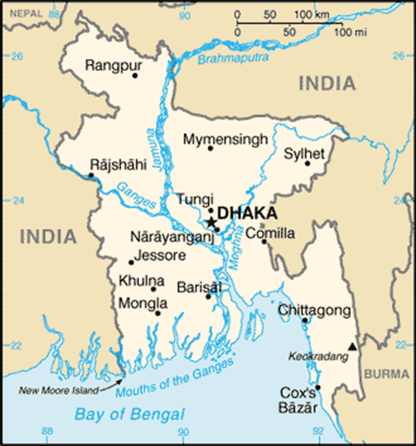
Bangladesh sits on the northeastern part of the Indian subcontinent. It shares borders with India on most sides and Myanmar to the southeast. Its 580 km coastline opens onto the Bay of Bengal. Bangladesh is one of the world’s most populated sovereign states relative to its land size, which is roughly 148,000 square kilometres. The population is approximately 170,000,000 (2025) with nearly 25 million people living in the capitol city, Dhaka.
Bangladesh has an extensive river system formed by the Ganges (Padma), Brahmaputra (Jamuna), and Meghna rivers and their tributaries. There are over 400 rivers, streams, and canals criss-crossing the nation, forming the largest delta system in the world. Rich sediment deposits from the Himalayan mountains have made the soil extremely fertile.
The country is mostly low lying, with vast plains in the south and hilly districts in the far northeast (Sylhet region) and southeast (Chittagong Hill Tracts).
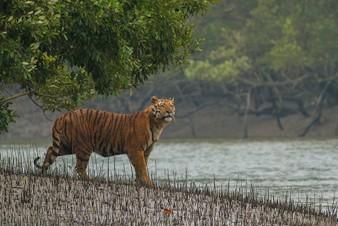
The southern coastline contains the Sundarbans, the largest contiguous mangrove forest in the world, which it shares with India. The Sundarbans are ecologically important as they protect against storm surges and are rich in biodiversity, including being home to the iconic Royal Bengal tiger. They are also a source of income for the local population through fisheries and timber. The mangroves are highly vulnerable to salinity intrusion and rising sea levels and, despite a total ban on killing almost all vertebrate animals, wildlife continues to be depleted.
Bangladesh has a tropical monsoon climate with hot, humid summers and a prolonged rainy season from June to October, driven by the southwest monsoon. On average it receives around 250 cm of rain each year. Flooding during the monsoon and storm surges from cyclones are recurring hazards, causing widespread damage and migration from rural areas to urban centres.
A Short History
The Bengal region has been inhabited for thousands of years and was part of major early Indian civilizations and trade networks.
Several local kingdoms, including the Pala dynasty (8th–12th centuries CE), rose to regional prominence. After centuries of civil war, the Palas ushered in an era of prosperity. They were renowned for their military strength and diplomacy, as well as their art and architecture. Buddhism became the dominant religion and higher learning flourished. By the end of the 11th century, the Senas, who were strongly Hindu, had gained control over a large part of Bengal.
Bengal’s coastal location exposed it to maritime trade with Southeast Asia and the Persian Gulf. As early as the 9th century, Arab traders brought Islam to the Bengal region. At the turn of the 12th Century, Muslim invaders from the northwest overthrew the Senas, beginning a long period of Muslim rule. This culminated with the Mughal dynasty (16th–18th century).
The Mughal Dynasty promoted a secular society where local customs were absorbed rather than supressed. Successive leaders were more concerned with expanding the state than enforcing religion; however, they showed a preference for Muslim settlers. At the height of their rule, the Mughals controlled what is now parts of Afghanistan, Balochistan, and most of the Indian Subcontinent. Economic activity increased and urban centres like Dhaka and Murshidabad expanded.
Bengal’s textile production – especially muslin and fine cottons – made it an international export hub. The region’s growing wealth attracted European trading companies, most notably the British East India Company (EIC). The company grew quickly to become the largest trading company in the world and was heavily involved in the slave trade, along with setting up large plantations and factories in India, particularly Bengal, where it opened its first factory in 1615.
The British gained strength in the region as the Mughal Empire weakened. The EIC emerged as the dominant political power following a series of treaties and battles, the most notable being the battle of Plassey in 1757. The victory gave them control of Bengali revenue, which was distributed to European shareholders at the expense of the local population.
Governor General Charles Cornwallis (served 1786-93) initiated a permanent settlement system in the territory whereby property rights were granted in perpetuity to local zamindars (landlords) who were mostly Hindus. This property policy indirectly stimulated the growth of a new middle class who owned large estates and collected taxes on behalf of the company and their own military purposes.
In 1770, a famine struck the region affecting roughly one third of the population and killing approximately 10 million people. The high casualties were blamed on mismanagement and corruption. With discontent rising in the region, the largest being the Sepoy mutiny of 1857, the British government finally dissolved the British East India Company and assumed control of its territories in 1858.
After considerable debate, in 1947 British India was partitioned into two dominions: India and Pakistan. Pakistan was created as a separate Muslim-majority state composed of two geographically and culturally distinct wings: West Pakistan (present-day Pakistan) and East Pakistan (present-day Bangladesh), with India in between. The partition divided Bengal along tribal lines – West Bengal remained with India, while East Bengal became part of Pakistan.
The boundaries immediately bought about large-scale migration on both sides. Between 12-15 million people, who believed themselves to be members of a threatened minority, moved into what they perceived as a place of refuge. Along with Muslim Bengalis arriving in East Bengal from Hindu-majority districts, there were many Muslims who came from other parts of India, mostly from Bihar. Violence, fuelled by fear, propaganda, and the sudden collapse of colonial authority, resulted in the death of between 1-1.5 million people. Woman were disproportionally affected.
The 1948 decision by Pakistan’s leadership to impose Urdu as the sole national language sparked protests in East Pakistan. On 21 February 1952 – now celebrated globally as International Mother Language Day – university students and activists in Dhaka clashed with police and several protesters were killed.
Over the 1950s and 1960s, the perception of political favouritism, economic neglect, and cultural marginalisation intensified. Tensions rose dramatically in 1970 when the East Pakistan Awami League party (led by Sheikh Mujibur Rahman) won a decisive majority, entitling it to form the national government. This was rejected and on 25 March 1971, the West Pakistani military launched Operation ‘Searchlight’, a brutal crackdown in East Pakistan aimed at suppressing Bengali political aspirations. Widespread atrocities, mass displacements, and a refugee crisis followed as millions fled to India. When Indian forces joined the war on behalf of the Bengalis, the tide turned against West Pakistan. On 16 December 1971, Bangladesh celebrated victory and independence.
The new state faced war devastation, an economy in disarray, and political instability. The first president, Sheikh Mujibur Rahman, was assassinated in 1975, leading to a period of military rule and frequent changes in leadership. The lack of stable governance hindered the country's development and contributed to social unrest. The1990s saw the introduction of a two-party system where the leadership has alternated between both parties.
From the late 1990s, Bangladesh made significant developmental gains, including a reduction in extreme poverty, increased life expectancy, the expansion of major exports (especially garment manufacturing), and improvements to primary education and health. Despite these gains, Bangladesh still struggles economically, and there have been periods of political violence, accusations of corruption, and a tightly controlled media.
In 2024, students protested the Hasina Government’s jobs quota system and were met with a brutal crackdown that killed approximately 1400 people. Protests intensified and eventually Hasina was forced to flee to India. An interim government led by Muhammad Yunus was formed on 8 August 2024 to act as caretaker and prepare for new elections. On 17 November 2025, Hasina was tried in absentia and sentenced to death for war crimes in a Bangladeshi court for her role in the crackdown.
In February 2026, the Bangladesh Nationalist Party was elected as the new government of Bangladesh under the leadership of Tarique Rahman. Rahman returned to Bangladesh in December 2025, following 17 years of exile in the United Kingdom following accusation of corruption and political violence during the Prime Ministerial term of his mother, Begum Khaleda Zia. Those accusations were dropped during the interim government tenure.
People and Society
The overwhelming majority of Bangladeshis are ethnically Bengali, a group that spans both sides of the international border with India’s West Bengal state. Bengali (Bangla) is the national and most widely spoken language. Minority ethnic groups, including the indigenous peoples of the Chittagong Hill Tracts (e.g., Chakma, Marma, Tripura) and various hill communities, maintain their own distinct languages and cultural practices.
Most people in Bangladesh follow Islam which was made the official religion by a 1988 constitutional amendment. Most Muslims are Sunni, but there are a small number of Shias, primarily descendants of immigrants from Iran. Hindus form a significant minority, while Christians and Buddhists make up just a tiny fraction of the population.
Family and community networks are central to social life. Gender equality has improved across education, the labour market (notably in garment factories and increasingly in other sectors), and public life, but inequalities persist in poorer and rural areas. Bangladesh’s social policy and NGO sector (including globally noticed microfinance initiatives) have played a major role in poverty reduction and women’s empowerment. According to the Global Gender Gap Report, Bangladesh ranks 24 out of 148 countries for gender equality.
Customs and traditions
Bengali culture is rich in music, poetry, handicrafts, dance, and festivals. Major festivals include Eid al-Fitr and Eid al-Adha (Muslim festivals), Durga Puja (Hindu), and cultural observances such as Pahela Baishakh (Bengali New Year). Folk traditions – baul music, rural crafts, and river-centered livelihoods – remain culturally important. Cuisine emphasizes rice and fish, with regional variations and strong culinary traditions along the coasts and rivers.
Media and Internet
Bangladesh has a diverse media which includes national and local newspapers (in Bangla and English), television broadcasters (state and private), radio, and growing online media and social media platforms. On 19 February 2018, Bangladesh officially launched 4G network services, marking a significant milestone in mobile internet connectivity. The Bangladesh Bureau of Statistics reported in 2025 that 54.8% of households had internet access, a significant increase from 43.6% in 2023. Smartphone adoption saw substantial growth, jumping from 63.3% to 72.8% during the same period. This expansion has enabled broader information flows but also new regulatory and content challenges. Digital connectivity in rural areas is still low by international standards.
Press Freedom
Press freedom in Bangladesh is contested. Under the Hasina Government, international rights organisations repeatedly cited restrictions on journalists, arrests, and intimidation. The Digital Security Act (2018) and other regulations were widely criticised as a way to prosecute or deter investigative reporting, restrict commentary, and chill online speech. While the Interim Government has vowed to make reforms, such as establishing safeguards against political control and creating greater equality, many are sceptical of any such promises and are worried press freedom will remain stifled.
For more general information on Bangladesh, see the resources below:
Videos
- Who Are The Bengali People?
- Who were the Mughals? Rise and Fall of the Mughal Empire explained (Documentary)
- How The East India Company Took Over An Entire Country
- Dhaka, Bangladesh: World's Fastest Growing MEGACITY
- THIS IS LIFE IN BANGLADESH: destinations, culture, people, geography, animals
Articles
- Bangladesh | History, Capital, Map, Flag, Population, Pronunciation, & Facts | Britannica
- country-information-report-bangladesh.pdf
- Bangladesh – The World Factbook
- A Brief History of Bangladesh
- Bangladesh: The challenges of living in a delta country
- Partition of India | Summary, Cause, Effects, & Significance | Britannica
- Fall of the East India Company – World History Encyclopedia
- bd-c836-gender-equality-brief_bangladesh_2024.pdf
- Bangladesh: The challenges of living in a delta country
- Bangladeshi – Core Concepts – Cultural Atlas
- report-an_assessment_of_bangladeshs_media_landscape-free_independent_and_pluralistic_media.pdf
Know your region
Know Your Region series gives you a shortcut to understanding other nations in the Indo-Pacific region.