Facts and figures
| Official name | Federated States of Micronesia |
| Country code | FM |
| Area | 702km2 |
| Population | 75,817 |
| Capital city | Palikir |
| Timezone | UTC+10 and +11 |
| GDP | $USD 0.45 billions |
| Currency | United States dollar (USD) |
| Government type | Federal assembly-independent presidential republic under a non-partisan democracy |
The ‘Know Your Region’ series is designed to support unit and individual professional military education on the Indo-Pacific region. It’s important for all serving members of our military to have a foundational knowledge of the countries and issues in the Indo-Pacific.
On this page:
- Summary
- A Short History
- People and Society
- Language and Religion
- National Psyche
- Customs and Traditions
- Media and Internet
Summary
The Federated States of Micronesia (FSM) is an independent island nation in the western Pacific between the Philippines and Hawaii. It is composed of around 600 islands within the Caroline island chain that are grouped into four states, roughly along cultural and linguistic lines – Yap, Chuuk, Pohnpei and Kosrae. The nation’s islands are spread across two million square kilometres of ocean; however, the total land area is small, covering only one hundred square kilometres.
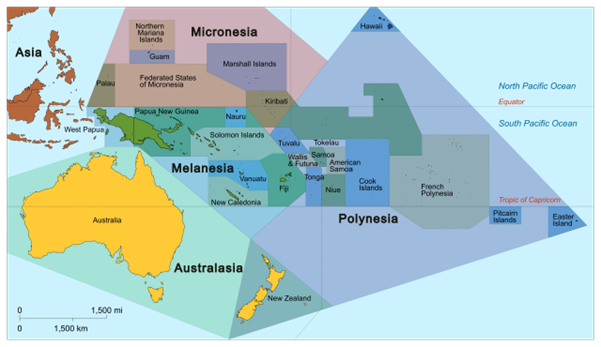
Image: Subregions (Melanesia, Micronesia, Polynesia and Australasia), as well as sovereign and dependent islands of Oceania – Wikipedia
There are two general types of islands: Volcanic islands that support a large variety of vegetation, and low-lying coral atolls with poorer soil. The climate is tropical, with high humidity and little seasonal variation in temperature. Rainfall averages about 120 inches (3,000 mm) per year, although Pohnpei receives more than 200 inches (5,000 mm) per year. The rainy season is typically between December and April.
On the high islands, mangrove swamps grow along the shore, and grassland or scrub ascends to tropical rainforests in the interior mountain areas. Settlements are almost without exception located near the coast. On the coral atolls, vegetation consists mostly of coconut palms, pandanus, and breadfruit trees. Atoll dwellers typically live on the lagoon side of the island.
The population of Micronesia is approximately 114,000 (2025). The population is young (median age in the low-to-mid 20s) and unevenly distributed. Pohnpei and Chuuk have the largest populations while many of the smaller outer islands have very small communities. Palikir is the nation's capital and seat of government, located on Pohnpei island.
A Short History
People arrived in what is now FSM millennia ago. The islands were populated by voyaging Micronesians who developed distinct languages and navigation techniques. The grand ancient stone city of Nan Madol, built on artificial inlets off the island of Pohnpei, reveals an advanced people living and trading in the region as far back as the fifth century CE.
From the 16th century, Spanish navigators frequented the islands, followed by European whalers and traders. In 1886, Spain finally colonised the Caroline and Mariana Islands, but its rule was short lived, ending in 1899 when the islands were sold to Germany following the Spanish-American War. The islands were later turned over to Japan under a League of Nations mandate after Germany was defeated at the end of WWI. Japan’s control continued throughout WWII where the islands were used extensively for wartime purposes.
After the war, the islands became part of the United Nations Trust Territory of the Pacific Islands (TTPI) administered by the United States (US). They were designated as strategically important to prevent hostile actors operating in the Pacific.
Micronesian leaders began negotiations with the US for full self-government in 1969. In a 1975 referendum, the Mariana Islands, Marshall Islands and Palao voted to separate from the proposed federation, choosing to peruse their own independence. FSM adopted its constitution in 1979 and became a sovereign nation. In a 1983 plebiscite, voters approved a Compact of Free Association (COFA) with the US, which was signed into law in 1986. Under COFA, the US provides financial assistance, access to certain US federal programs, and is responsible for national defence. In return, the US receives international defence authority and military access to FSM. Although the original compact had a 15-year lifespan, it was renewed by mutual consent in 2003 and again in 2023. The contract is now due to expire in 2043. The other Micronesian states signed their own COFA agreements around the same time. Collectively they are referred to as the Freely Associated States (FASs).
People and Society
Language and Religion
The people of FSM are predominantly Micronesian, with each state having one or more distinct indigenous languages: Chuukese (Chuuk), Pohnpeian (Pohnpei), Yapese (Yap), and Kosraean (Kosrae) are the principal indigenous languages in their respective states. English is the official language of government and education and is widely used for commerce and inter-state communication. Many FSM citizens are bilingual (English + local language). Christianity is the dominant religion, and the church plays an important role in everyday life. Roughly a little over half the population is Roman Catholic and a substantial minority are Protestant, with variations by state.
National Psyche
Micronesian societies are traditionally organised around extended families and clan systems, emphasising communal living and reciprocity. Land is considered sacred and is held collectively by families rather than individuals, reinforcing the principle that resources are shared for the common good. Respect for elders and chiefs remains central, with authority often derived from lineage and customary law.
In many communities, gender roles are determined by custom. Men traditionally are responsible for fishing, navigation, and public decision-making; while women manage land-based activities like taro cultivation, household duties, and weaving. These roles are respected and considered complementary rather than hierarchical, but they can limit women’s access to leadership opportunities.
Education is a national and state responsibility. FSM citizens may attend US colleges and institutions under COFA arrangements, and many pursue higher education abroad. Access and quality of education vary depending on location. The more remote islands tend to struggle with teacher shortages and lack of resources.
Customs and Traditions
Despite political unification under a single federation, cultural life remains deeply tied to the identities of the four states. While there are cultural differences between the islands, there are also commonalities. This is largely due to the history, ecology, and geography of the region as well as colonial influences.
Connection to Sea and Land
Micronesian culture reflects a deep connection to the sea and land. As well as being a physical space, nature is also a source of identity, spirituality, and survival. FSM’s ancestors were master voyagers, using stars, currents, and bird flight patterns to traverse thousands of miles without instruments. Traditional knowledge of voyaging and canoe construction persists on many islands with inter-island navigation being part of a wider revival of ancient traditions.
Yap – Rai (stone money)
Yap is famous for its rai stones – large carved stone disks used historically (and sometimes today symbolically) as a form of currency. Rai stones vary in size from small hand-held discs to massive stones several metres across. The stones’ value was determined by factors such as size, workmanship, origin, and the story of how they were acquired (ocean voyages to quarry islands such as Palau added value). Ownership of a rai stone could be recorded by the community without physically moving the stone; the stones functioned as a social, ceremonial, and economic system binding community relationships and obligation networks. While modern commerce uses conventional currency, rai stones remain a powerful cultural symbol and are still used in certain customary transactions (marriage, land arrangements) and tourist displays.
Traditional Dances
Each state has its own unique dances and music that is performed during festivals, religious ceremonies, and community gatherings. Most include elaborate skirts and headdresses made from local materials. The Yapese are particularly known for their skills in dancing. The Yapese stick dance is performed by men, women, and children sitting together, while standing dances are performed either by women or men and boys, but never both together.
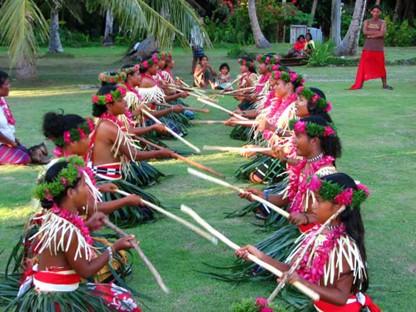
Image: Traditional Yapese dancers – Wikipedia
Arts and Craft
Traditional FSM crafts include weaving mats, baskets, and sails from pandanus and coconut fibres – skills that have been passed down through generations. As well as being utilitarian, they also indicate status and are used in ceremonial exchange. Canoe carving is among the most revered arts, requiring mastery of wood selection, shaping, and ornamentation. Canoes symbolize mobility, survival, and prestige – often adorned with motifs representing clan identity and ocean spirits.
Media and Internet
FSM’s small population and dispersed islands mean the media sector is limited.
Print: The Kaselehlie Press (based in Pohnpei) is a widely cited local newspaper that covers national and local issues and distributes across the islands; it is one of the few regularly published local print outlets.
Radio & broadcast: Radio is the most important broadcast medium because it reaches remote communities. State radio stations (often with call signs beginning V6) operate in several states (for example Radio Chuuk V6AK, Voice of Pohnpei V6AH, Voice of Kosrae V6AJ, and stations in Yap). These provide news, public-service announcements, church programming, and music. Many radio stations are community or church-based and are critical for public information, especially in emergencies.
Television & online: International TV and online content is transmitted via satellite or internet. Social media and online platforms are increasingly important for communication among FSM communities at home and abroad.
FSM Telecommunications Corporation (FSMTC/FSM Telecom) is the main national telecom provider, offering fixed and mobile phones, and internet services across states. FSM Telecom runs wireless/cellular networks on the main islands and has been expanding coverage, including upgrades to wireless broadband in recent years. Private and public partnerships aim to extend connectivity to outer islands as resources allow.
Internet Access
As of 2023, around 40 percent of the population had Internet access; mobile connections per 100 people were lower than many countries, reflecting infrastructure constraints. Internet access quality varies strongly between states and between main islands and outer atolls.
For more general information on the Federated States of Micronesia see the resources below:
Videos
- What is Micronesia? (9:26)
- Welcome to Yap Island (10:29)
Articles
- Micronesia | History, Capital, Population, Map, & Facts | Britannica
- Micronesia, Federated States of – The World Factbook
- Federated States of Micronesia (FSM) country brief | Australian Government Department of Foreign Affairs and Trade
- POP Cultures: People of Micronesia – Guampedia
- Digital Atlas of Micronesia
- Culture of Federated States of Micronesia – history, people, traditions, women, beliefs, food, customs, family, social
- Traditional Culture – Federated States of Micronesia
- Traditional Dance Forms of Micronesia
Know your region
Know Your Region series gives you a shortcut to understanding other nations in the Indo-Pacific region.