Facts and figures
The ‘Know Your Region’ series is designed to support unit and individual professional military education on the Indo-Pacific region. It’s important for all serving members of our military to have a foundational knowledge of the countries and issues in the Indo-Pacific.
On this page:
- Summary
- A Short History
- FSM Security
Summary
The Federated States of Micronesia (FSM) occupies a strategically significant position in the western Pacific Ocean despite its small population and limited land area. Spread across hundreds of islands and controlling a vast exclusive economic zone (EEZ), FSM’s security concerns differ markedly from larger and more militarised states. Rather than maintaining a standing military force, FSM relies on diplomacy, regional cooperation, and a close security partnership with the United States (US) under a Compact of Free Association (COFA).
A Short History
Prior to World War I, the Caroline, Mariana, and Marshall Islands north of the equator were under German control. In August-October 1914, the Imperial Japanese Navy seized German possessions across Micronesia – including Jaluit (Marshall Islands), Yap and Pohnpei (Carolines), Chuuk (Truk), Saipan and Angaur (Marianas). This formed the basis for Japan’s later legal claim and the Treaty of Versailles (1919), which placed Micronesia under Japanese civil governance. Japanese policy evolved from naval occupation (1914-1918) to civilian rule from 1922, and then re‑militarization in the late 1930s.
During the war in the Pacific (1941-45), the mandate islands became key Imperial Japanese Navy bastions and logistics hubs. Chuuk (Truk Lagoon) was transformed into a major fleet base, Kwajalein (in present‑day RMI) supported operations linked to the Pearl Harbor attack and early amphibious campaigns, while Saipan and Palau served as air/naval bases. US forces targeted these hubs in 1943-45 through island‑hopping, carrier strikes, and amphibious assaults, including Operation Hailstone (February 1944) against Truk (Chuuk), crippling Japanese naval capabilities.
Though some decisive battles occurred beyond present‑day FSM borders, much of the Caroline Islands – including Chuuk and Pohnpei – were directly involved. Postwar, Micronesia shifted from Japanese to US administrative control under the United Nations Trust Territory (TTPI), laying foundations for the eventual emergence of FSM, RMI, and Palau as sovereign states.
WWII left behind many naval wrecks (notably in Chuuk Lagoon) and war relics. It had a significant impact on local communities which is still felt today. Under Japanese rule (beginning in 1914), Micronesians were forced to construct military infrastructure, such as airfields, fortifications, trenches, roads, bunkers, and coastal defences. They were also made to clear fields and produce food, clothing, and supplies for Japanese troops. Land was confiscated with little or no compensation and there were shortages of food and medicine. Some Micronesian men were drafted into Japanese auxiliary roles, such as logistics, while others were conscripted directly into the military. Civilian settlements, villages and farms were caught in the crossfire between Japanese and US forces. Elderly witnesses recall fires, crops burned, sudden displacement, and forced sheltering in caves or jungles. Many civilian lives were lost.
After World War II, Micronesia became part of the UN Trust Territory of the Pacific Islands (TTPI), administered by the US. The islands were seen as strategically important especially with the onset of the Cold War. When FSM gained independence, the TTPI was replaced by the COFA which has undergone several renewals. In March 2024, FSM and the US agreed to another extension, reaffirming the US defence mandate while extending long‑term economic assistance and federal program access through FY2043. These agreements ensure continued US responsibility for external defence, disaster response support, aviation and maritime safety services, and secure access to US federal agencies, while guaranteeing that no foreign military can access FSM territory without permission – an essential aspect of the compact’s strategic denial framework.
FSM Security
FSM’s internal security includes the Department of Justice (oversees law enforcement, immigration, and local policing), state police, and civil defence agencies, supported by the Department of Environment, Climate Change & Emergency Management (DECEM). When disasters or SAR (search and rescue) events occur beyond national capacity, US and regional partners respond under COFA and other Pacific frameworks.
Beyond the US, FSM works with neighbouring Pacific Island countries through frameworks such as the Pacific Islands Forum and regional maritime surveillance initiatives. These partnerships focus on shared security concerns, including illegal fishing, transnational crime, disaster response, and border control. Joint patrols, information sharing, and training exercises help FSM monitor its vast exclusive economic zone, which it would otherwise struggle to protect on its own.
Relationship with Australia
Australia is one of FSM’s closest regional partners and contributes to FSM’s security indirectly through development cooperation, regional stability initiatives, and infrastructure projects. The partnership is built on “equality and respect” and focuses on supporting climate and disaster resilience, aviation and maritime connectivity, education, and gender protection, all of which strengthen FSM’s broader human and national security.
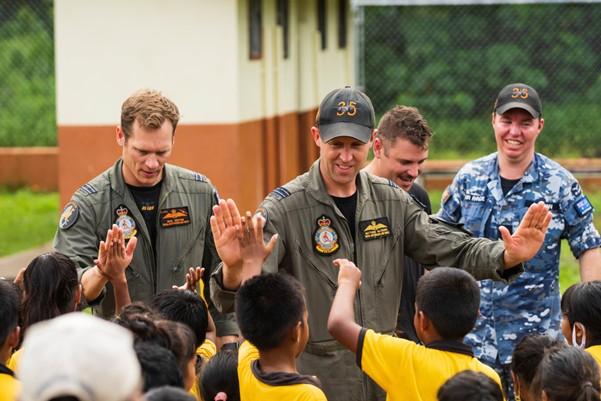
Image: Royal Australian Air Force aviators greet students during a visit to an elementary school in Pohnpei, Federated States of Micronesia, during Operation SOLANIA – ADF
Australia is also a lead funder of the East Micronesia Cable (EMC), alongside the US and Japan that will provide secure telecommunications infrastructure for FSM, Kiribati, and Nauru. This will help protect the region from vulnerabilities associated with untrusted telecommunications providers.
For more information on FSM Security, see the resources below:
Articles
Know your region
Know Your Region series gives you a shortcut to understanding other nations in the Indo-Pacific region.