
Introduction
The Basic Fitness Assessment (BFA) has served Army well. Since 1997, it has been tied to the Army Individual Readiness Notice (AIRN) and must be renewed every six months for permanent members, and every twelve months for reserve members (ANAO, 2003). It is simple, enforceable, and available to every unit. For almost three decades, it has been the common measure of minimum fitness.
Defence science, allied practice, and operational demands have shifted, and the Army fitness test has, too, evolved. In the early 1990s, the standard included a 5 km run, push-ups, sit-ups, and pull-ups. This test was replaced by the current 2.4 km run format to better reflect readiness requirements (Smart Soldier: Changes in Fitness Levels, Cove, 2019). The lesson is simple: Standards are not fixed. They evolve when soldiering changes or science advances. After nearly thirty years, the BFA is due for another evolution.
The Royal Australian Navy has already removed sit-ups. Australian Special Forces Entry Test (SFET) does not use them, relying on cadence push-ups instead. The United States Army replaced them with the plank in 2020. The question for Army is clear: should sit-ups still define readiness when combat demands something else?
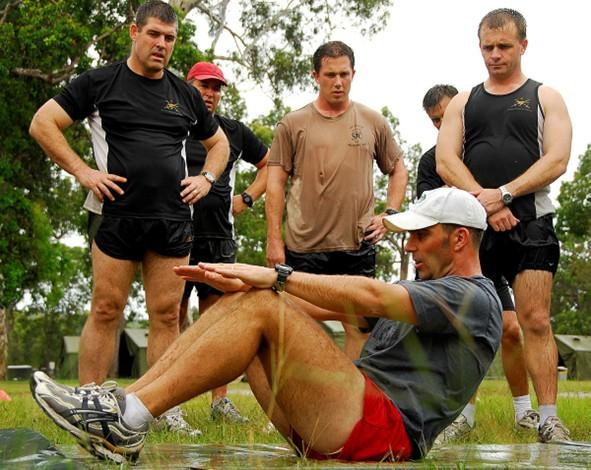
Sit-Ups Are Not Soldiering
The sit-up has value. It is easy to teach, quick to assess, and for years it has provided a universal baseline. Every soldier understands the standard. However, sit-ups are not soldiering. They test spinal flexion and, in the feet-held position, rely more on hip flexors than the trunk. Combat requires something different. Soldiers carry packs, drag casualties, fire from prone, and stabilise under fatigue. These are stability tasks, not flexion tasks.
Research confirms the gap and the risks. Professor McGill, a spine biomechanist (McGill 2009) showed repeated spinal flexion under load increases the risk of lumbar injury. Dr Horschig, a lead physical therapist (2020, Squat University) defines true core strength as resisting motion, not creating it. Defence injury data shows lumbar spine injuries remain a leading cause of lost workdays (Defence, 2024). Sit-ups once served as a simple proxy for core endurance. Today, they no longer measure what soldiers need.
Better Options for Army
There are proven alternatives that are safer, relevant, and already in use.
Cadence Push-Ups Test: Used by Australian Special Forces and the US Marine Corps. Cadence enforces form, eliminates poor repetitions, and requires the trunk to remain stiff under fatigue. Soldiers fail because their core collapses, not because they can bounce their torso. By introducing cadence push-ups, Army would also improve supervision. Physical Training Instructors and Fitness Leaders gain more control, particularly when managing multiple subjects at once. This increases fairness and consistency.
Plank Hold Test: Adopted by the Royal Australian Navy and the US Army. The plank directly measures trunk stiffness, is a simple test to run, and scales by time.
Integrated Core Stability Push-Up Test: A combined test, this is an original concept developed by the author for consideration to replace the BFA sit-ups and push-ups. Subjects hold a push-up position for a set duration, then immediately complete cadence push-ups. This sequence reflects combat demand: first stabilise under load, and then act explosively. This test could combine the core and upper body test and complete in one. However, there is some risk of complexity in their testing. The benefits are worth exploring for this as an option, with variability in the push-up hold duration and the push-up repetitions.
Each option reflects the physical tasks soldiers perform and avoids the risks inherent in sit-ups.
Simplicity Matters
Complexity is not the answer. The UK’s Soldier Conditioning Review offers one model, expanding assessments to include agility, power, and strength (Cove, 2021). While valuable, it risks overcomplicating testing and demanding equipment that not every unit can access.
The strength of the BFA is its universality. It can be conducted almost anywhere: a parade ground, a hangar, the side of a running track, or even in a park. Army does not need a more complicated test. It needs a more relevant one. Cadence push-ups, planks, and the 2.4 km run strike that balance.
Proposed Replacement Test
|
Gender |
Age |
Plank (time) |
Cadence Push Up (reps) |
2.4km Run/Walk |
|
M |
17-25 |
2min |
35 |
11.18 |
|
M |
26-30 |
1min 45sec |
30 |
11.48 |
|
M |
31-35 |
1min 30sec |
25 |
12.18 |
|
M |
36-40 |
1min 15sec |
20 |
12.42 |
|
M |
41-45 |
1min |
15 |
13.12/44.00 |
|
M |
46-50 |
1min |
10 |
13.48/45.00 |
|
M |
51-55 |
1min |
6 |
14.30/45.00 |
|
M |
56-60 |
1min |
5 |
15.30/50.00 |
|
M |
61-65 |
1min |
3 |
16.30/55.00 |
|
Gender |
Age |
Plank (time) |
Cadence Push Up (reps) |
2.4km Run/Walk |
|
F |
17-25 |
2min |
20 |
13.30 |
|
F |
26-30 |
1min 45sec |
15 |
14.00 |
|
F |
31-35 |
1min 30sec |
10 |
14.30 |
|
F |
36-40 |
1min 15sec |
8 |
15.00 |
|
F |
41-45 |
1min |
5 |
15.30/45.00 |
|
F |
46-50 |
1min |
3 |
16.00/47.00 |
|
F |
51-55 |
1min |
3 |
16.30/47.00 |
|
F |
56-60 |
1min |
3 |
17.00/52.00 |
|
F |
61-65 |
1min |
3 |
17.30/57.00 |
Why It Matters
The BFA is tied to readiness. It is mandated every six months under AIRN and has remained unchanged since 1997 (ANAO, 2003). Credibility depends on relevance. The Physical Employment Standards (Defence, 2024) stresses that tests must reflect the tasks soldiers actually perform. Injury prevention is also force preservation. Lumbar spine injuries are a preventable loss of combat power.
Tri-service alignment matters too. Navy has modernised. Special Forces lead with cadence push-ups. Allies have moved away from sit-ups. Army risks being left behind if it does not adapt.
Conclusion
The sit-up is part of Army’s history, but it should not define its future. It provided a simple measure once, but it no longer reflects combat demands. SFET does not use it. Navy has already moved on. The US Army and Marines have changed up.
Cadence push-ups and planks are safer, relevant, and accessible. They preserve the simplicity of the BFA while making it meaningful again.


As an example:
- In 2004, the under 21 M was required to do 50 pushups
- In 2006?, there was a six month period that pushups had no "rest" position
- In 2007, the under 21M was required to do 40 pushups
It would appear that the standard has again been further reduced.
Perhaps the deeper questions are:
Why has Army decided to continually reduce the standard of baseline physical fitness expected of its soldiers?
What has changed over 20 years that a 30% reduction in physical fitness standards is acceptable in the Army of today?
Due to the large amount of injuries caused by extensive PT sessions by inappropriately qualified people for the sake of "because it's hard, people can get fitter from it" opposed to actual structure utilising the battering ram strategy (building in intensity then utilise a deload/recovery phase)
If fitness tests were to assess an acceptable standard for soldiers, it would utilise either a long distance utilising aerobic capacity (which is impractical for administration and time constraints) or anaerobic capability where many tests prior to the Vietnam war utilised a short distance of 400 to 800m in a fast pace.
The US Army RASP cell made a decent 1st part of their new PT test (with body armour) which makes a decent and realistic look at soldiers own personal fitness in a combat environment where a simple 40 pushups/35 cadence push-ups and a sub 11:18min 2.4km run doesn't explicitly show.
We can do things like fire and movement in a PESA but that would destroy people's knees if the ground isn't soft mud.
Injuries like prolapsed discs, affected meniscus in the knees, chronic compartment syndrome in the tibalis anterior (shin muscles affected by compression from the fascia unable to expand with the muscle) can be avoided by giving a realistic look at fitness opposed to something that might translate well for an athletic environment where any sport outside of a pentathlon doesn't require to carry weight.
Speaking of weight which to cut this comment short, we should look towards exoskeletal solutions such as Crye Precision's STKSS and make body armour like our TBAS platform more similar to the Crye AVS to work with rigid belt to put weight to the hips opposed ontop of the shoulders which leads to compression to the spine