



This is the third article in this series. The previous two articles in this series can be found here and here.
Domain Control and Combined Arms
History has shown the necessity for air and sea control during littoral operations. Prior to Operation POSTERN, Allied maritime success in the Battle of the Bismarck Sea in March 1943 denied Japanese reinforcement of positions in Papua New Guinea (PNG) and August 1943 air raids destroyed over half of deployed Japanese fighter planes in the region.
These successes established sea and air dominance for the September 1943 landing at Lae, supported airborne deployment of troops during the operation, and limited enemy resupply. Sea and air control continues to be vital in allowing for littoral manoeuvre and will require integrated efforts with the Royal Australian Navy and Royal Australian Air Force. Service integration is already evident in the make-up of Australian Headquarters Amphibious Task Group, and can be potentially replicated at other levels of command and operational planning for littoral tasks.
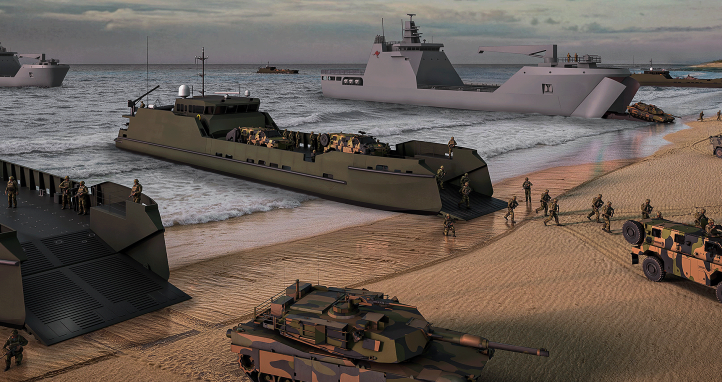
The employment of combined arms is similarly important for littoral warfare. Amphibious assaults during 1945 Operation Oboe required significant combined arms support, involving joint fires from artillery, mortars, air support, and naval gunfire as well as the deployment of armour, engineers, and infantry in complementary manoeuvre. Similar use of combined arms is evident during 1943 Operation POSTERN, and Russian failure to deploy combined arms armour with infantry led to significant tank destruction in the Russo-Ukraine War.
While the United States (US) Marines have divested tank capability in their Force Design 2030, the use of armour and combined arms proved pivotal to successful urban operations during the 2008 Battle of Sadr City, Iraq, and 2017 Battle of Marawi, Philippines. Combined arms should consider the integration of technology such as drones, autonomous systems, data processing, and electronic warfare, particularly in urban environments whereby even non-peer adversaries can employ drones, misinformation, and electronic warfare.
Information operations were employed alongside combined arms by Philippine joint forces in the Battle of Marawi; while In Ukraine, Russian and Ukrainian forces learnt that losing access to the electromagnetic spectrum led to denial of command-and-control.
Modern combined arms in the littoral includes a range of integrated effects, from kinetic to information operations, from sea and air to cyber and space, essential not only in supporting initial landing but while forces subsequently penetrate through to seize urban environments. Integration and interoperability between corps, services, and partners will be essential to Army capability. Defined, but integrated jurisdictions and responsibilities between services and partners and developing expertise in technology and combined arms will support Army littoral capability.
Training and Education
Training is an important enabler of RAD manoeuvre. The Australian Amphibious Force already conducts training through various realistic exercises, and small craft operations courses are used to develop skills in riverine patrolling and beach insertions with Zodiac-inflatable watercraft. The Accelerated Maritime Officer Course is further preparing Army officers to command larger littoral vessels and understand the maritime domain. Army can look to continue honing these skillsets to develop readiness for littoral warfare.
Littoral manoeuvre in the northern approaches will also require a distinct form of preparation for the operating environment. In conducting 2024 rotations through the Philippines, the US Army found that heat and disease injuries became endemic, and that traditional combat fitness was inadequate for longer time under weighted load and in navigating tough terrain. High temperatures further reduced battery-life for radios, laptops, and UAS, and larger vehicles could not be utilised in the arduous natural environment.
David Kilcullen recounts similar experiences in Timor-Leste during 1999 INTERFET operations, whereby the average load carriage across his Company was 71 kilograms per person, with soldiers sometimes consuming up to 18 litres of water per day. Following landing at Port-en-Bessin, France, British commandos were required to make a 19-kilometre, 40-kilogram loaded march to reach their objective. Training and rehearsal must consider this type of arduous operating environment, as well as proficiency in local languages.
Communicating in language is another key enabler during littoral operations for gathering intelligence, developing local support, and navigation when maps are outdated. Language proficiency supported amphibious operations at Port-en-Bessin allowed UK commandos to collaborate with the local civilian population – with locals even providing medical care for wounded following battle. Evan Zachary Ota notes that language skills were further essential in the WWII Pacific, whereby Australian soldiers were attached to New Zealand amphibious forces and US Marines specifically for their skills in local Pijin. This allowed for communication with local populations and the development of support for Allied efforts, creating substantial asymmetric advantage over the Imperial Japanese invading forces.
Training with international partners is another opportunity, with Army already conducting urban littoral training with PNG. These efforts could be expanded into multilateral littoral training and exercises with other near north partners such as Indonesia and Timor-Leste, as well as the US, Japan, and South Korea. This might take place at Shoalwater Bay and in littoral and jungle areas of PNG, as well as in the archipelagic environments around Indonesia and Timor-Leste. Army never fights alone and Australian littoral operations during WWII each worked in conjunction with Allied forces.
Other relevant Army corps can be integrated where relevant into littoral combat corps, with urban and littoral skillsets further included in the employment training for corps in certain locations. Army reservists in Western Australia already undertake amphibious training and, just as Army full-time and reserve personnel contribute to Operation Resolute and Talisman Sabre, rotations could move through Army Amphibious Task Group. This type of cross-pollination of littoral skillsets and experiences will disseminate capability across Army and allow for depth in mobilisation and deployment of forces for littoral manoeuvre.
A PNG-version of Rifle Company Butterworth, Malaysia, is another opportunity that could be facilitated under the Pukpuk Treaty, whereby Army members could complete urban-littoral training with PNG partners at joint Australia-PNG basing in the Pacific. Potential sites include Igam Barracks, Lae, or Lombrum Naval Base.
Peter Dean has described historical precedent for such an idea, whereby in WWII amphibious training centres were established in PNG, the Philippines, and several Australian locations. Allied amphibious training sites were also established in North Africa to prepare for the 1943 invasion of Sicily. Army could undertake similar efforts towards dispersed training infrastructure again in the future, which might also contribute towards Australian forward presence in the northern approaches.
Andrew Carr and Stephan Frühling have argued that forward presence can further support deterrence and Australian force projection. Training centres in PNG would act as a means of improving interoperability and provide options for taking rapid littoral defensive positions in the region for collective security if the need arises. This presence could act as a template to employ with other partners such as Indonesia and Timor-Leste, tailored to host individual political and security conditions. Partner training could also include guerilla and irregular warfare in their curriculum; Army employed similar forms of training for local populations to resist Japanese forces during WWII Operation Semut in Borneo.
Training can also build capability and interoperability in emerging technologies, such as drones. Conflicts in the Middle East and Ukraine have shown that military drone operators are readily mobilised from the local population. Army could look to build similar capability from amateur drone operators or seek drone expertise from Ukrainian forces once war concludes and operators are demobilised.
Advancements in technology will require continual training and adaptation to remain capable as these systems and effects evolve. While building expertise in new capabilities, Army must ensure self-regulation is maintained in its application, whereby urban littoral environments may be densely populated and carry the risk of turning cities into rubble with the employment of new technologies and capabilities.
Logistics
Amphibious logistics have been described by Walker Mills as the most difficult sustainment operation that can be undertaken. During 1943 Operation POSTERN, a lack of logistical planning led to troops being reallocated from combat taskings to support beachhead logistics efforts, the landing area becoming a congested bottleneck of troops and equipment and with key supplies being placed alongside fuel and ammunition dumps.
Rhys Crawley further writes that at Gallipoli, logisticians were left in Egypt rather than traveling with the landing forces, leading to logistical issues on the ground. These challenges underline the importance of consideration of logistical concerns during littoral operations.
To support logistics, Army should once again employ multi-corps ‘beach groups’, a key lesson from Operation POSTERN that was later implemented during 1945 Operation Oboe to organise the landing of troops, vehicles, and stores, as well as establish logistical support for division-level operations. Air and sea control are once again essential to supporting logistical sustainment and lines of communication.
Aside from landing logistics, protracted conflict will require its own broader logistical and supply chain considerations. Rather than centralise its manufacture and transport of drones, Ukraine has disaggregated sustainment into agile workshops across frontlines to allow for short design, construction, testing, and revision cycles. Meanwhile, Russia’s early reliance on rail resulted in resupply difficulties once railways were disrupted. Littoral operations will need to consider sea lines of communication and the transport of troops, supplies, and equipment over the longer-term if Army enters protracted war.
Even the means of troop transportation offer opportunities for ingenuity: Japan used bicycles to cover long distances following WWII amphibious landings in Thailand and used small boats to continue to hook down the coast of Malaya. German forces similarly utilised bicycle troops and carts post-landing during WWI Operation Albion in 1917. While Army is unlikely to stand up a bicycle brigade, unconventional approaches to transportation and logistics have been utilised in Ukraine, such as using drones to deliver supplies, materiel, and evacuate the wounded.
The Millennium Challenge of the early 2000’s provides further food for thought in unconventional approaches to alternative forms of transportation and tactics. While not directly littoral-related, this wargame utilised both live exercises and computer simulations pitting a technologically advanced US ‘blue’ team against a lesser equipped Iran-like ‘red’ team enemy, eventually involving 13,500 service members across 17 different locations.
Within days, the red team had sunk 19 blue team ships and rendered its carrier battle group ineffective through a strategy of early missile strike via ground-based systems, commercial ships, and planes flying low without radio, along with swarms of kamikaze speedboats loaded with explosives. The ‘red’ team further utilised motorcycles to deliver messages, rather than relying on radio or other telecommunications that could be intercepted. Similar unconventional and creative thinking may aid littoral planners in developing approaches to logistics.
Foraging supplies from local populations is another enduring, but risky post-amphibious landing strategy that relies on the support of local populace. Japan experienced the risks of this tactic during the WWII Guadalcanal campaign: once Japanese supply lines were cut, within months an average of 200 soldiers were lost daily to starvation after their foraging strategy failed. If Army wishes to consider this strategy for sustainment, ADF initiatives like the Defence Cooperation Program can build partner support in the region now which will be required during conflict, along with the development of language abilities across Army.
Unconventional Warfighting
Unconventional warfare has potential beyond employment as a part of localised combined arms littoral operations and could be considered as a part of broader efforts if Australia faces conflict in the region. Opportunities exist across the spectrum of mis- and disinformation, political and psychological warfare, 'lawfare', influencing public and international opinion, targeting financial systems, and leveraging existing domestic instability or hostile groups. As Sun Tzu outlined: we must seek to break the enemy’s resistance without fighting. These are methods that might assist in that approach, the threat of a developed capability in these may deter potential conflict.
While these tactics fall outside the direct employment of littoral warfare, strategies of unconventional warfare alongside littoral manoeuvre can be considered as a means of limiting war and attrition by, for example, potentially targeting an adversary’s domestic infrastructure and stability without lethal effect. In wartime, Army may need to conduct offensive cyber and sabotage activities targeting political and military systems, leadership, and dual-use infrastructure. Building the skills, workforce, and operating procedures and limits for the employment of these capabilities now will assist Army should they need to be employed in the future.
The Kosovo War came to an end in part due to the use of air power to target Serbian industry, imposing direct costs on the ruling elite which generated pressure on Serbian leadership. This may provide a lesson in that similar strategies targeting industry and infrastructure to bring an end to conflict could be implemented via cyberattack. Information and psychological operations might also be conducted targeting an adversary’s will to fight.
The potential use of unconventional warfare is an uncomfortable reality for Australian society, and we likely view these as tactics as those only employed by authoritarian regimes. Thomas Rid has described how strong democracies are often reluctant to deploy and optimise these effects; bureaucracies engaging in systematic disinformation often optimise their culture and processes towards that purpose, employing disinformation domestically as well as abroad.
While unpalatable, Australia and Army may need every tool at their disposal to deter conflict in our northern approaches. The consideration of these effects is the responsibility of the Australian Government and relevant agencies, but for Army, self-regulation will be an important determinant in the potential application of effects such as cyber and information warfare.
When considering these approaches, we should remember the words of US Civil War General William Sherman: “War is cruelty, and you cannot refine it.” In war, Army may need to employ unconventional means towards victory or survival.
Littoral Strategy
RAD manoeuvre has been conceptualised as a means of supporting deterrence and limited conflict, but Army must not fail to prepare for protracted war. Lawrence Freedman warns of short war fallacy, whereby surprise offensives are relied upon to produce decisive victories in conflict. Predictions of swift and successful Russian and Israeli invasions have proved incorrect, with both conflicts continuing for years. Freedman writes that the key to victory in both World Wars was unbeatable stamina, rather than military prowess. Long wars require constant adaptation and evolution, with whole economies and society moving to war footing to support a nation’s defence.
An Army littoral strategy can act as a signal to Australian society, industry, academia, and government for what is required to fight protracted littoral war. A British Army division in high-intensity conflict can consume up to 800,000 litres of diesel fuel per day. British Army now looks to battlefield electrification to mitigate risks in fuel reserves, while Germany relied on synthetic fuel production to fuel their Blitzkrieg in WWII. Ukraine pivoted to reportedly manufacture 1.5 million drones in 2024, while Russia produces 1,500-2,000 tanks annually (although 85-90% are refurbishments). These are the types of effort that may be required of Australia during protracted conflict.
Similar questions of industrial, societal, and ADF preparedness to support and execute littoral operations are worthy of consideration. Although these are whole-of-nation considerations falling outside the distinct remit of Army littoral capability, a public-facing Army littoral strategy may assist in signalling the needs and considerations of Army in developing littoral capability and potentially how to meet those challenges in preparation for and during protracted conflict.
The acknowledgement of these requirements and preparation for which will likely also have a deterring effect and potentially reduce the risk of conflict. It has been written that ‘endurance is deterrence’ and Australia’s ability to sustain itself during protracted conflict in the littorals may assist in ensuring war does not commence in the beginning.
This series of articles has outlined how Army can optimise for littoral operations in the northern approaches using RAD manoeuvre. Air and sea control, combined arms, training, logistics, partner cooperation, and unconventional warfighting are important enablers. An Army littoral strategy can assist in communicating what is needed of Australia in protracted war. Optimisation for littoral operations can support asymmetric deterrence and limit conflict if it arises. Australia expects much of Army, but much is required to wear the badge of the Rising Sun and to defend our nation. Littoral warfare is only one aspect of Army’s ability to deter conflict and employ lethality if forced into war, but remains an important one.

It will be very interesting to see just how the Army's littoral capabilities evolve on delivery towards being an instrumental part of the integrated force. Your concepts for RAD are interesting to consider.
Thank you for your article!